What Is Departure Angle on a Vehicle?
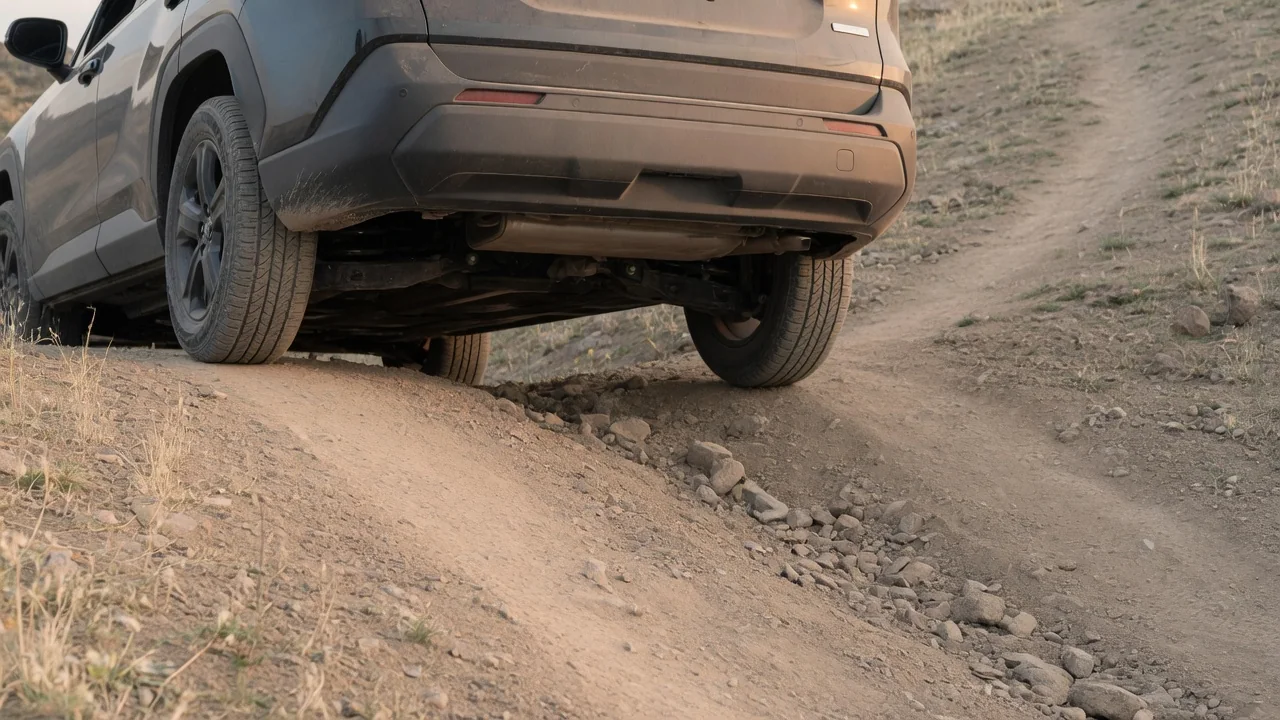
Anyone asking what is departure angle on a vehicle is really asking how steep a slope the rear end can leave without scraping. It describes the clearance behind the rear wheels as the vehicle drives off an incline onto flatter ground, and it matters for off-road trails, steep driveways, loading ramps, and any transition where the tail swings low.
Geometry
Departure angle is measured between the ground and an imaginary line drawn from the point where the rear tire touches the surface up to the lowest part of the vehicle that hangs behind that tire. On most cars and trucks, that lowest point is the bottom edge of the rear bumper, though an exhaust tip, spare tire carrier, or tow hitch can sit lower. The steeper that imaginary line, the larger the angle, and the steeper the slope the vehicle can leave without the tail touching down.
Two dimensions control the result: rear overhang and ride height. Overhang is the length of body extending past the rear axle, and a long overhang flattens the line and shrinks the angle. Height works the opposite way, because a taller suspension or larger tires raise the rear bodywork and steepen the line. This explains why a short-tailed off-road utility vehicle usually clears obstacles that a long-bed pickup or a low sedan with a deep rear bumper would drag across, even when their ground clearance under the axles looks similar.
Ramp example
Picture a vehicle driving down a steep ramp onto a level parking lot. As the rear wheels reach the bottom and roll onto the flat surface, the body behind them is still hanging over the sloped section. If the ramp is steeper than the departure angle, the ramp surface rises into the space behind the rear tires faster than the bodywork clears it, and the bumper or whatever hangs lowest makes contact. The scrape happens just as the rear wheels reach the transition, not partway down the ramp.
The same thing happens in reverse when backing up an incline, because the tail meets the slope before the rear tires begin to climb. On a trail, the equivalent is dropping off a rock ledge or climbing out of a ditch: the rear wheels come down off the obstacle and the tail follows them toward the edge. A ramp that changes grade gradually is far more forgiving than one with a sharp crease at the bottom, since the abrupt change is what brings the surface up toward the overhang.
Hitch and cargo effects
A receiver hitch is one of the most common reasons a vehicle's real-world rear clearance is worse than its published figure. The receiver tube often sits below the bumper, and an installed ball mount extends farther rearward and lower still. Because it sits at the very end of the overhang, even a small drop in height takes a noticeable bite out of the angle. Bike racks, cargo carriers, and hitch-mounted steps have the same effect, and they extend the overhang as well as lowering the lowest point.
Weight matters as much as hardware. Heavy cargo in the bed or trunk, a full load of rear passengers, or trailer tongue weight compresses the rear springs and lowers the tail, which reduces the angle without any visible change to the bodywork. The amount of sag depends on the suspension design and how the vehicle is loaded, so a truck that clears a ramp empty may drag when loaded. Vehicles with adjustable or self-leveling suspension can recover some of that height, but the behavior varies by model and should be checked for the specific vehicle.
Everyday Use and Observations
Most drivers meet their departure angle at home rather than on a trail. A steep driveway that meets the street at a sharp crease, a deep gutter or drainage dip, a parking garage exit, or a ferry or car hauler ramp can all bring the pavement up toward the rear bumper. A scraping noise from behind just as the rear wheels reach level ground is the classic sign. Low sports cars, vehicles with aerodynamic rear diffusers, and long sedans are the usual candidates, especially with passengers and luggage aboard.
Evidence of past contact is easy to spot with a look under the tail. Scuffed plastic on the lower bumper edge, a flattened or scratched exhaust tip, scrape marks on a hitch receiver, or a bent license plate bracket all show where the vehicle has touched down. Taking a steep transition slowly and at a diagonal often helps, because one rear wheel reaches the change in grade before the other and the tail does not drop squarely onto the crease. That technique reduces contact but does not change the underlying geometry.
Limits and Next Steps
Departure angle is only one of three related measurements. Approach angle describes the same clearance at the front, and breakover angle describes whether the underside between the axles will clear a crest. A vehicle can be strong in one and weak in another, so a good rear figure does not guarantee it will clear an obstacle overall. Published numbers also assume a specific trim, tire size, and an unloaded vehicle on a hard surface, so soft ground, worn springs, different tires, or added accessories can make the real figure differ.
For a specific vehicle, the manufacturer's specifications for the exact model year and trim are the right starting point, followed by a look at what actually hangs lowest behind the rear wheels. Removing a ball mount when not towing is the simplest way to regain clearance. Changes such as taller tires, suspension lifts, or high-clearance bumpers can increase the angle, but they also affect handling, braking, load ratings, and sometimes legal compliance, so they are worth discussing with a qualified shop that knows the vehicle before committing.