What Is Approach Angle on a Vehicle?
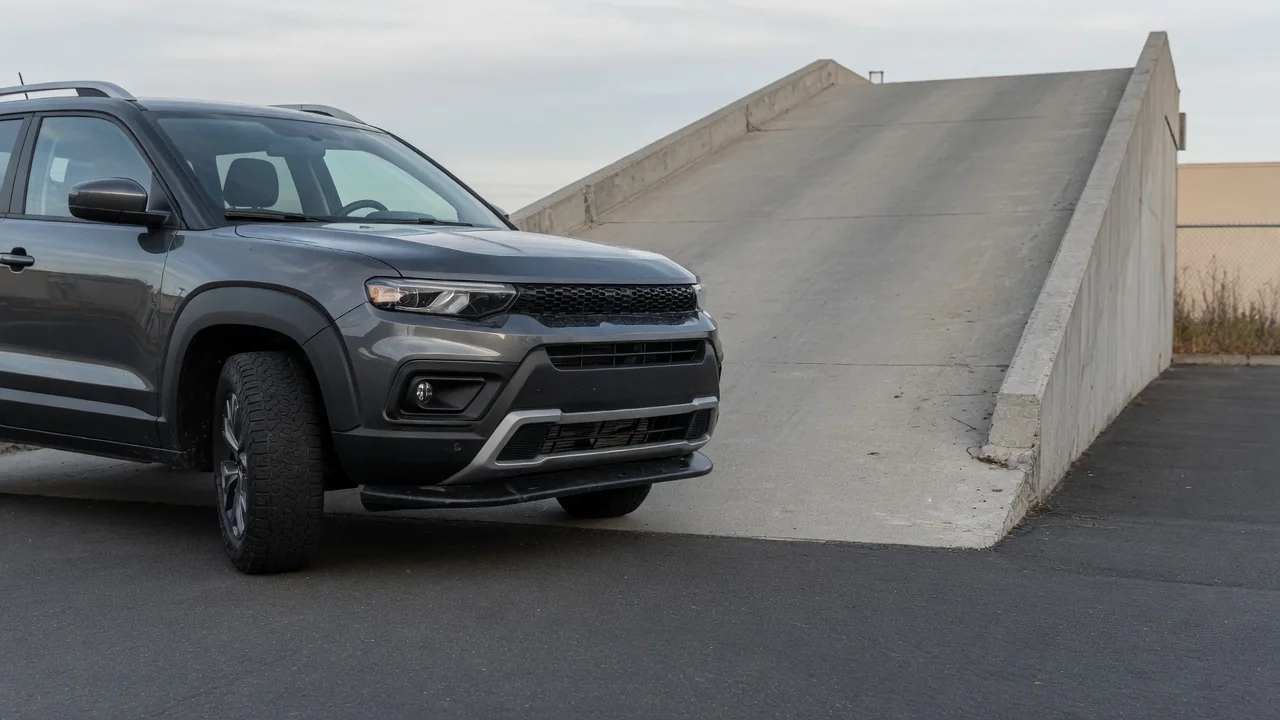
What is approach angle on a vehicle? It is the steepest incline a vehicle can drive onto from level ground before the front bumper or another low part of the nose touches the slope. The figure describes front-end clearance where flat pavement turns into a ramp, and it explains why some vehicles scrape on driveways that others climb without contact.
Geometry
Picture the vehicle from the side, parked on flat ground. Draw a line from the spot where the front tire meets the pavement up and forward to the lowest part of the body ahead of that tire, usually the bottom edge of the bumper, an air dam, or a tow hook. The angle between that line and the ground is the approach angle. Any ramp steeper than that line meets bodywork before it meets rubber, so the tire never gets the chance to start climbing.
Two dimensions set the result: front overhang, meaning how far the body extends ahead of the front axle, and the height of the lowest forward component. A short overhang with a high bumper produces a large angle, which is why trucks and off-road SUVs with tucked-in front ends tend to climb obstacles cleanly. A long nose with a low splitter, common on sports cars and some sedans, produces a small one. Tire diameter matters as well, since a taller tire raises the whole front end.
Driveway example
A steep driveway apron is where most drivers meet this limit. As the front wheels roll through the gutter at the street edge, the nose is still hanging out ahead of them while the driveway rises to meet it. If the slope is steeper than the vehicle's approach angle, the lower bumper or plastic air dam scrapes before the tires reach the incline. The gutter dip makes matters worse, because the wheels drop slightly just as the bumper arrives at the rising concrete.
Entering on a diagonal is the familiar workaround, and the geometry explains why it helps. One front wheel reaches the slope first and begins lifting that corner before the center of the bumper arrives, and the effective slope along the vehicle's path is gentler than the same driveway taken head-on. The scraping sound often comes from a flexible lower valance, not the painted bumper cover, though this differs by vehicle. Some models carry rigid parts low, such as an undertray or support brace, where contact is less forgiving.
What changes with load
Any approach angle a manufacturer publishes applies to a particular ride height, and ride height is not fixed. Passengers and cargo compress the springs, and weight carried at the front, such as a winch, a heavy aftermarket bumper, or a plow mount, lowers the nose and may also lengthen the overhang. Weight at the rear works differently: a loaded bed or trailer tongue weight squats the back, which can tip the nose up slightly while taking clearance away from the departure angle behind the rear wheels.
Motion changes the picture as well. Braking pitches the body forward, so a driver who is still on the brake pedal when the bumper reaches a ramp has less clearance than the static figure suggests. Dropping into a dip compresses the front suspension in the same way. Height-adjustable air suspension, lowering springs, lift kits, and different tire sizes all shift the angle, and tired springs that have settled over the years can quietly reduce it on an otherwise unmodified vehicle.
Everyday Use and Observations
Away from the trail, the same geometry shows up at parking garage ramps, concrete wheel stops, tall curbs, ferry and trailer loading ramps, and the lip where a sloped parking lot meets the street. Wheel stops are a common trap, because a low nose can slide over one while parking and then catch on it when backing out. Evidence of past contact is easy to find: scuffs along the underside of the bumper, a cracked or wavy air dam, or missing fasteners on a splash shield.
A quick visual check gives a useful sense of any vehicle's limit. Crouch beside the front wheel and sight from the tire's contact patch to the lowest point of the nose; the steeper that imaginary line, the better the clearance at an incline. Ground clearance is a separate measurement taken under the body, so a vehicle can sit high and still have a modest approach angle if its nose is long. Departure angle and breakover angle describe the rear overhang and the span between the axles.
Limits and Next Steps
Approach angle is a static figure, and it only answers one question. It says nothing about traction, clearance under the middle of the vehicle, or whether the rear bumper will clear on the way out. Surface matters too, since tires sinking into sand or mud lower the nose, and an abrupt ledge behaves differently from a smooth ramp. Published numbers may also reflect a specific trim, tire size, or suspension setting, so the figure for one version of a model may not apply to another.
For a specific vehicle, the owner's manual or the manufacturer's specifications for that exact trim are the right reference. After a hard scrape, it is worth looking under the nose for a hanging undertray, displaced ducting, or damage near fog lights and parking sensors, since some vehicles mount driver-assistance hardware low in the bumper. Anything loose or any new warning message justifies a professional inspection. Suspension or tire changes meant to gain clearance can affect alignment and headlight aim, so they deserve qualified advice first.