Why Does a Car's Range Estimate Jump After Refueling?
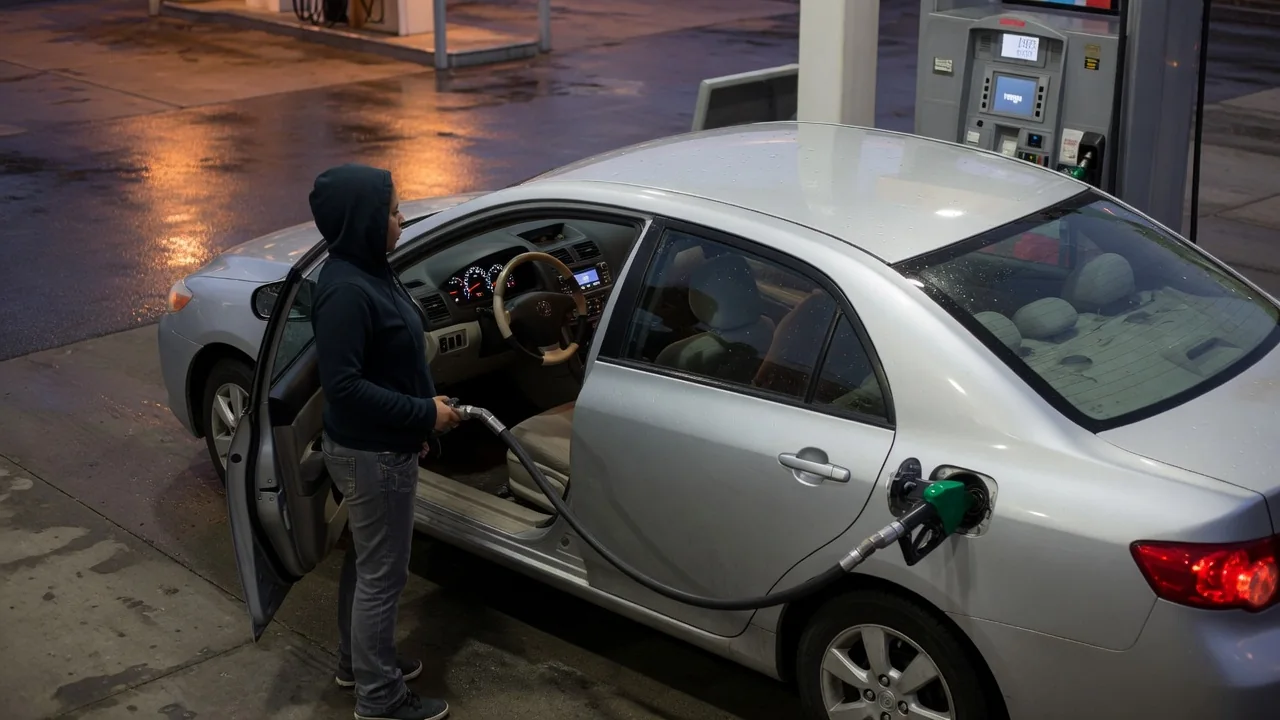
Fill the tank, start the engine, and the distance-to-empty figure often leaps by far more or far less than expected. Why does a car's range estimate jump after refueling? The short answer is that the display is a calculation, not a measurement, and a fill-up changes one of its two main inputs all at once while the other input carries over from your recent driving.
Fuel reading
The range figure starts with how much fuel the car believes is in the tank. In most vehicles a float or similar sensor inside the tank reports the level, and the instrument cluster or an engine computer converts that signal into an estimated volume. Because fuel sloshes during cornering, braking, and acceleration, the signal is heavily smoothed. That damping keeps the gauge steady on the road, but it also means the system reacts slowly to a real change in level.
Refueling is the one moment when the level changes dramatically in a few minutes. Many cars look for a large difference between the level recorded at shutdown and the level seen at the next start, then accept the new reading at once instead of filtering it slowly. The result is a sudden step in the display. Some vehicles update within seconds of switching on, while others need a short drive before the gauge and range number settle, so the timing differs between makes.
Driving history
Fuel level alone says nothing about distance. To turn gallons into miles, the car multiplies the estimated fuel by a fuel economy figure drawn from recent driving. Depending on the design, that figure might be a rolling average over the last several dozen miles, a longer-term average, or a blend of the two. The car is essentially assuming that the next tank will be driven much like the stretch it most recently remembers.
This is why the same full tank can show very different numbers on different days. Fill up after a long highway cruise and the estimate may look generous, because the stored economy is high. Fill up after a week of short trips, cold starts, idling in traffic, or towing, and the same quantity of fuel produces a smaller figure. The jump at the pump therefore reflects both the added fuel and whatever driving pattern the computer happens to be carrying forward.
Estimate limits
Each input has its own weak points. Tank shapes are often irregular, so the sensor may not track volume evenly from top to bottom, and the reading near full or near empty can be less precise than in the middle. Many gauges stay on full for a while after a fill-up because the float sits at the top of its travel. During that period the range may barely move, then begin dropping faster once the level comes into the sensor's working span.
The economy side is equally approximate. A recent average cannot foresee a headwind, a mountain grade, a loaded roof rack, or a switch from highway to city streets. Manufacturers also tend to build in a reserve, so the display may reach zero while some fuel remains, though how much is vehicle-specific and should not be relied on. Treat the figure as a projection that is continually revised, not as a promise of how far the car will actually travel.
Everyday Use and Observations
Drivers can watch the recalculation happen. After a fill-up, the number commonly climbs in one step, then drifts up or down over the next several miles as fresh consumption data replaces the old. Leaving the station straight onto a freeway may cause the estimate to hold steady or even rise for a while, because the car is burning less fuel per mile than its stored average expected. Stop-and-go driving produces the opposite effect, with range falling faster than the odometer advances.
Small habits also influence what appears. Adding only a few gallons may not trigger the quick-update logic in some cars, so the gauge and range can lag until the vehicle has been driven or restarted. Refueling on a slope can skew the initial reading, as can topping off with the ignition on in certain models. Resetting the trip computer or average economy display may change the basis of the calculation in some vehicles and leave it untouched in others, depending on how the software is arranged.
Limits and Next Steps
A jump after refueling is normal behavior, and a different number from one fill-up to the next is not by itself a sign of trouble. More useful warning signs are patterns that do not fit the logic described here: a gauge that stays low after a genuinely full tank, a needle that swings erratically on smooth roads, a range that collapses suddenly without a change in driving, or a fuel level warning that appears with plenty of fuel on board.
When behavior like that persists, the sensible check is a comparison against known facts. Tracking the amount pumped against miles driven over several tanks shows whether actual consumption matches what the display implies. If the two disagree widely, or the gauge itself misbehaves, a technician can evaluate the level sensor, wiring, and instrument cluster with vehicle-specific information. The owner's manual is also worth consulting, since it usually describes how that particular model calculates and refreshes its range display.