Why Do Tire Grooves Have Different Widths?
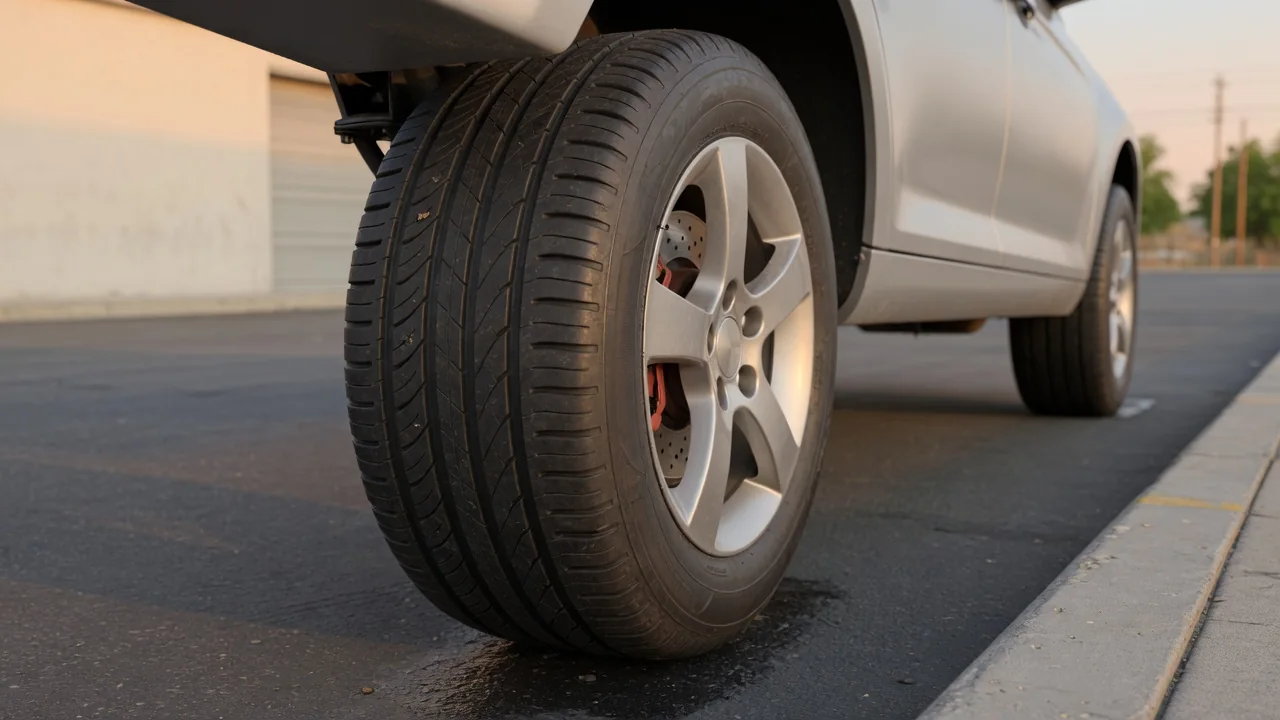
Look closely at almost any modern tire and you will see that the grooves are not uniform. Some run wide and continuous around the circumference. Others are narrower and angled toward the shoulders. Many tread blocks are also cut by slits barely wider than a knife blade. These differences are deliberate. Tire groove width design balances three competing demands: moving water away from the road, controlling how much the tread blocks flex, and managing the noise the tread makes as it rolls.
Water paths
On a wet road, the tire has to push water out of its contact patch quickly enough for the rubber to keep touching the pavement. The widest grooves are usually the circumferential ones that run around the tire. They act as main channels, giving water a low-resistance route backward and out of the footprint. Their job is to carry volume, so they need enough cross-section to avoid filling up. That is why they are typically the most prominent voids in the tread.
Lateral grooves run across the tread toward the shoulders and play a supporting role. They collect water from the tread blocks and feed it into the main channels or out to the sides. They are often narrower than the main grooves because they handle smaller amounts of water over shorter distances, and making them wider would remove more rubber than necessary. Many designs vary lateral groove width along its length, opening it up near the shoulder where the water exits. Sipes are the thin slits within the blocks, and they do not move much water by volume. Instead, they help wipe away the thin film that remains on the road surface, and they add biting edges. The result is a hierarchy. Wide channels handle bulk flow, medium paths handle collection, and fine cuts deal with the last layer of moisture.
Block stiffness
Every groove removes rubber, and the rubber that remains forms ribs and blocks. How stiff those elements are has a direct effect on handling, braking, and wear. A block surrounded by wide grooves gets less lateral support from its neighbors, so it can bend and squirm more under cornering and braking forces. A rib bordered by narrow grooves, or with no lateral cuts at all, stays more rigid. That rigidity helps steering response and straight-line stability.
Engineers use groove width as one of several tools to tune stiffness across the tread. The center of the tread often carries continuous or nearly continuous ribs to keep steering feedback precise. Shoulder areas may use larger blocks with narrower separating grooves so they resist deformation during cornering. Where more flexibility is useful, as on tires intended for snow, more numerous and wider voids let blocks move and dig in. Some designs use interlocking three-dimensional sipes or angled groove walls so that neighboring blocks brace against one another under load. This recovers some support without closing off the water path.
Stiffness also affects wear. Blocks that flex too much can scrub against the road and wear unevenly, while sections that are too rigid may give up grip on irregular surfaces. Varying groove widths lets designers distribute stiffness so that different regions of the tread wear at a more consistent rate. Actual wear still depends heavily on inflation, alignment, and driving conditions.
Noise
Grooves are a major source of tire noise. When a long circumferential groove sits in the contact patch, the road surface closes it off and it can behave like a pipe, resonating at certain frequencies. Lateral grooves create a different effect. As a block enters and leaves the footprint, air trapped in the groove is squeezed and released, which produces a pumping sound. Wider grooves generally hold more air, which can make both effects more noticeable.
Varying groove width is part of how tires keep this noise from becoming a single irritating tone. If every block and groove were identical, the tread would strike the road in one regular rhythm, concentrating sound energy at one pitch. Designers use blocks of different lengths and grooves of different widths in a deliberate sequence, often called pitch sequencing. This spreads the sound across a broader range of frequencies, so it is perceived as a less intrusive hum. Some tires use narrower or partially closed lateral grooves near the center of the tread, or features inside the main grooves, to interrupt resonance. These choices often trade against water evacuation. That trade-off is one reason quiet touring tires and aggressive wet-weather or off-road tires look so different.
Practical implications and limits
For drivers, the most important consequence is that groove performance changes as the tire wears. The width at the surface may look similar for much of the tire's life, but the depth decreases, so the volume available for water shrinks. A tire that handled standing water well when new will have less capacity as it wears. The loss matters most in the channels that do the most work. Tread wear indicators are molded into the main grooves for this reason. When the tread reaches them, the grooves are at the end of their intended service life.
Wear also shifts the balance between stiffness and noise. As blocks get shorter they become stiffer. This can sharpen response slightly, but it may reduce the flexing that helps in snow or on rough surfaces. The noise character can change too, especially if wear is uneven, because irregular blocks disrupt the pitch sequence the designer intended. Uneven groove wear across the tread usually points to something worth checking, such as incorrect inflation pressure or alignment. It is not normally a feature of the tread design itself.
A groove pattern alone can only tell you so much. Rubber compound, internal construction, tire size, load, and inflation all interact with the tread. Two tires with similar-looking grooves can therefore behave differently, and the same tire can feel different on different vehicles. Directional and asymmetric patterns also depend on correct mounting to keep their water paths and stiffness zones working as intended. Groove width is best read as a clue to a tire's priorities, such as wet traction, handling precision, quietness, or loose-surface grip. It is not a complete measure of the tire's performance.