What Is a Tire Compound? Grip, Temperature and Wear Explained
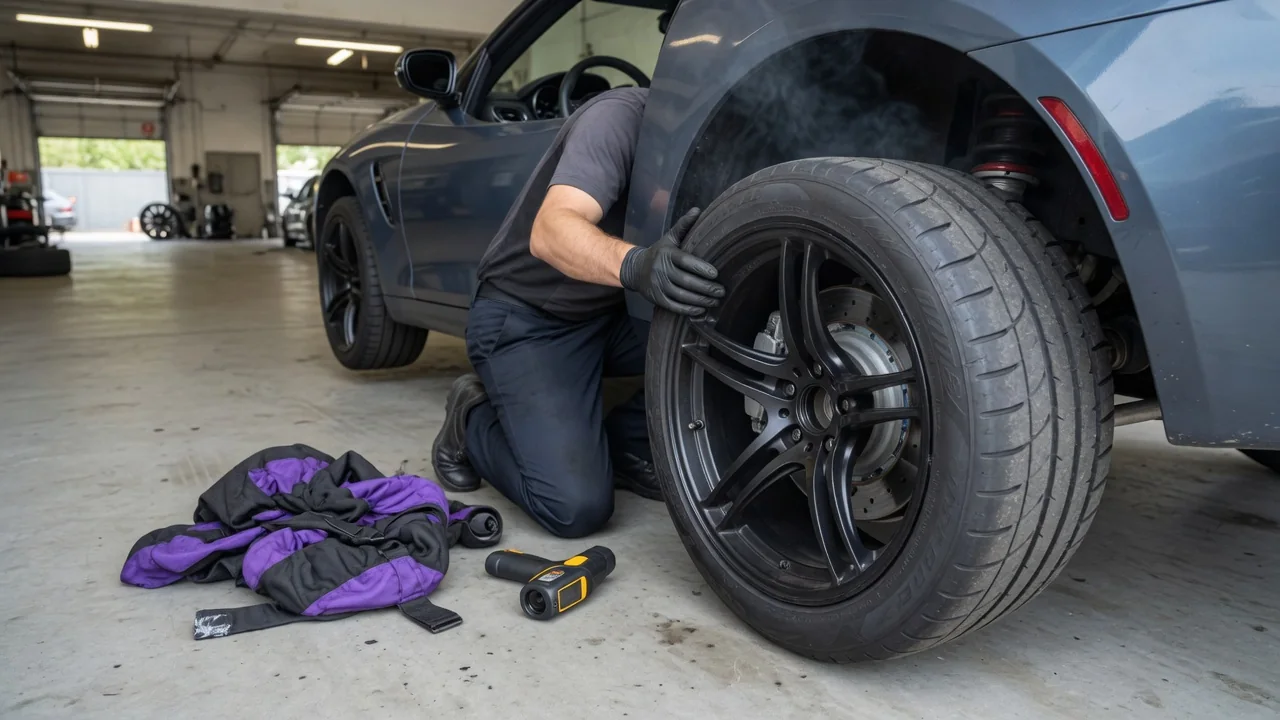
A tire compound is the specific recipe of rubber and other ingredients that a manufacturer mixes, shapes and cures to form the parts of a tire, most importantly the tread. A car tire rubber compound is never just rubber. It is an engineered blend whose chemistry largely determines how the tire grips, how it responds to heat and cold, and how quickly it wears. Those three behaviors explain most of what the word compound means on a tire.
Grip: How Compound Chemistry Creates Traction
A typical tread compound combines natural rubber with synthetic polymers such as styrene-butadiene rubber and polybutadiene. Reinforcing fillers, mainly carbon black and silica, add strength and stiffness. Processing oils and resins adjust softness and tackiness. Sulfur and accelerators drive vulcanization, the curing step that links polymer chains into a durable, elastic network. Antioxidants and antiozonants slow chemical attack from air and ozone. A single tire usually contains several compounds, because the tread, sidewall, inner liner and belt coating each do different jobs.
Grip depends on rubber being viscoelastic, which means it behaves partly like a spring and partly like a thick fluid. Two mechanisms matter most. Adhesion comes from molecular-level contact between rubber and road, and it is strongest on clean, dry pavement. Hysteresis comes from the rubber deforming over the tiny peaks of the road texture and recovering slightly out of step. That lag turns some energy into heat, and the energy loss resists sliding. A compound that absorbs more energy at the deformation rates involved in braking and cornering generally produces more grip. This is why performance-oriented treads tend to be softer and stickier.
On wet roads, the tread pattern must clear standing water, but the compound still has to grip through the thin film that remains. There, hysteresis does more of the work than adhesion. Silica-reinforced compounds with chemical coupling agents became widely used because they help improve wet grip while limiting the rolling resistance penalty that extra hysteresis would otherwise bring. The result is a better balance, not a free gain.
Temperature: The Compound's Operating Window
Every compound has a temperature range in which it works best. The key property is the glass transition temperature. Below it, the polymer loses flexibility and turns stiff and glassy. Well above it, the rubber is soft and pliable. Engineers tune this behavior through their choice of polymers, oils and resins. A summer compound is formulated to stay firm and responsive on warm roads, so it stiffens noticeably as conditions turn cold. A winter compound stays flexible at low temperatures, which lets the tread keep conforming to cold, icy or snowy surfaces. All-season compounds aim for the middle and give up some performance at both extremes.
Heat does not come only from the weather. The same hysteresis that produces grip also generates heat inside the tire each time the tread and sidewalls flex. Speed, load, inflation pressure and driving style all change how much heat builds up. A compound that is too cold can feel slippery and slow to respond. One pushed far beyond its intended range can soften excessively, lose grip, and wear or tear quickly. Underinflation matters here because it increases flexing and therefore heat, however well the compound was designed.
Wear: Abrasion, Aging and Trade-Offs
Tread wear is mostly abrasion. As the tire slips slightly against the road during acceleration, braking and cornering, small particles of rubber are torn away. Resistance to this depends on polymer type, the amount and dispersion of reinforcing filler, and the degree of cure. In general, softer high-grip compounds lose material faster. Harder, abrasion-resistant compounds last longer but usually offer less ultimate traction. Engineers often describe a trade-off among grip, rolling resistance and treadwear: improving one tends to cost something in another. Much of compound development aims to shift that balance rather than escape it.
Rubber also changes with time, not only with distance. Oxygen, ozone, heat and sunlight gradually degrade the polymer network, and some oils and protective additives migrate out over the years. As a result, the tread becomes harder and less able to grip, sometimes with fine surface cracking, even when plenty of tread depth remains. Protective additives slow this aging but do not stop it. Storage conditions and use patterns influence how fast it progresses.
Wear also feeds back into grip. As tread depth falls, the blocks become shorter and stiffer, and reduced groove volume limits water evacuation on wet roads. A worn tire's behavior therefore reflects its remaining tread geometry as well as the original recipe.
Practical Implications and Limits
For a car owner, the compound is largely invisible. Manufacturers rarely publish full recipes, and squeezing a tread block or reading marketing terms says little about it. The useful signals are the tire's category and its sidewall markings. The intended use, such as summer, all-season or winter, shows which temperature window the compound targets. In the United States, Uniform Tire Quality Grading markings on many tires include treadwear and traction grades. These allow a rough comparison, most reliably within one manufacturer's range, but they are not mileage predictions. The three-peak mountain snowflake symbol marks a tire that met a defined snow traction test. The DOT code gives the week and year of manufacture, which helps track aging.
Matching the compound to your conditions matters more than chasing the stickiest option. A soft performance compound can be a poor fit for a long-distance commuter in a cool climate. A long-wearing touring compound may feel less sharp in spirited driving. Let typical temperatures, road surfaces and mileage expectations guide the choice, within the size, load index and speed rating the vehicle manufacturer specifies.
Compound also has clear limits as an explanation. Real-world grip, heat and wear also depend on tread pattern, internal construction, size, inflation pressure, alignment, suspension condition, vehicle weight and driving habits. Two vehicles can wear the same tire very differently. The compound sets a tire's potential, while maintenance and use decide how much of it you get. No treatment can restore rubber that has hardened with age.