Why Do Tires Contain More Than One Rubber Compound?
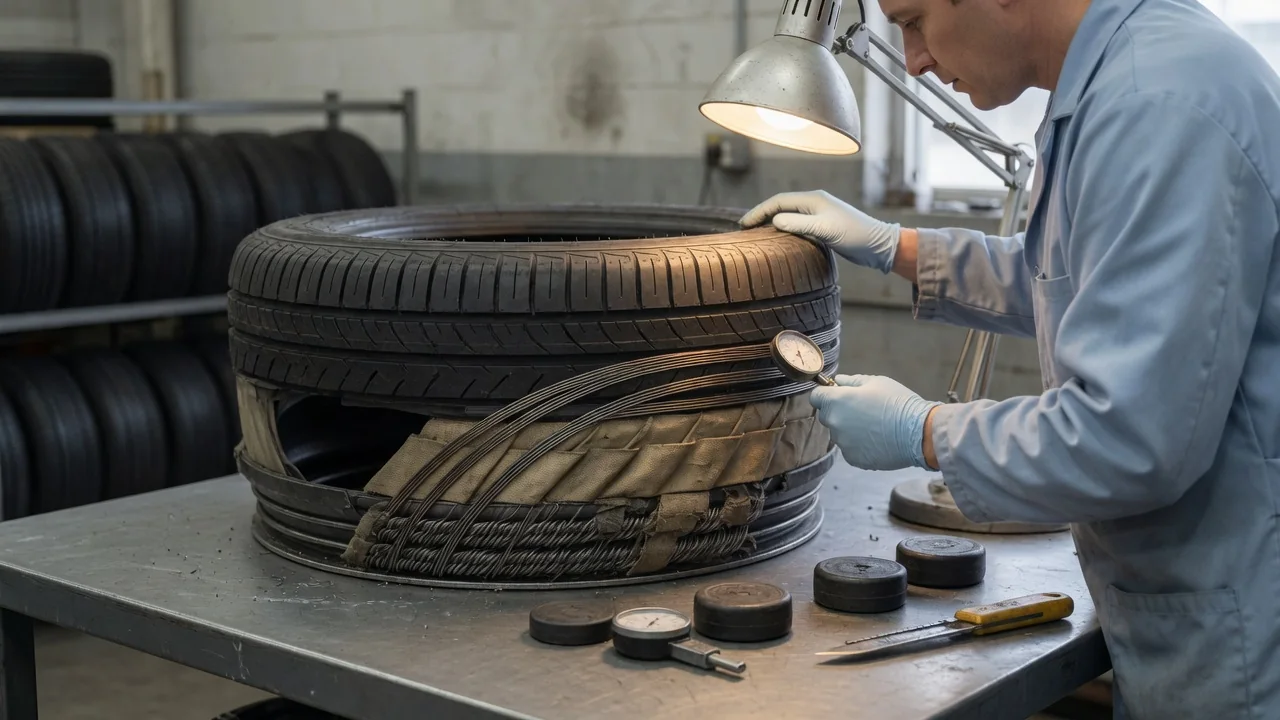
A tire looks like one piece of black rubber, but it is built from several compounds, each formulated for a specific job. The tread has to grip and resist wear, the sidewall has to flex repeatedly without cracking, and hidden layers hold air and bond to steel and fabric. This article explains why tires contain more than one rubber compound, how tire compound zones divide the work, and how those zones age over time.
Tread and sidewall
The tread is the only part of the tire meant to touch the road, so its compound is built around grip and abrasion resistance. Tread compounds typically blend synthetic rubbers such as styrene-butadiene and polybutadiene, sometimes with natural rubber, reinforced with fillers like carbon black or silica. The recipe controls how the rubber conforms to the texture of the pavement, how it behaves on wet surfaces together with the tread pattern, and how slowly it wears away. It must be firm enough to hold the shape of the tread blocks, yet compliant enough to grip at normal operating temperatures.
The sidewall has a very different job. It does not need to grip anything, but it flexes with every rotation as the tire squashes into its contact patch and recovers. Over the life of a tire that adds up to an enormous number of bending cycles, often while exposed to sunlight, ozone and road splash. Sidewall compounds are therefore formulated for flexibility, fatigue resistance and crack resistance, commonly using natural rubber and polybutadiene blends with protective additives. A compound tuned for tread grip would generally be a poor choice here, because it could crack or generate unnecessary heat as it flexes.
Several internal compounds complete the picture. The inner liner, usually based on halogenated butyl rubber, slows the escape of air through the tire wall, a role that ordinary tread or sidewall rubber does poorly. Skim compounds coat the steel belts and fabric plies so the rubber bonds firmly to the reinforcement. A hard bead filler, often called the apex, stiffens the lower sidewall where the tire meets the wheel. Many tires also place a separate base layer under the tread. Each of these zones exists because no single formula can do all of these jobs well.
Performance roles
Tire engineers often describe tread design in terms of competing goals: wet and dry grip, rolling resistance and wear life. Improving one tends to cost something in another. Grip depends partly on the rubber absorbing energy as it deforms over small irregularities in the pavement, while low rolling resistance requires the rubber to waste as little energy as possible as the tire rolls and flexes. Compounders manage this trade-off through polymer choice, filler type and amount, oils and resins, and the curing system. Silica-reinforced tread compounds are widely used to lower rolling resistance while maintaining wet grip, which is one reason efficiency and traction are not simply opposite ends of one scale.
Splitting the tire into layers lets designers place each trade-off where it matters. A common arrangement, often called cap-and-base, uses a grip-oriented cap compound on the surface and a cooler-running base compound underneath. The base can reduce heat buildup and rolling resistance and help transmit forces between the tread and the belts, while only the cap has to deliver traction. Some tires go further and vary the compound across the tread width, for example using one compound in the shoulders, which work hard in cornering, and another in the center. Whether a given tire uses such zoning, and how, depends entirely on its design.
Temperature is another factor. Winter tire treads are formulated to stay pliable in the cold, where a compound designed for summer use can stiffen and lose grip. Internal compounds have structural roles as well: belt skim rubber must keep its bond with steel under repeated flexing and heat, and bead area compounds must resist chafing against the wheel rim. These jobs have little to do with traction, but a failure in any of them affects the whole tire.
Aging
Rubber ages chemically even when a tire is not driven. Oxygen attacks the polymer chains, heat speeds that reaction, ultraviolet light degrades exposed surfaces, and ozone in the air can cut into rubber that is held under strain. Because each compound has a different polymer blend and additive package, the zones of a tire age in different ways and at different rates. Compounders add antioxidants, antiozonants and waxes to slow the damage, and many of these additives are designed to migrate gradually to the surface, where they form a protective film. The brownish discoloration sometimes seen on sidewalls is commonly this migrated protective material.
On the outside, aging usually shows first on the sidewall as fine surface cracks, often called weather checking or crazing, because that compound is both exposed and constantly flexed. Tread rubber tends to harden over time as it oxidizes and loses some of its softening ingredients, which can reduce grip even when plenty of tread depth remains. Inside the tire, oxygen that slowly passes through the inner liner can age the rubber around the belts and weaken the bond between rubber and steel. This internal aging cannot be seen from outside, which is why a tire's age matters, not only its wear and appearance.
Practical implications and limits
For an owner, the multi-compound design explains several common rules. Tread depth shows how much of the tread cap remains, but it says nothing directly about how hard the compound has become, so an older tire with deep grooves is not necessarily as capable as it was when new. Cracking in the sidewall or at the base of tread grooves deserves attention, and a tire professional is the right person to judge how serious it is. Puncture repairs are generally limited to the tread area by industry practice, because the thin, constantly flexing sidewall does not hold a repair the same way.
Age information is printed on the tire itself. Tires sold in the United States carry a DOT code whose last four digits indicate the week and year of manufacture, which is useful when checking spare tires, low-mileage vehicles or new tires that may have spent time in storage. Guidance on maximum service life differs between vehicle and tire manufacturers, so the owner's manual and the tire maker's recommendations are the appropriate references rather than one universal number. Keeping tires at the pressure listed on the vehicle placard and storing removed tires away from sunlight, heat and ozone sources such as electric motors helps every compound age more slowly.
There are limits to what an owner can know. Exact compound recipes and zone layouts are proprietary and are not marked on the tire, and two tires that look similar can be built very differently. The mechanisms described here are general; how quickly a particular tire hardens, cracks or wears depends on its design, the climate, the load it carries and how it is driven. When a tire's condition is uncertain, inspection by a qualified technician is more reliable than judging by appearance alone.