Why Does Tire Temperature Affect Grip?
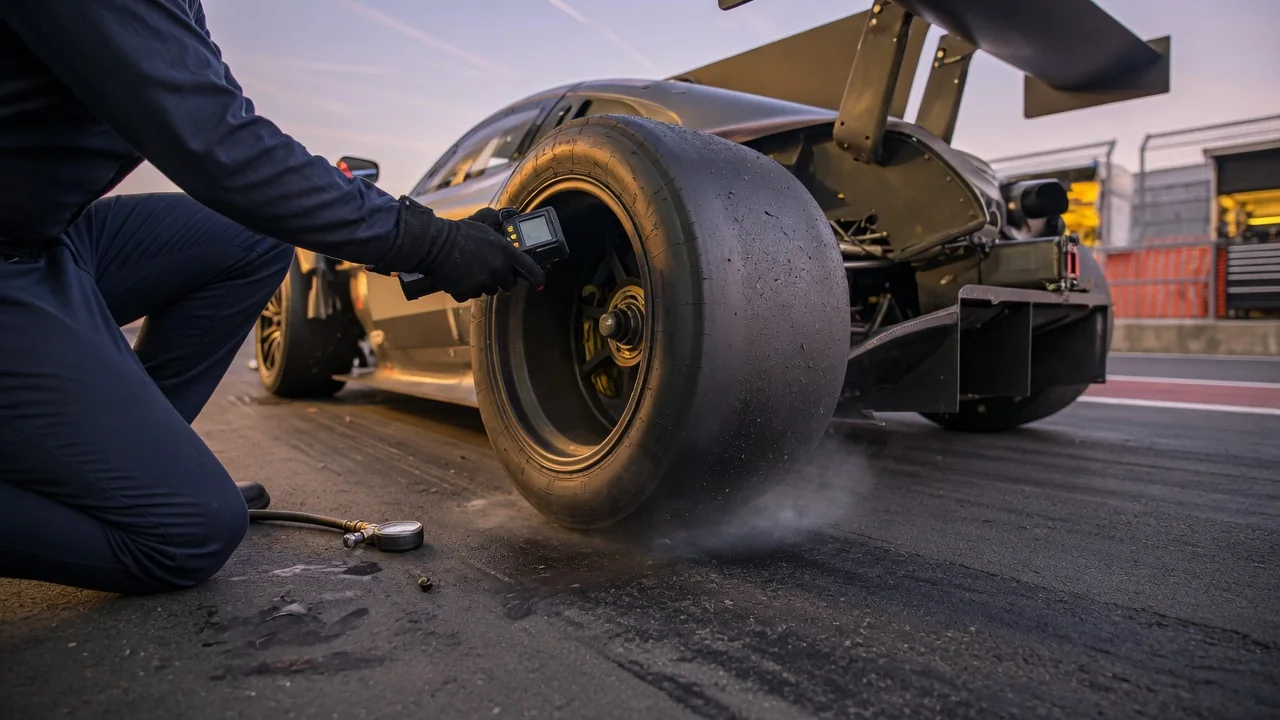
Tire temperature affects grip because the rubber in a tread compound behaves differently as it warms and cools. Its stiffness, its ability to conform to the road surface, and the way it absorbs and releases energy all shift with heat. Temperature also changes inflation pressure, which reshapes the contact patch. This article explains the link between tire temperature and grip through rubber properties, pressure, and road and weather conditions, then outlines what those mechanisms mean for everyday driving.
Rubber properties
Tire tread compounds are viscoelastic materials. They behave partly like an elastic solid, which springs back after being deformed, and partly like a thick fluid, which flows and dissipates energy. The balance between those two behaviors depends strongly on temperature. When rubber is cold, it becomes stiffer and moves closer to its glass transition, the region where polymers turn hard and less pliable. Warm rubber is softer and deforms more readily under load.
Grip on dry pavement comes mainly from two related effects. Adhesion is the molecular attraction between rubber and the road across the area where they actually touch. Hysteresis, often called deformation friction, occurs as the tread drapes over the tiny peaks and valleys in the pavement texture; the rubber deforms, and because it does not return all the energy it absorbed, a resisting force develops as the tire slides. Both effects depend on how pliable the compound is. A compound that is too cold cannot conform closely to the surface texture, so the real contact area and the energy loss both drop, and friction falls with them.
More heat is not always better. Every compound is designed to work within an operating temperature range. Beyond it, the rubber can become too soft to support the loads at the surface, and the tread may begin to grain, blister, or wear rapidly. Sustained overheating can also degrade the compound over time. Different tire categories target different ranges: compounds intended for cold weather are formulated to stay flexible at low temperatures, while high-performance summer compounds are generally designed to work best when warmer. The exact window varies by product and cannot be read from the sidewall.
Pressure
Air inside a tire follows the same basic behavior as any enclosed gas: as its temperature rises at roughly constant volume, its pressure rises too. Driving warms the tire through flexing of the sidewalls and tread, friction with the road, and heat from nearby brakes, so pressure typically climbs after a period of driving and drops again as the tire cools. Ambient temperature has the same effect over longer periods, which is why pressures often read lower on cold mornings and in colder seasons.
Pressure matters for grip because it shapes the contact patch, the small area where the tire actually meets the road. Too little pressure lets the sidewalls and tread flex excessively. That extra flexing generates more internal heat, overloads the tread shoulders, makes steering response vaguer, and can raise the risk of heat-related damage. Too much pressure crowns the tread, concentrating load in the center and shrinking the effective contact area, which can reduce available grip, especially on uneven or wet surfaces.
This creates a feedback loop between heat and pressure. An underinflated tire runs hotter, and a hot tire shows elevated pressure, which can mask the original problem if pressure is only checked after driving. For this reason, vehicle manufacturers specify recommended inflation as a cold pressure, measured before the tire has been driven far or warmed by the sun.
Conditions
Road surface and air temperature set the starting point for the tread. On a cold day, the tire begins near the cold end of its range and may not warm much in normal driving, because a road car rarely generates the sustained heat seen in racing. Pavement temperature can differ noticeably from air temperature: sunlit asphalt can be much warmer than shaded stretches, and bridges and overpasses can be colder than the surrounding roadway because they lose heat from above and below. These variations mean grip can change over a short distance.
Water and cold amplify the temperature effect. A wet road cools the tread and adds a film that must be cleared through the tread pattern before rubber can contact the surface. In near-freezing conditions, a compound that has stiffened struggles to maintain contact with cold pavement, and on snow or ice the tread pattern and compound design matter as much as temperature. This is a key reason tire categories exist: winter tires use compounds and tread designs intended for cold, while summer tires prioritize warm-weather dry and wet performance and can lose substantial grip when temperatures drop. All-season tires attempt a compromise between the two.
Driving style and load also influence tire temperature. Sustained high speed, heavy loads, towing, aggressive cornering, and repeated hard braking all add heat. On a road vehicle, this extra heat rarely moves the tire into a better grip window; more often it increases wear and, combined with low pressure, adds stress to the tire structure.
Practical implications and limits
For everyday drivers, the most useful habit is checking pressure cold and setting it to the figure on the vehicle's door placard or in the owner's manual, rather than the maximum printed on the sidewall. Pressure is worth rechecking when seasons change. Releasing air from a hot tire to bring it down to the cold specification leaves it underinflated once it cools, so adjustments are best made after the tire has rested.
Matching the tire category to the local climate matters more than trying to manage tread temperature while driving. Weaving to warm tires on public roads is not an effective substitute and adds risk. In the first miles on a cold morning, smoother inputs and longer following distances allow for reduced grip, particularly with performance-oriented summer tires. A tire pressure monitoring system can alert the driver to a significant loss of pressure, but it does not replace regular checks with an accurate gauge.
Temperature is only one variable in traction. Tread depth, tire age, compound, road texture, surface contamination, suspension setup, and vehicle weight all interact with it, and the ideal temperature range differs from one tire to another. The mechanisms described here explain general behavior; specific pressure values, temperature limits, and performance characteristics should come from the vehicle and tire manufacturers rather than from rules of thumb.