What Is a Tire Contact Patch? Load, Pressure, and Grip Explained
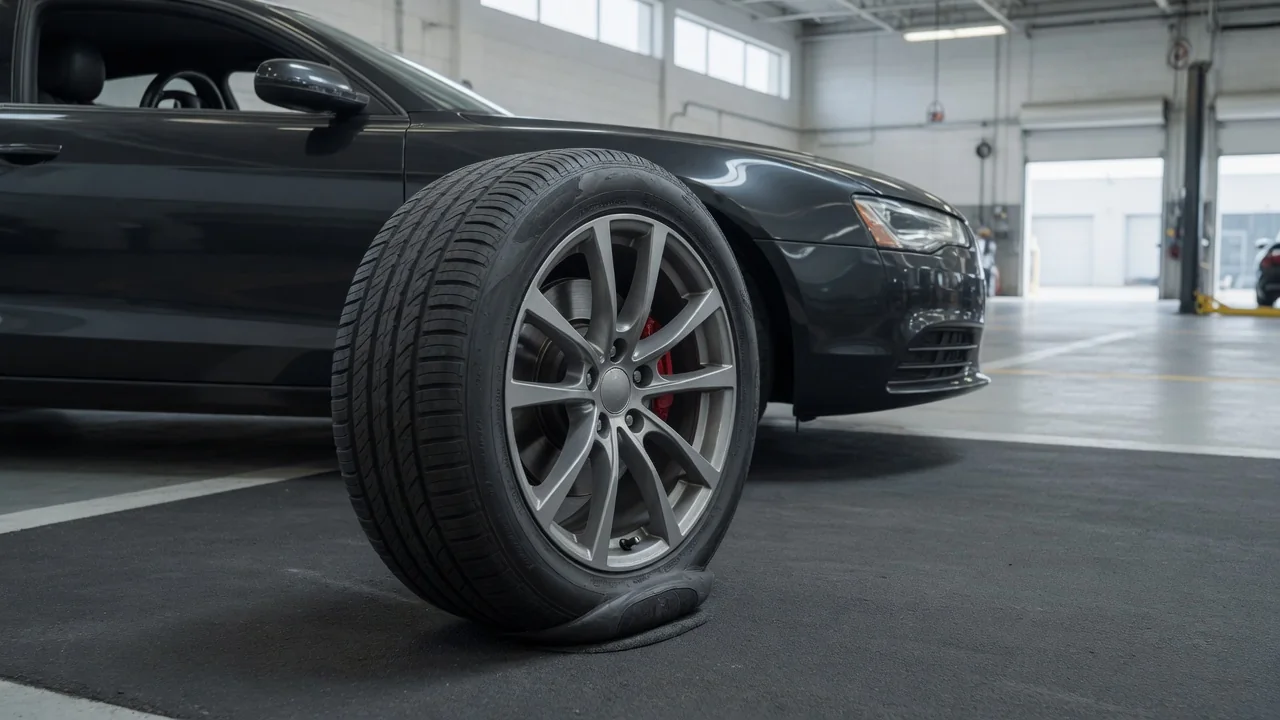
A tire contact patch is the area of tread that touches the road at any given instant. Everything a car does, including accelerating, braking, steering, and carrying its own weight, passes through these patches of rubber, one per tire. Understanding the tire contact patch meaning helps explain why inflation, load, and tread condition matter so much. This guide covers how the patch forms under load, how inflation pressure shapes it, and how it produces road grip.
Load area
A tire is round, but the road is flat. When the weight of the vehicle presses down on the wheel, the tire's tread and sidewalls deflect, and the bottom of the tire flattens against the pavement. That flattened region is the contact patch. It is not a fixed part of the tire. As the wheel rolls, fresh tread continuously enters the front of the patch and leaves at the rear, so every section of the tread passes through it once per revolution.
The size of the patch is set mainly by how much load the tire carries and how far the tire deflects to support it. A common simplified explanation is that the load on a tire roughly equals its inflation pressure multiplied by the contact area. In practice this is only an approximation. The carcass, belts, and sidewalls are stiff structures that carry part of the load themselves, so the actual area depends on tire construction as well as air pressure. The general principle still holds: the same tire at the same pressure forms a larger patch when it carries more load.
Load on each tire is rarely constant. Under braking, weight shifts toward the front, so the front patches grow while the rear patches shrink. Cornering moves load to the outside tires, and acceleration moves it rearward. Passengers, cargo, and towing change the baseline load as well. Shape matters along with size. Tire width, sidewall height, and internal construction all influence whether a patch is shorter and wider or longer and narrower, even when the total area is similar.
Pressure
Inflation pressure is the main way an owner influences the contact patch. The air inside the tire supports much of the load and holds the structure in its intended shape. With too little air, the tire deflects more, the patch becomes longer, and the center of the tread can carry less of the load, concentrating force toward the shoulders. With too much air, the tire resists deflection, the patch becomes smaller, and the load concentrates in the center of the tread.
Pressure within the patch is not uniform either. Contact pressure, meaning the force per unit area between rubber and road, varies from the leading edge to the trailing edge and from the center to the shoulders. Tread blocks, grooves, and sipes create local peaks and gaps. Tire designers aim for a reasonably even distribution at the intended operating conditions, because uneven contact pressure leads to uneven wear and less consistent grip. That is one reason recommended inflation is tied to a specific vehicle and load rather than to the tire alone.
Underinflation also increases flexing of the sidewalls and tread with every rotation. That repeated flexing generates heat, raises rolling resistance, and over time can damage the tire's internal structure. Overinflation reduces flexing but makes the ride harsher and leaves the patch less able to conform to small irregularities in the road surface. Neither direction is an upgrade; the goal is the pressure range the vehicle manufacturer specifies for the expected load.
Road grip
All of a tire's grip is generated inside the contact patch. Rubber grips pavement through two main mechanisms. Adhesion is molecular-level bonding between the rubber and the road surface, and it is strongest on clean, dry pavement. Hysteresis comes from the rubber deforming around tiny peaks in the road texture and recovering more slowly than it deformed, which absorbs energy and resists sliding. On wet roads adhesion drops, so hysteresis plays a relatively larger role.
Tire rubber does not follow the simple textbook rule in which friction force equals load multiplied by a fixed coefficient. A tire's available grip generally rises as load increases, but less than proportionally, an effect often called load sensitivity. As a result, when weight transfers across the car in a corner, the more heavily loaded tire gains less grip than the lightly loaded tire loses. This is a general characteristic of pneumatic tires; how strongly it shows up depends on the tire and on the vehicle's suspension design.
The patch also does not grip as one uniform area. When a tire steers, brakes, or drives, tread elements deform as they travel through the patch. The leading portion tends to hold the road while elements toward the trailing edge begin to slide. As demand increases, the sliding zone grows until the entire patch slides and the tire breaks away. On wet pavement, tread grooves must channel water out of the patch. If water cannot escape fast enough, a film can build under the tread and lift it from the surface, which is hydroplaning.
Practical implications and limits
For everyday driving, the most useful step is keeping tires at the inflation pressure listed on the vehicle's tire placard, usually found on the driver's door jamb or in the owner's manual. The figure molded into the sidewall is the tire's maximum rating, not the recommended operating pressure for a particular vehicle. Checking pressure when the tires are cold gives a more consistent reading, since driving warms the air and temporarily raises pressure. Some manuals list a separate figure for heavier loads.
Wear patterns offer indirect clues about how the patch has been working. Wear concentrated on both shoulders can point to running underinflated, while wear down the middle of the tread can indicate overinflation. Wear on only one edge is more often linked to alignment than to pressure. These are general indicators rather than a diagnosis, and a tire professional can inspect alignment, suspension components, and tire condition. Tread depth matters too, because worn tread has less groove volume to clear water from the patch.
There are limits to what general principles can tell an owner. The contact patch cannot be observed while driving, and its exact size and pressure distribution depend on tire construction, wheel width, load, alignment, speed, and road surface. Wider tires do not automatically deliver more grip, and lowering pressure on the street in an attempt to enlarge the patch is not a reliable way to gain traction while it adds heat and wear. Real handling also depends on suspension design, stability control systems, and rubber compound, so these mechanisms explain trends rather than predict exactly how a specific car will behave.