What Is Scrub Radius? Steering Axis, Tire Contact, and Feel Explained
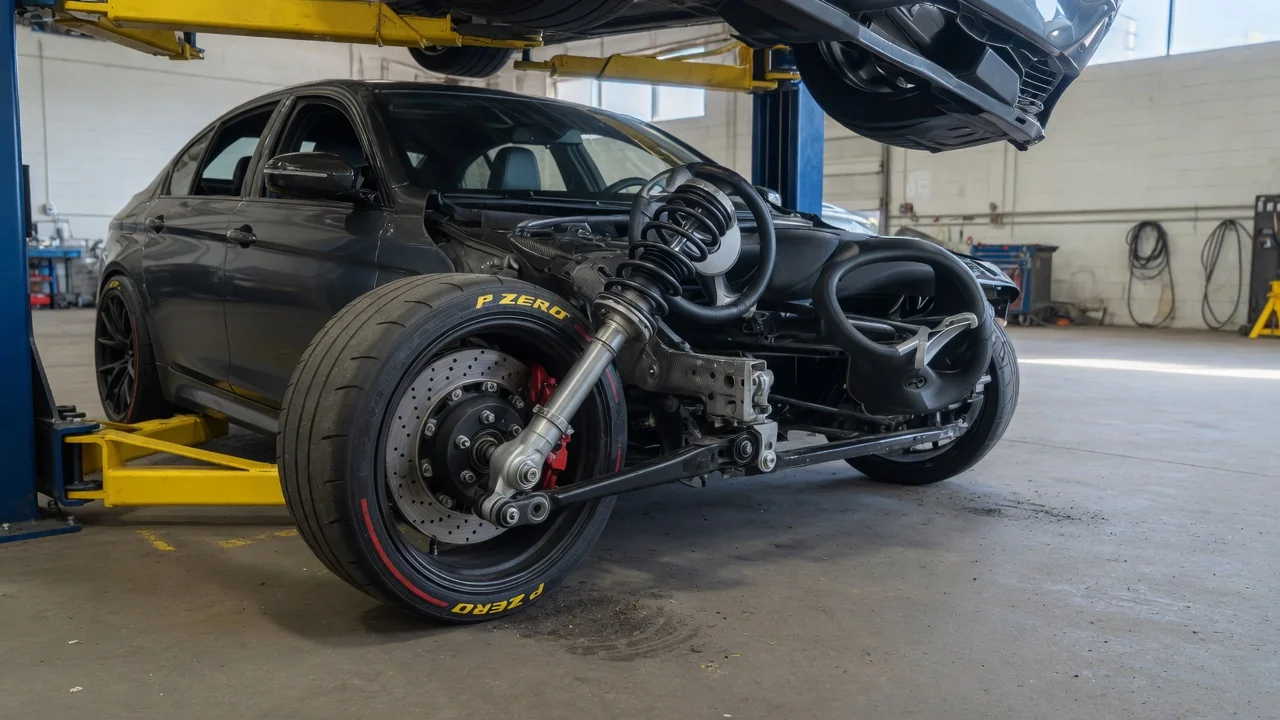
Scrub radius is one of the less visible measurements in steering geometry, but it shapes how a car's front wheels respond to braking, bumps, and steering input. Scrub radius is the sideways distance at the road surface between two points: where the steering axis meets the ground, and the center of the tire's contact patch. To understand what scrub radius means for a car, start with the steering axis and the contact patch.
The steering axis and where it meets the road
A steered front wheel does not pivot around its own center. It pivots around an imaginary line that runs through the upper and lower steering pivots. On a double wishbone suspension, those pivots are the upper and lower ball joints. On a MacPherson strut, they are the strut's upper mount and the lower ball joint. Seen from the front, this line usually leans inward at the top. That tilt is called steering axis inclination, or kingpin inclination. If you extend the line down, it meets the road at a specific point.
Scrub radius is the side-to-side distance, measured at ground level in front view, between that point and the centerline of the tire's contact patch. It is positive when the steering axis meets the ground inboard of the patch center. It is negative when the axis meets the ground outboard of it. When the two coincide, the scrub radius is zero, which is sometimes called center-point steering. Terminology varies between sources. Some call this dimension kingpin offset or steering offset, and some sign conventions differ, so check how a particular manual defines it.
Several design choices set the scrub radius. These include the inclination angle of the steering axis, where the pivots sit relative to the wheel, and how far the wheel's mounting face is positioned from the rim centerline. Tire width and camber also affect where the patch center falls. Engineers generally have to fit the pivots around the brake rotor, the caliper, and the wheel bearing. That packaging limits how freely they can choose this dimension.
Tire contact: forces acting through a lever arm
Every force between the car and the road passes through the contact patch: braking, rolling resistance, cornering loads, and the jolts from bumps. Any rearward force at the patch that acts at a distance from the steering axis twists the wheel around that axis. Scrub radius is the length of that lever arm. With a positive scrub radius, braking force tends to swing the front of the wheel outward, toward toe-out. With a negative scrub radius, the same force tends to swing it inward, toward toe-in. When both front wheels brake equally, the two effects largely cancel through the tie rods. When the forces differ from side to side, a net steering torque appears.
The difference matters most on surfaces with uneven grip, for example when one side of the car is on ice and the other on dry pavement. The wheel with more grip brakes harder, and the car tends to yaw toward that side. With a negative scrub radius, that harder-braking wheel is pushed toward toe-in, which steers slightly against the yaw. A negative scrub radius is commonly cited as a stability aid for this reason. It is especially relevant for diagonally split brake systems, where a fault in one circuit can produce uneven braking. The effect helps the driver but does not remove the need for steering correction.
Scrub radius also affects what the tire does when the wheel is turned. With a nonzero scrub radius, the contact patch travels along a small arc around the steering axis, so the tire partly rolls. With zero scrub radius, the patch mainly twists in place. Because a real contact patch has width, some twisting and scrubbing always occurs. That scrubbing action is the usual explanation for the term's name.
How scrub radius shapes steering feel
At parking speeds, scrub radius is one of several factors behind steering effort. Others include tire width, inflation pressure, load on the front axle, and the steering geometry as a whole. Letting the tire roll through an arc can feel different from twisting it on the spot. Power assistance hides much of that difference on most modern cars. Even so, the underlying geometry still determines how much resistance the assist system has to overcome.
On the road, the effect shows up mainly as feedback. Potholes, sharp bumps, uneven brake force, an out-of-balance wheel, or rotor thickness variation all create changing rearward forces at the contact patch. The longer the lever arm, the more of these forces reach the steering wheel as kickback, shimmy, or tugging. A small scrub radius tends to keep the steering calmer over broken pavement. Designers generally balance that calm against keeping enough road information for the driver to sense grip.
Scrub radius is not responsible for everything the steering wheel communicates. Self-centering at speed comes mainly from caster trail and the tire's own pneumatic trail. Steering axis inclination adds a returning tendency at larger steering angles, because turning the wheel slightly raises the front of the car. On front-wheel-drive cars, drive torque acts at the wheel center rather than at the ground. As a result, the offset between the steering axis and the hub has more influence on torque steer than the ground-level scrub radius does.
Practical implications and limits
Owners rarely change scrub radius on purpose, but they can change it without meaning to. Fitting wheels with a different offset, adding spacers, or switching to a different rim and tire width can move the contact patch centerline. Moving the patch outward increases a positive scrub radius or reduces a negative one. Possible effects include heavier or more nervous steering, more kickback, altered behavior under uneven braking, and higher loads on wheel bearings and steering parts. How much any of this happens depends on the vehicle. The manufacturer's approved wheel and tire fitments remain the reliable reference.
Scrub radius is not a routine alignment adjustment. Alignment equipment reports camber, caster, and toe, and many systems also measure steering axis inclination. Scrub radius itself is fixed by the suspension design. After a hard impact, however, a bent control arm, strut, or steering knuckle can shift the steering axis. That shift changes the scrub radius along with other angles. An inclination reading outside specification, while the adjustable angles look normal, is one clue that parts may be damaged.
Symptoms such as pulling under braking, steering vibration, or heavy steering have many possible causes. These include sticking calipers, unequal tire pressures, worn bushings or ball joints, and simple misalignment. Scrub radius also shifts slightly as the suspension moves and camber changes under load. It is one parameter among several interacting ones, so judge it against the vehicle-specific figures in the service manual rather than general rules of thumb.