What Is Steering Trail? Contact Patch Offset, Return Force and Feel
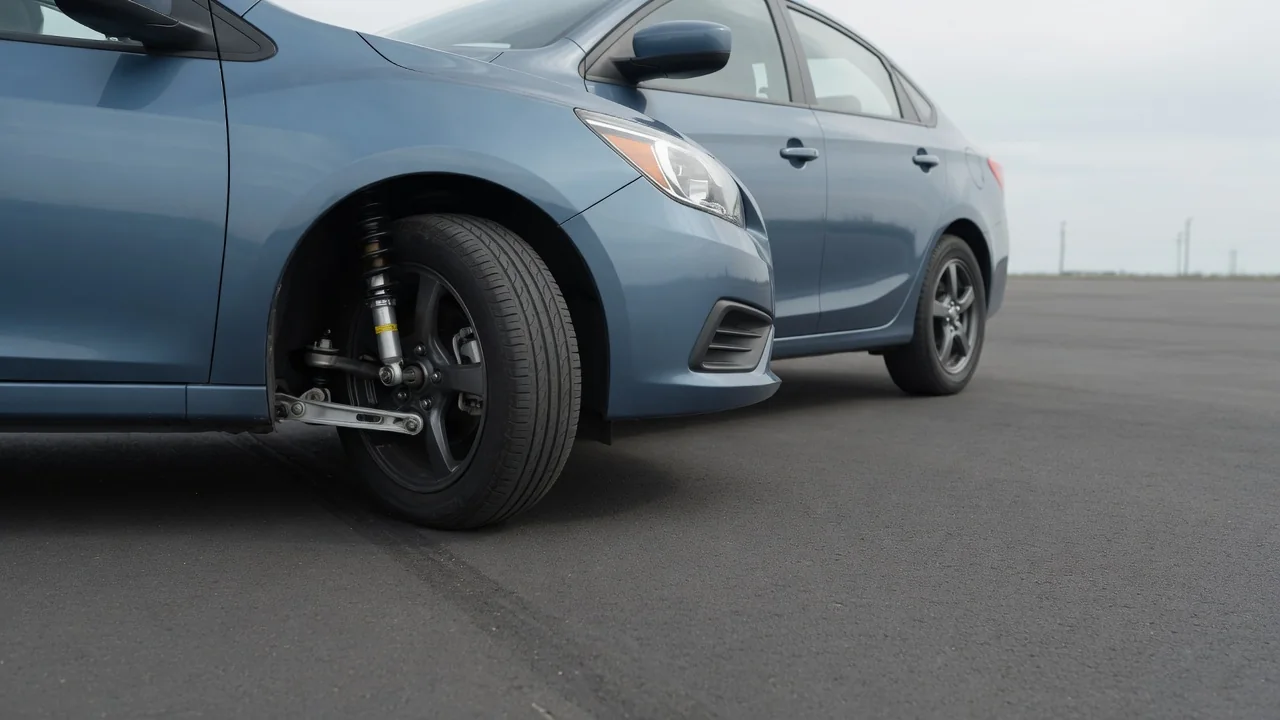
Steering trail is the distance, measured along the ground, between the point where a front wheel's steering axis meets the road and the center of the tire's contact patch. It sounds like a minor detail of suspension design, but it shapes how a car tracks straight, how the steering wheel returns after a turn, and how much the driver can sense through the rim. This guide explains the car steering trail concept in practical terms, without tying it to any particular model.
Contact patch offset
Every steerable front wheel pivots around an imaginary line called the steering axis. On a strut suspension it runs roughly through the upper strut mount and the lower ball joint; on a double-wishbone layout it connects the upper and lower ball joints. Seen from the side of the car, this axis is usually tilted so that its top sits further back than its bottom. That tilt is the caster angle. Because of it, when you extend the steering axis down to the pavement, it meets the road slightly ahead of the center of the tire's contact patch. The horizontal distance between those two points is the mechanical trail, often simply called steering trail or caster trail.
Caster angle is not the only factor. Designers can also position the wheel center ahead of or behind the steering axis, an arrangement sometimes called caster offset or spindle offset. Moving the hub forward relative to the axis reduces trail for a given caster angle; moving it rearward increases it. That is why two vehicles with similar caster figures can have different amounts of trail. Trail is also distinct from scrub radius, which is the sideways offset between the steering axis and the contact patch as seen from the front of the car.
A second component comes from the tire itself. When a rolling tire carries a cornering load, its tread deforms within the contact patch, and the resulting side force acts at a point behind the patch center. That extra distance is called pneumatic trail. The total trail the steering system works with is the sum of the mechanical trail built into the geometry and the pneumatic trail generated by the tire, and the second part changes constantly with load, slip and tire condition.
Return force
Trail matters because it gives the road a lever. When the car turns, the tires produce a side force at the contact patch. Since that force acts behind the point where the steering axis meets the ground, it creates a twisting moment about the axis that tries to swing the wheel back toward straight ahead. Engineers call this the self-aligning torque. Its size depends on how large the cornering force is and how long the lever is, so more total trail generally means a stronger tendency for the wheels to straighten themselves.
This is the same principle that makes a shopping cart caster or a bicycle fork follow the direction of travel. The wheel trails behind its pivot, so a deflection is resisted and corrected. On a car, the effect helps the steering return to center when the driver relaxes their grip coming out of a corner, and it helps the vehicle hold a straight line on a crowned or uneven road without constant small corrections.
Trail is not the whole story behind steering return, especially at low speed. When the car is barely moving, cornering forces are small, so the trail-based moment is weak. In that situation, caster and steering axis inclination play another role: turning the wheels slightly lifts the front of the vehicle, and the weight of the car pressing back down encourages the wheels toward center. At higher speeds the trail-based aligning moment becomes the more noticeable contributor. Pneumatic trail also behaves in a particular way: it tends to shrink as a tire approaches its grip limit, so the aligning torque can level off or fall even as steering angle increases.
Feel
Because the self-aligning moment pushes back against the driver's hands, trail is a major source of steering weight and feedback. A geometry with generous trail tends to produce a heavier wheel that builds resistance as cornering load rises, which many drivers read as stability and connection. A geometry with little trail tends to feel lighter and quicker to respond but can seem vague or nervous around center, needing more attention to keep the car tracking straight.
The changing pneumatic trail is part of what drivers describe as feel. As the front tires near the limit of grip, the reduction in pneumatic trail can make the steering go lighter, which is one of the cues that the front end is beginning to slide. Whether that cue reaches the driver clearly depends on the rest of the system. Hydraulic and electric power steering add assistance that reduces effort, and electric systems in particular are tuned by software that can filter, add or reshape the forces the driver senses. Rack design, bushings, column compliance and tire construction also influence how much of the trail-generated torque arrives at the rim.
Practical implications and limits
For owners, the most direct link to trail is wheel alignment. Most alignment reports list caster angle rather than trail, and many factory suspensions offer limited or no caster adjustment, so a caster reading outside the manufacturer's range often points to a bent or worn part rather than a setting to dial in. A left-to-right difference in caster can cause the car to drift toward one side, and worn control arm bushings or a damaged strut can alter the geometry enough to change steering return and weight. If the steering wheel no longer centers itself as it once did, or the car wanders, an alignment check and a suspension inspection are reasonable first steps.
Modifications can shift trail too. Lowering or lifting a vehicle may change caster angle depending on the suspension design, and wheels with a different offset or tires with a different construction, size or pressure can change pneumatic trail and scrub radius. The results can be subtle or noticeable and depend heavily on the specific vehicle, so the general direction of an effect should not be treated as a prediction for a particular car.
It also helps to keep the concept in proportion. Trail explains much about straight-line stability, centering and feedback, but it interacts with toe, camber, steering axis inclination, scrub radius, tire characteristics and power steering calibration. Manufacturers choose trail as part of a compromise among effort, stability, feedback and packaging, and there is no single ideal value for every vehicle. Alignment work is best guided by the manufacturer's published specifications for the vehicle in question.