What Is Kingpin Inclination? Steering Axis Geometry Explained
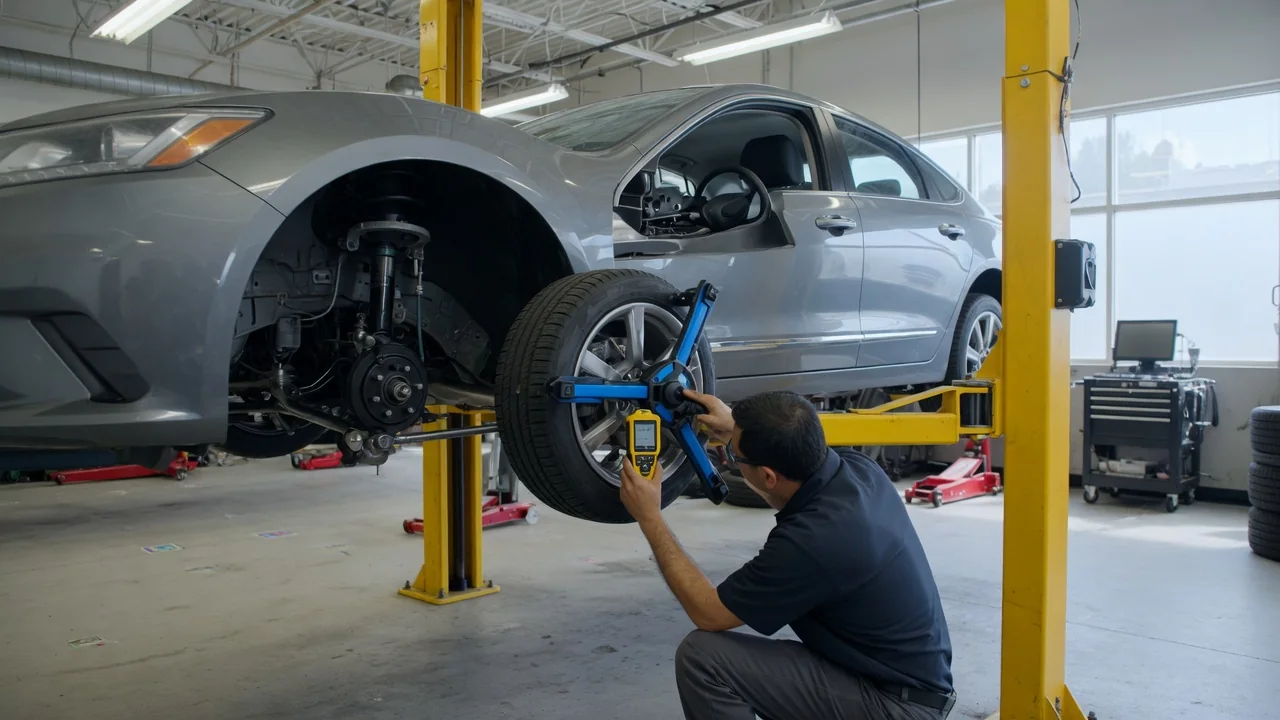
Kingpin inclination, also called steering axis inclination (SAI), is how far the axis a front wheel pivots around leans inward from vertical when viewed from the front of the car. This built-in angle helps the steering return to center, keeps steering effort manageable, and shapes how the tire meets the road while turning. This guide explains what kingpin inclination is, how it works, and why alignment technicians measure it even though it usually cannot be adjusted directly.
Pivot geometry
Every steered wheel turns around an imaginary line called the steering axis. Some older trucks and heavy vehicles with a solid front axle use an actual kingpin to form that axis. A kingpin is a hardened pin that joins the steering knuckle to the axle, and it gave the angle its name. Most modern cars have no physical kingpin. On a MacPherson strut suspension, the steering axis on the car runs from the center of the upper strut mount down through the lower ball joint. On a double-wishbone or multilink layout, it runs through the upper and lower ball joints or equivalent pivot points. Kingpin inclination and steering axis inclination describe the same angle, whatever hardware defines it.
Viewed from the front, the steering axis tilts so its top sits closer to the vehicle centerline than its bottom. The angle between that line and true vertical is the kingpin inclination. Because the upper pivot is inboard, the axis meets the ground closer to the center of the tire contact patch than a vertical axis would. The distance between the point where the axis meets the ground and the center of the contact patch is called the scrub radius. Inclining the axis is one of the main ways engineers keep scrub radius small. A small scrub radius reduces how far the tire has to scrub sideways when steered. It also limits how strongly bumps, braking forces and uneven traction tug at the steering wheel. Wheel offset and the packaging of brakes and hubs inside the wheel also affect scrub radius, so inclination is one part of a balance rather than a standalone solution.
Kingpin inclination is closely linked to camber, which is the inward or outward tilt of the wheel itself. Added together, the two angles form the included angle. The included angle is set by the shape of the steering knuckle or strut assembly, and that relationship becomes important during alignment.
Steering return
Because the steering axis is tilted, the wheel does not swing in a flat horizontal circle when it is steered. As the wheel turns away from straight ahead in either direction, the spindle follows an arc that would carry it downward toward the road. The tire cannot move into the pavement, so the front of the vehicle is raised slightly instead. The vehicle's weight resists being lifted. That resistance creates a torque that rotates the wheels back toward the position where the front end sits lowest, which is straight ahead.
This lifting effect is a key reason a steering wheel tends to unwind after a turn. It depends mainly on the load carried by the front axle rather than on road speed, so it helps with centering even during slow maneuvers such as parking-lot turns. Caster works differently. Caster tilts the steering axis fore and aft and creates mechanical trail, and the tire's side forces acting through that trail produce a self-aligning torque that grows with cornering force. In most cars, inclination, caster and the tire's own self-aligning behavior work together. Hydraulic or electric power steering then shapes what the driver actually feels, so how much each mechanism contributes varies from one design to another.
On a correctly built car, the inclination is the same on both sides, so the centering forces cancel out when driving straight. If one side differs from the other, those forces no longer balance. The imbalance can contribute to a pull or to uneven steering return in left and right turns.
Alignment
On most passenger vehicles, kingpin inclination is not a direct adjustment. It is determined by where the suspension mounting points sit and by the shape of parts such as the knuckle, strut and control arms. Technicians still measure it because it shows whether those parts are where they belong. Alignment equipment typically measures steering axis inclination by steering the wheels through a set angle to the left and right while sensors record how the wheel plane changes. This is often part of the same procedure used to measure caster.
Technicians compare inclination, camber and included angle from side to side and against the manufacturer's specifications to find damage. Some general patterns are common. If inclination is within specification but camber and included angle are not, a bent knuckle, spindle or strut is a likely suspect. If inclination is off while the included angle is correct, the problem tends to lie in the mounting points, such as a bent control arm, a shifted subframe or a displaced strut tower. Diagnostic charts in service information vary with suspension type, so these patterns are general guides rather than universal rules.
Adjustments made elsewhere can still affect the angle. Camber adjustment at the upper strut mount moves the top of the steering axis and therefore changes inclination. Camber adjustment at the strut-to-knuckle bolts changes camber without moving the steering axis, so it changes the included angle instead. Changing ride height can alter control arm angles and shift measured inclination. The correct values for a given vehicle come from its service information.
Practical implications and limits
For owners, kingpin inclination is mostly invisible until something disturbs it. Signs worth investigating include a pull that remains after toe and camber are corrected, a steering wheel that returns sluggishly or unevenly, and steering that feels different in left and right turns. Each of these can also come from tire pressure, tire construction, worn ball joints or tie rod ends, binding strut mounts or dragging brakes. They justify an inspection, not a conclusion. After a curb strike or collision, asking for an alignment readout that includes steering axis inclination and included angle helps separate a bent part from one that only needs adjusting.
Modifications can change how the geometry behaves even when the angle itself stays the same. Wheels with a different offset, or wheel spacers, move the contact patch relative to the steering axis and change the scrub radius. That can make the steering more sensitive to bumps, braking and uneven grip. Lowering kits, lift kits, aftermarket control arms and adjustable top mounts can alter the balance engineers chose for the original design, so a full alignment check after such changes is sensible.
Kingpin inclination is one angle within a larger system. It does not determine handling, steering feel or tire wear on its own, and the appropriate value differs widely between suspension designs. No single figure suits every car, and the vehicle's service specifications remain the reference. Understanding the angle helps owners read an alignment report and ask useful questions, but it does not replace measurement on proper equipment.