Why Are Wheel Alignments Checked During Production?
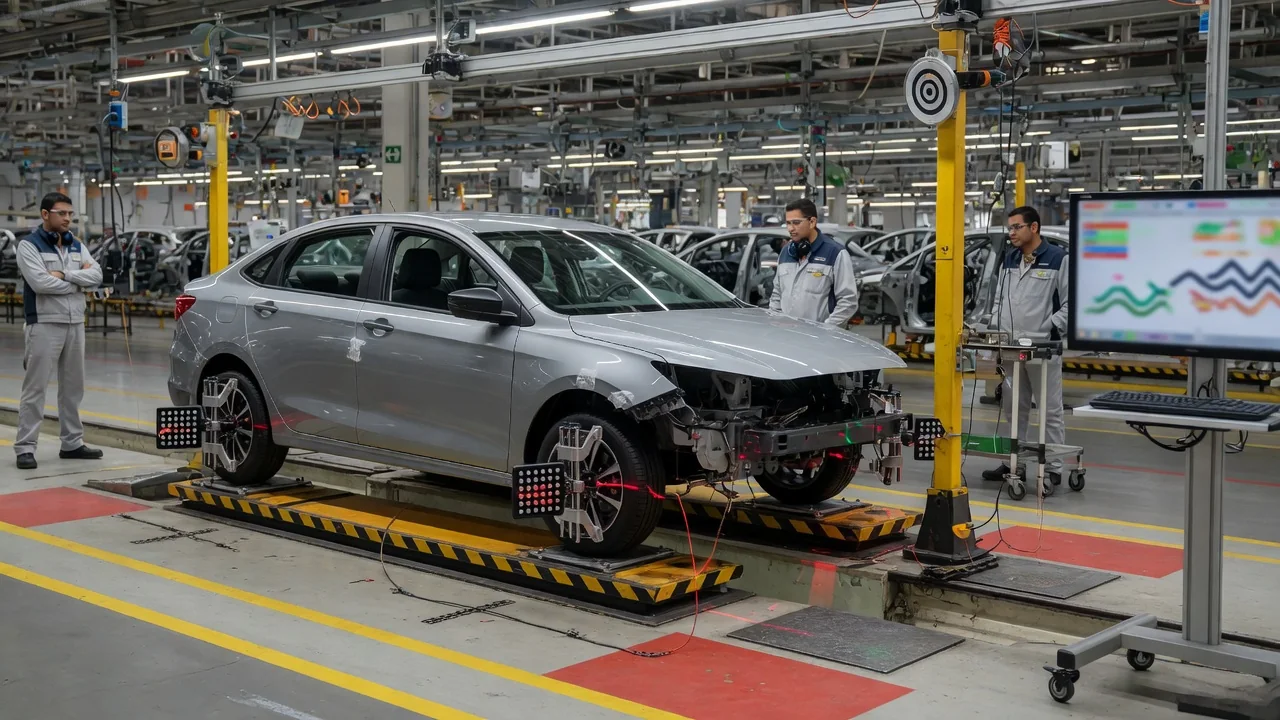
Before a new car leaves the assembly plant, its wheel angles are commonly measured and, where the design allows, adjusted. A factory wheel alignment check exists because a suspension built from many separate parts rarely lands exactly on its design targets without verification. This article explains why wheel alignments are checked during production, focusing on three connected concerns: suspension geometry, tire wear, and the way the steering feels to the driver.
Geometry
Wheel alignment describes the angles at which each wheel meets the road, relative to the vehicle body and to the other wheels. The three most commonly discussed angles are toe, camber, and caster. Toe is whether the front edges of a pair of tires point slightly toward or away from each other when viewed from above. Camber is the inward or outward tilt of the wheel when viewed from the front. Caster is the forward or rearward tilt of the steering axis when viewed from the side. Engineers choose target values and tolerances for these angles during development, balancing stability, responsiveness, tire life, and ride comfort for that particular vehicle.
The challenge on the production line is tolerance stack-up. The body shell, subframes, control arms, steering knuckles, bushings, and tie rods each have small permitted variations in their dimensions, and the mounting points where they join vary within limits as well. Individually these deviations are acceptable, but combined they can push a wheel angle away from its intended value. Fastener torque, bushing preload, and the order in which parts are tightened can add further variation. Measuring the finished assembly is the practical way to confirm that the sum of all those small differences still falls inside the specified window.
Factory alignment equipment generally measures the vehicle at a defined ride height and loading condition, because suspension angles change as the springs compress. On many vehicles, toe is adjustable through threaded tie rods and can be set on the line, while camber and caster may be fixed by the suspension design and therefore only verified. The check also establishes the thrust line, the direction in which the rear axle steers the car. That line matters for straight tracking and, on vehicles equipped with driver-assistance cameras or radar, can serve as a reference for sensor calibration.
Tire wear
Alignment has a direct effect on how evenly a tire's tread contacts the road. When toe is outside its target, each tire is effectively dragged slightly sideways as it rolls forward. That scrubbing action tends to wear the tread unevenly and can produce a feathered pattern, where the tread blocks feel sharp on one edge and smooth on the other. Because the effect accumulates with every revolution, even a small toe error can shorten tire life over many miles.
Camber influences wear in a different way. Excessive negative camber concentrates load on the inner shoulder of the tire, while excessive positive camber shifts it toward the outer shoulder. A modest amount of camber is often part of the design because it helps the tire keep a useful contact patch when the body leans in corners, but too much on a straight road leaves one edge working harder than the rest of the tread.
From a manufacturing quality standpoint, uneven tire wear is a problem that appears slowly and far from the factory. A car can leave the plant feeling normal and only show abnormal wear months later, after its owner has driven a substantial distance. Checking alignment before delivery helps prevent that kind of delayed complaint. Sideways scrubbing also adds rolling resistance, so keeping toe within its design window supports the efficiency the vehicle was engineered to deliver, not only the life of the original tires.
Steering feel
Drivers notice steering problems quickly, which makes steering feel one of the most visible outcomes of the factory alignment check. A common goal on the line is a steering wheel that sits centered when the road wheels point straight ahead. Because toe adjustment moves the tie rods, it can also rotate the steering wheel relative to the road wheels, so toe and steering wheel position are typically set together. An off-center steering wheel on a brand-new car is an easy-to-spot defect even when the vehicle otherwise drives correctly.
Caster plays a large role in how the steering returns to center after a turn and how settled the car feels at highway speed. Positive caster creates a self-aligning tendency, similar to the way the wheels on a shopping cart trail behind their pivot. If caster or camber differs too much from one side of the vehicle to the other, the car may pull toward one side, forcing the driver to hold a constant correction. Toe settings also influence how eagerly the vehicle responds to small steering inputs and how stable it feels when tracking in a straight line.
On vehicles with electric power steering and driver-assistance features, the systems may rely on a steering angle sensor that needs to know where center is. When the alignment is set at the plant, related calibration steps can follow so that the electronics and the mechanical geometry agree. The exact procedure depends on the vehicle and is described in its manufacturer's service information.
Practical implications and limits
A factory alignment check confirms the vehicle's condition when it was built, not for the rest of its life. Alignment can shift during transport and handling, as new bushings and springs settle, or after an impact with a pothole or curb. Replacing suspension or steering parts, changing ride height, or fitting different wheels and tires can also change the angles. A vehicle that left the factory within specification may therefore need an alignment later, and service information commonly calls for one after related repairs.
Not every pull or wear pattern points to misalignment. Uneven tire pressures, a tire with internal construction irregularities, worn suspension components, or a dragging brake can produce similar symptoms. Many roads are built with a crown that slopes toward the edge for drainage, and that slope can make a correctly aligned car drift gently. A sensible first step is to check tire pressures and look at the tread across its full width before assuming the geometry is at fault.
Owners should also keep in mind that alignment specifications are vehicle-specific. The correct values and the angles that can actually be adjusted vary between designs, so a general explanation cannot replace the figures in the manufacturer's service manual. When an alignment shop provides a before-and-after report, comparing it with those published specifications is the most reliable way to judge whether the car has been returned to the condition the factory intended.