How Are Car Seat Tracks Checked in Production?
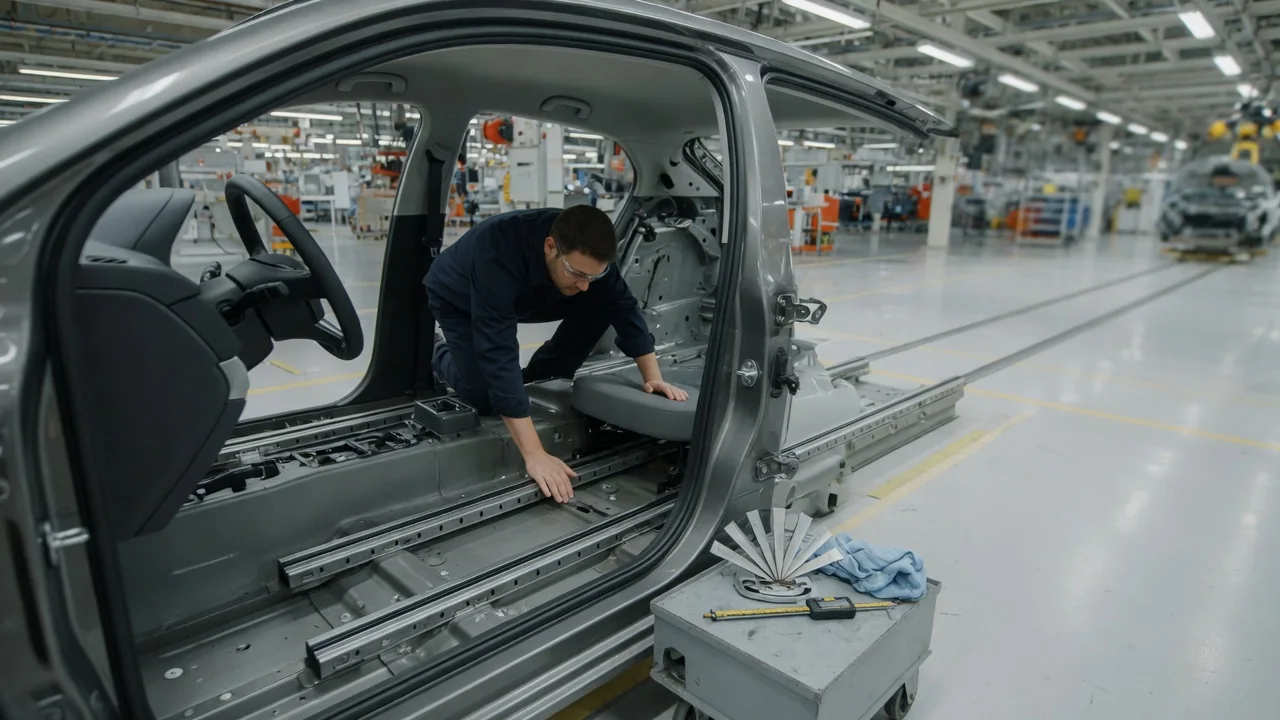
Seat tracks are the paired rails that let a front seat slide forward and back and then hold it firmly in place. They carry occupant loads and affect how a seat feels every day, so manufacturers and their seat suppliers check them at several points during production. Factory seat track quality checks generally focus on three questions. Does the seat travel the full intended distance? Does it lock securely? Are the rails aligned so the seat moves smoothly and mounts correctly?
Travel range
Travel range is the distance a seat can move between its forward and rearward end stops. In production, the basic question is whether a finished track assembly reaches both stops and covers the designed distance without binding. On manual tracks, this is commonly checked by cycling the upper rail along the lower rail on a test fixture while equipment or an operator confirms that the stops are present and engaged. Fixtures may measure displacement directly or simply verify that the rail reaches defined positions at each end. The travel distance and its tolerance come from each vehicle program's drawings, so no single number applies to every car.
Sliding effort is usually evaluated alongside travel. A track can reach both ends and still feel rough, sticky or uneven in the middle. That can point to problems such as debris, inconsistent lubrication, damaged rolling elements or deformed rails. Many lines measure the force needed to move the seat and compare the result with limits defined for that design. For powered tracks, they may measure motor current and travel time instead. Powered seats get further checks, such as confirming that the motor stops properly at each end and that position sensors or memory functions, where fitted, report travel correctly. Noise during travel may also be screened. Squeaks and clicks are a common source of customer complaints even when the mechanism works correctly.
Locking
The locking mechanism keeps the seat from sliding once the occupant releases the adjustment lever. On many manual tracks, spring-loaded pins, teeth or pawls drop into a row of slots or notches along the rail. Production checks typically confirm that the lock engages fully at several positions along the travel, not just at one convenient spot, and that it releases cleanly when the lever is operated. A partially engaged lock can feel secure in the showroom but slip under load, so verifying full engagement is a central part of the inspection.
Holding strength is generally assessed in two ways. Before production begins, design validation subjects sample parts to demanding load tests. These tests are meant to show that the track and its locks meet the manufacturer's requirements and any applicable regulations. Checks on the assembly line are usually milder and non-destructive. Equipment may push or pull on a locked seat with a controlled force to confirm that it does not move more than an allowed amount. Some plants also take sample assemblies from production for periodic destructive testing. This confirms that the process still produces parts that match the validated design.
Free play, sometimes called chuck, is another locking-related concern. Even a properly latched track has small clearances between its parts, and if those clearances are too large the seat can rock or rattle. Measuring the fore-aft and side-to-side movement of a locked seat helps catch worn tooling, out-of-tolerance stampings or missing components before the seat reaches a vehicle.
Alignment
Most seats ride on two tracks, one on each side, and the two need to work as a matched pair. If the left and right rails are not parallel or are out of step with each other, the seat can twist slightly as it moves. That increases effort and wear and can stop both locks from engaging at the same position. Production checks therefore look at how the two tracks relate to each other. Often the pair is built on a fixture that holds the rails at the intended spacing, and the check confirms that both slide together and lock at matching positions. On manual seats, a single lever usually releases both locks through a linkage, and that linkage is checked to make sure both sides release together.
Alignment also covers how the track assembly fits the vehicle. The mounting holes or studs must line up with the anchorage points in the floor pan, and the track must sit at the intended height and angle. Gauges, checking fixtures and measuring equipment may be used on stampings and finished assemblies to confirm that hole positions and key surfaces are within drawing tolerances. When the seat is installed in the body, fastener torque is typically controlled and recorded. Correct clamping is essential for the seat anchorage to perform as designed. Misalignment found at this stage may be traced back to either the track supplier or the body structure.
Practical implications and limits
For owners, these production checks explain why a healthy seat should move with steady effort, stop firmly at each end and stay put without noticeable rocking. They do not guarantee that a seat will feel the same years later. Daily use, spilled drinks, grit in the rails, objects wedged under the seat and knocks from cargo can all change how a track behaves after the car leaves the factory. The exact tests, tolerances and sampling frequencies also vary between manufacturers, suppliers and seat designs, and they are rarely published in detail. A general description cannot tell you what was checked on any particular vehicle.
Some symptoms are worth taking seriously. Watch for a seat that slides when braking or accelerating, a lever that does not spring back, a lock that engages at some positions but not others, or one side that seems to move separately from the other. Seat tracks are part of what holds the occupant in place during a crash, so they are generally treated as safety-related components. The owner's manual and the manufacturer's service information are the right references for adjustment and inspection. If a seat does not lock reliably, have a qualified technician evaluate it rather than relying on a temporary fix.