How Does a Power Seat Motor Move the Seat?
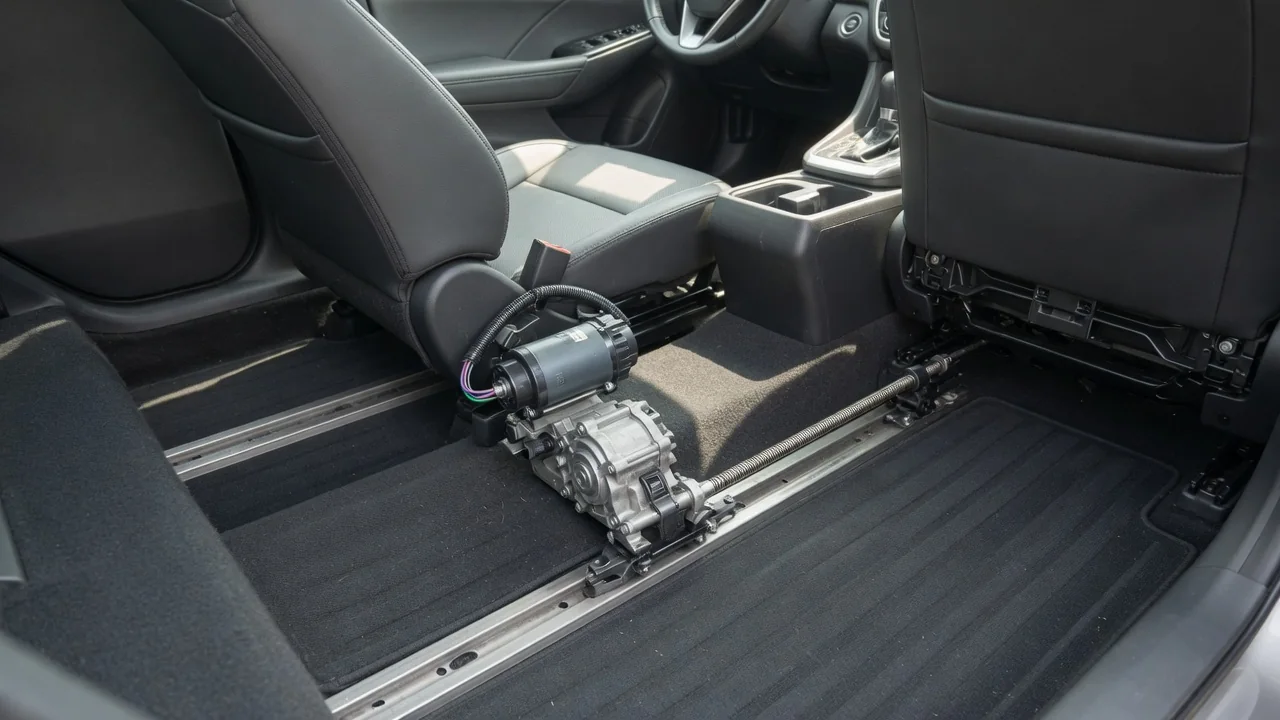
A power seat looks like it glides on its own, but its movement comes from a small set of ordinary mechanical parts. Electric motors spin, gears slow that spin and multiply its force, and threaded rods or geared tracks turn rotation into straight-line or tilting motion. A switch decides which motor runs and in which direction. Knowing how these pieces connect explains why a power seat behaves the way it does and why it sometimes stops.
Gear and Track: How Motor Rotation Becomes Seat Movement
Most power seats use compact permanent-magnet DC motors, usually one for each direction of adjustment the seat offers. A basic seat may have a single motor for forward and rearward travel. A more elaborate seat adds motors for height, cushion tilt, recline and sometimes lumbar support. These motors spin fast but produce little torque on their own, so none of them pushes the seat directly. Instead, each motor feeds a gear reduction, commonly a worm and worm wheel, that trades speed for force. The result is slow, steady movement strong enough to shift the seat with a person sitting in it.
Fore-and-aft travel is the clearest example of the power seat motor mechanism. The seat rides on a pair of tracks, each made of a fixed lower rail bolted to the floor and a sliding upper rail attached to the seat frame. In many designs a threaded lead screw runs along the track, and a gearbox with a matching nut is mounted to the moving rail. When the motor turns, the gearbox rotates either the screw or the nut, and the threads walk the upper rail along the lower one. Other designs use a small pinion engaging a toothed rack in the track. Where one motor drives both tracks, flexible drive cables, similar in principle to an old mechanical speedometer cable, carry rotation from the motor to a gearbox at each side so both rails move together.
Height, tilt and recline use the same idea with different linkages. A gear may turn a sector gear or a screw that pivots a lift arm, raising the front, rear or entire cushion, while recline is handled by a geared mechanism at the seatback hinge. Worm gears and fine-pitch screws are generally difficult to drive backward, so the seat tends to hold its position when the motor stops, without a separate lock or continuous power.
The Switch: Directing Power and Reversing Direction
The seat switch is essentially a set of contacts that route battery voltage to the selected motor. Because these motors are DC, their direction depends on polarity. Pressing a control one way connects one motor terminal to positive and the other to ground; pressing it the opposite way swaps them, so the motor spins in reverse. A single knob or paddle often contains several of these contact sets, each tied to a different motor, which is why pushing the control forward, back, up or down produces distinct movements. In simpler systems the switch carries the full motor current itself, which is one reason switch contacts wear over time.
Many vehicles place a seat control module between the switch and the motors. In that arrangement the switch sends a low-current signal, and relays or electronic drivers in the module supply motor power. Seats with memory functions also need to know where they are, so their motors or tracks carry position sensors, often Hall-effect sensors that count motor revolutions or potentiometers that report position. The module uses that information to drive each motor to a stored setting and stop it there. Circuits are protected by a fuse or circuit breaker, and some modules also watch for the current rise that occurs when a motor stalls at the end of travel. Which of these features a given seat uses varies by vehicle, so the wiring diagram in the service information is the reliable reference.
Failure: What Goes Wrong and What the Symptoms Suggest
Power seat problems are usually either electrical or mechanical, and the symptom often points to which. If nothing on the seat works in any direction, the shared parts of the circuit are the likely suspects: a blown fuse or tripped breaker, a poor ground, or a loose connector under the seat, where wiring is pushed and flexed every time the seat moves. If only one movement fails, or it works in one direction but not the other, a worn switch contact or a single failed motor becomes more likely, since the rest of the circuit is clearly delivering power.
When the motor can be heard running but the seat does not move, the electrical side is usually doing its job and the problem lies in the drive. A stripped plastic gear in a gearbox, a broken or disconnected drive cable, or a damaged lead screw can let the motor spin without moving anything. If the seat moves on one side but not the other, or shifts at an angle, a cable or gearbox on one track may have failed, leaving the two rails out of step. Grinding, clicking or jerky travel can come from worn gear teeth, debris in the track, or a track that has bound up.
Foreign objects are a common and simple cause. Coins, pens and other items that drop beside the seat can wedge in the tracks and stall the motor. Repeatedly holding the switch against an obstruction or the end of travel makes the motor work against a stalled load, which generates heat and stresses the gears. Built-in protection may then cut power temporarily, leaving a seat that seems dead until the protection resets.
Practical Implications and Limits
Because seat motion relies on slow, self-holding gearing, a seat that has stopped working usually cannot simply be pushed into a better position by hand, and forcing it risks damaging the gears. If a seat fails in an awkward spot, repositioning it typically means reaching the track fasteners or the motor drive, a job governed by a service procedure that differs between vehicles. Keeping the area around the tracks clear and releasing the switch once the seat reaches its limit are simple habits that reduce strain on the mechanism.
Work under a power seat also involves more than seat wiring. Many seats carry side airbag connectors, seat belt sensors, heater circuits and occupant detection hardware, and the manufacturer's procedure may call for disconnecting the battery and waiting before unplugging anything. Replacement parts are not always sold individually; on some vehicles a motor or gearbox is serviced only as part of a track assembly. Some memory systems may also need to relearn positions after power is disconnected or a component is replaced. These details are vehicle-specific, so the owner's manual and factory service information remain the authority for any particular car.