How Does a Car Blower Motor Move Cabin Air?
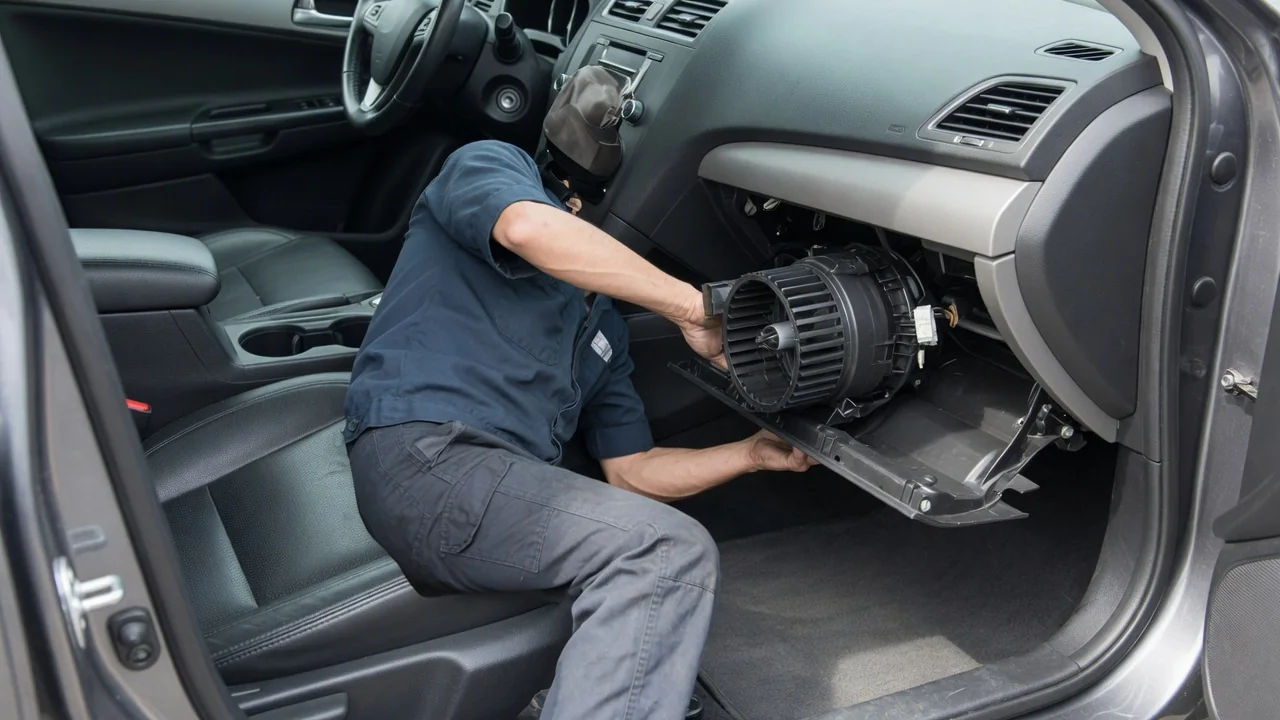
A car blower motor moves cabin air by spinning a fan wheel that draws air in from outside or from the cabin and pushes it through the heating and cooling hardware behind the dashboard. Car blower motor operation comes down to three things: how fan speed is controlled, which path the air follows, and why the system makes the sounds it does. Details vary by vehicle, but the core mechanism is shared by most modern cars.
Fan speed
Most blower motors are 12-volt DC electric motors that drive a centrifugal fan, often called a squirrel-cage wheel. Instead of pushing air straight ahead like a propeller, the wheel's many shallow, curved blades fling air outward from its center as it spins. A spiral-shaped housing, called a scroll or volute, collects that air and guides it toward an outlet. This arrangement builds enough pressure to force air through filters, heat exchangers, and narrow ducts, which a simple propeller fan would struggle to do in the tight space behind a dashboard.
On many vehicles with manual climate controls, fan speed is set by a blower motor resistor. Each lower setting routes current through more resistance, which reduces the voltage reaching the motor and slows the fan. The highest setting commonly bypasses the resistor entirely, sending close to full system voltage to the motor. Because the resistor turns the unused electrical energy into heat, it is usually mounted in the airstream so moving air keeps it cool, and some designs include a thermal fuse that opens if it overheats.
Automatic climate control systems typically use an electronic blower control module or power transistor instead of a fixed set of resistor steps. These devices can vary motor speed smoothly, often by switching power on and off very rapidly, a method known as pulse-width modulation. The climate control computer adjusts fan speed based on inputs such as cabin temperature sensors and the selected target temperature. Some newer vehicles use brushless motors with integrated control electronics. Which approach a particular car uses depends on its design.
Air path
Air enters the system through one of two inlets. In fresh-air mode, it comes from outside, usually through openings in the cowl area at the base of the windshield. In recirculation mode, a recirculation door closes off the outside inlet and opens a passage that draws air from inside the cabin, often near the passenger footwell. Many vehicles place a cabin air filter in this intake stage to trap dust, pollen, and debris, although the exact filter location differs between designs.
After the blower, air is pushed into the HVAC housing. It typically passes through the evaporator core first, where the air conditioning system can cool and dry it. A blend door then sends some or all of that air through the heater core, which is warmed by engine coolant in conventional vehicles, while some vehicles use electric heating instead. The ratio of heated to unheated air sets the outlet temperature. Fan speed controls how much air moves, not how warm or cool it is.
Mode doors then distribute the conditioned air to the dashboard vents, floor ducts, windshield defroster outlets, and, in some vehicles, rear-seat outlets. These doors may be moved by cables or by small electric actuators. Air does not simply build up inside the cabin; it leaves through pressure relief vents, often called body extractors, usually hidden in the rear of the body. Without these exits, cabin pressure would rise and the blower would move noticeably less air.
Noise
Some blower sound is normal. As fan speed rises, more air moves faster through the housing, ducts, and vent grilles, so a steady rushing sound grows louder on higher settings. Turbulence at the vent openings adds to that sound, and switching between fresh-air and recirculation mode or between vent modes can change its character because the air takes a different route.
Abnormal noises often have mechanical causes. Leaves, filter fragments, or other debris that reach the fan wheel can produce ticking, flapping, or rattling that speeds up and slows down with the fan. A fan wheel that is out of balance, whether from buildup or a damaged blade, can cause vibration or humming. Worn motor bushings or bearings may squeal, whine, or grind, and some of these sounds are more noticeable in cold weather. Brushed motors also wear internally over time.
Not every sound behind the dashboard comes from the blower itself. A repeated clicking that continues when the fan is off may come from a door actuator struggling to reach its position. A whistle can indicate a heavily restricted filter or air slipping past a worn seal. A useful first observation is whether the noise changes with fan speed; if it does, the blower assembly or its airflow is the more likely source.
Practical implications and limits
The most direct way an owner affects blower performance is through maintenance. A clogged cabin air filter restricts airflow, which reduces how much air reaches the vents and can make the motor work harder. Replacement intervals are listed in the vehicle's owner's manual and may be shorter in dusty or leafy environments. Keeping the cowl area clear of leaves and debris also reduces the chance of material being drawn into the intake.
Certain symptom patterns are common starting points for diagnosis. On resistor-based systems, a blower that works only on its highest setting frequently points to a failed resistor. A blower that does not run at any setting could involve a fuse, relay, wiring, connector, control module, or the motor itself. A motor that runs only intermittently or starts after a bump may be wearing out. These patterns are not conclusions; confirming the actual cause requires testing according to the vehicle's service information.
There are also limits to what the blower can do. Raising fan speed does not make air colder or warmer on its own; it only moves more of the air the system has already conditioned. Recirculation can help cooling, but it may allow humidity to build inside the cabin, so fresh air combined with air conditioning is generally more effective for clearing fogged glass. Component locations and control strategies vary widely, so consult vehicle-specific instructions before any repair, disconnect power before handling electrical parts, and allow resistors or control modules time to cool.