What Is a Blower Motor Resistor? Fan Speed Control, Heat and Common Faults
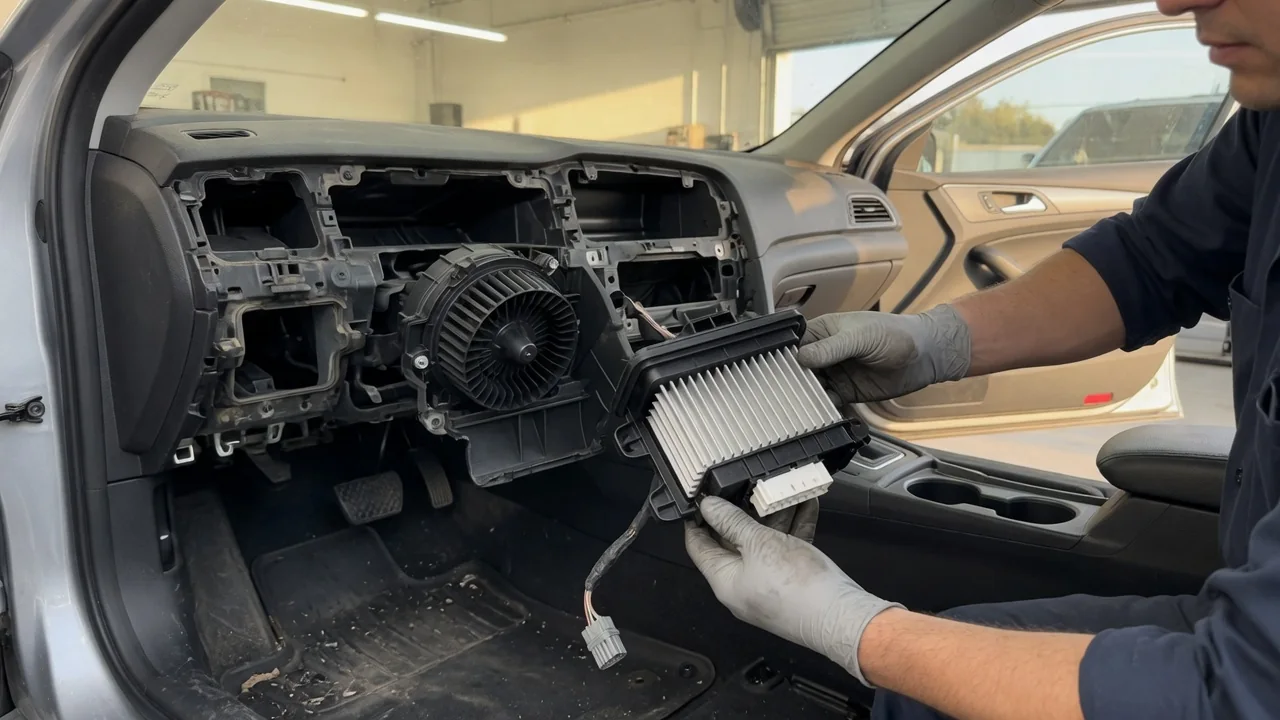
A blower motor resistor is a small electrical component in a car's heating, ventilation and air conditioning (HVAC) system that lets the cabin fan run at more than one speed. When you turn the fan control, the resistor changes how much voltage reaches the blower motor, so airflow rises or falls in steps. Knowing the car blower resistor function explains why fan problems often follow a recognizable pattern and why heat plays such a large role in how this part works and fails.
How the Resistor Controls Fan Speed
The blower motor in most cars is a direct-current motor, and its speed depends largely on the voltage applied to it. Full system voltage makes it spin fast; a reduced voltage makes it spin slower. The resistor pack is how a basic HVAC system creates those reduced voltages. Inside the pack are several resistive elements, which may be wire coils or printed resistive tracks on a ceramic or circuit board. The fan speed switch routes current through different combinations of these elements. On the lowest setting, current passes through the most resistance, so the motor receives the least voltage and turns slowly. Each higher setting routes current through less resistance, raising the voltage at the motor and increasing airflow.
The highest fan setting usually works differently. In many designs it bypasses the resistor entirely, sending full voltage to the motor either directly through the switch or through a separate high-speed relay. This detail matters later, because it means the top speed can keep working even when the resistor itself has failed. The number of available speeds depends on how many resistive steps the pack provides and how the switch is wired, so it varies from one vehicle to another.
Not every vehicle uses a simple resistor pack. Many automatic climate control systems use an electronic blower control module, sometimes called a power transistor or final stage unit, which varies motor speed smoothly rather than in fixed steps. Parts catalogs and owners sometimes call these modules resistors as well, but they work on a different principle. The service information for a specific vehicle is the reliable way to confirm which type is installed.
Why Heat Is Part of the Design
A resistor does not make electrical energy disappear. When it drops voltage to slow the blower motor, the energy that does not reach the motor is converted into heat inside the resistive elements. This is not a side effect that engineers try to eliminate in a resistor-based system; it is simply how this method of speed control works. Whenever the fan runs on a reduced-speed setting, the resistor is shedding energy as heat, and that heat has to go somewhere.
For that reason, blower motor resistors are typically mounted in the air path, often in the HVAC housing or ductwork downstream of the blower fan. The moving air passes over the resistive elements and carries heat away, keeping the part within a safe operating temperature. Many resistor packs also include a thermal fuse or thermal limiter. If the resistor gets hotter than its design allows, this protective element opens the circuit and cuts power to the resistor-routed speeds, helping prevent damage to the surrounding plastic housing and wiring.
Several conditions can push resistor temperature higher than normal. A blower motor with worn bearings, worn brushes or debris in the fan wheel can draw more current, which increases the heat generated in the resistor. Anything that reduces airflow over the resistor reduces its cooling. Poor electrical connections add resistance at the terminals, creating localized heat at the connector rather than in the resistive elements themselves.
Common Blower Motor Resistor Faults
The best-known symptom of a failed resistor is a fan that works only on its highest setting. Because the top speed often bypasses the resistor, it keeps running while the lower speeds, which depend on the resistor, stop working. When only one or two speeds are missing, a single resistive element may have broken open. When every lower speed is dead at once, an open thermal fuse or a break in a shared part of the resistor circuit is a common explanation.
Connector damage is another frequent fault. Heat at a loose or corroded terminal can discolor or melt the connector body and burn the terminals, sometimes causing intermittent fan operation before the circuit fails completely. Moisture can also be a factor, since the HVAC housing deals with condensation and can be exposed to water leaks, and corrosion on the resistor or its terminals can interrupt current flow.
Some fan problems point away from the resistor. If the fan does not run at any setting, including high, the cause is more likely a fuse, relay, switch, wiring fault, poor ground or the motor itself. In vehicles with an electronic control module, erratic speeds, a fan stuck at full speed or a fan that keeps running with the ignition off suggest a module or control signal problem rather than a resistor pack fault. A general diagnostic approach is to check the relevant fuse, measure voltage at the blower motor on each setting, and compare resistance across the resistor terminals with the values listed in the vehicle's service manual.
Practical Implications and Limits
Replacing a failed resistor fixes the symptom, but it does not always fix the cause. If a worn blower motor is drawing excess current, a new resistor may be subjected to the same overheating and can fail again. A connector that has already been heat-damaged can continue to cause poor contact and further heat even after the resistor is replaced, which is why some repair procedures call for replacing the damaged connector at the same time. Looking at the condition of the motor and wiring before installing a new part helps avoid repeat repairs.
Location and access differ widely between vehicles. The resistor is often reached from the passenger footwell area or behind the glove box, but the only dependable guide is the procedure for the specific vehicle. The part can be hot right after the fan has been running, and the service manual may call for disconnecting power before work. Bypassing a thermal fuse or wiring the fan directly to power removes a protective feature and can create a fire risk, so it is not a sound workaround.
Finally, it helps to recognize the built-in limits of resistor-based control. It offers only a fixed number of speed steps, and it turns part of the electrical energy into heat instead of airflow. Those trade-offs are one reason electronic blower control is common in automatic climate systems. Neither approach is universally better for every vehicle, but knowing which one your car uses makes it much easier to interpret fan symptoms correctly.