How Does a Ventilated Seat Fan Move Air? Channels, Perforations and Noise
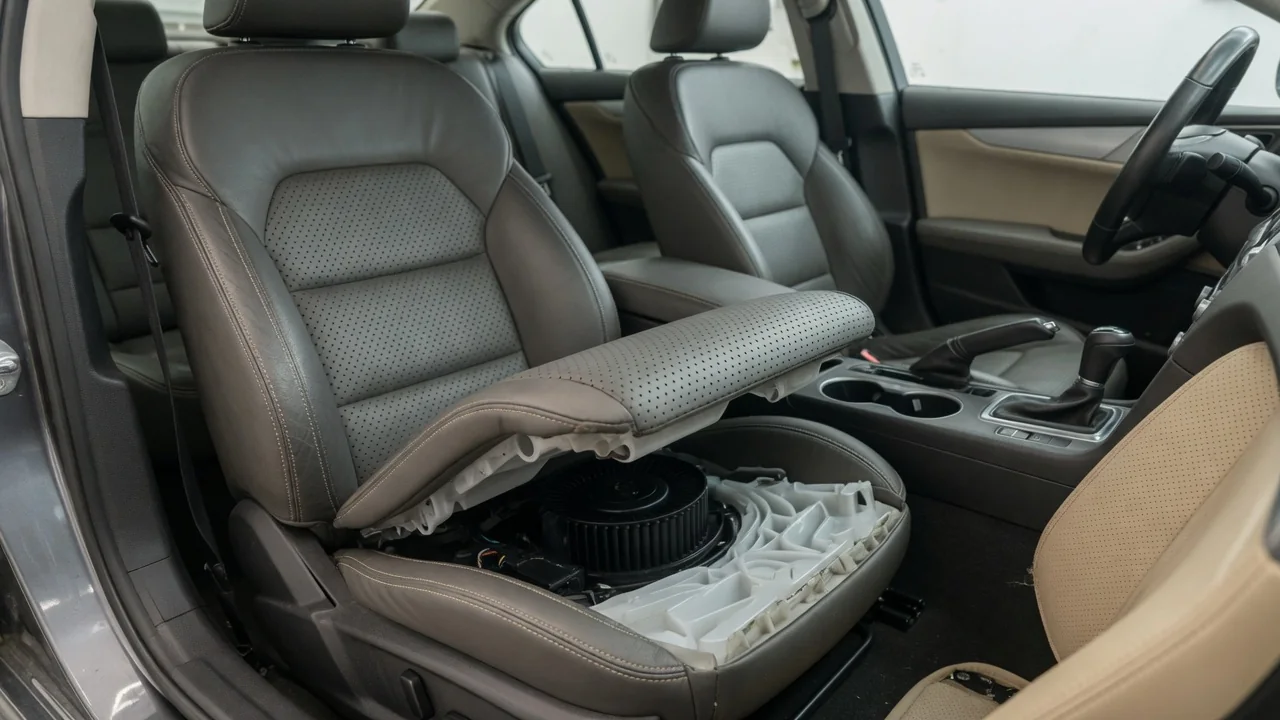
A ventilated seat keeps the contact area between your body and the upholstery from trapping heat and moisture. It does this with one or more small electric fans hidden inside the seat cushion and seatback. How a ventilated seat fan moves air comes down to three parts working together: the internal air channels that distribute the flow, the perforations that let air reach or leave the surface, and the fan behavior that determines how much noise you hear.
Air Channels: How Flow Travels Through the Seat
In a typical design, a compact fan is mounted on the underside of the seat cushion, and another is mounted on the rear of the seatback. Many of these units are centrifugal blowers, which draw air in along the axis of a spinning impeller and fling it outward into a housing. That builds pressure, which helps push air through dense seat materials. Other designs use axial fans, which work more like a small computer cooling fan. The fan type, the number of fans and their exact locations vary by vehicle and seat design.
A single fan outlet cannot spread air evenly across a large seating surface on its own, so the seat contains a distribution path. Depending on the design, this can be grooves or tunnels molded into the foam, a chamber beneath the main seating area, or a layer of spacer fabric, a springy three-dimensional mesh that stays open even under body weight. Air leaves the fan, spreads sideways through this open structure, and then moves toward the surface through the layers of the trim cover.
Systems also differ in airflow direction. Some push cabin air up through the seat toward the occupant, creating a gentle breeze at the surface. Others reverse the flow, drawing warm, humid air away from the body and exhausting it beneath or behind the seat. Both approaches rely on air from the cabin, so ventilation alone moves air at roughly cabin temperature. Designs that actively chill the air add separate components, such as thermoelectric modules or a connection to the climate system. The owner's manual or service information for a specific vehicle is the place to confirm which approach it uses.
Perforations: Where Air Meets the Occupant
The trim cover is the last barrier between the airflow and the person in the seat. Ventilated seats generally use perforated leather, perforated synthetic leather or a breathable textile so air can pass through the surface. The perforations are small holes arranged in patterned zones, usually concentrated where the body makes the most contact, such as the center of the cushion and the middle of the backrest. Side bolsters and edges are often left solid, because they need little ventilation and unperforated material there tends to hold up better to wear.
Perforations only work if the layers behind them are also open. Between the cover and the distribution layer there is usually thin padding or a backing material that must let air through. If a cover is replaced with non-perforated material, or a dense backing is added during reupholstering, the fan may still run while the surface feels far less effective. The same applies to aftermarket seat covers laid over a ventilated seat: an airtight or heavily padded cover can block much of the flow the system was designed to deliver.
Because the holes are open, they can collect dust, crumbs and dried cleaning residue over time. Partially clogged perforations increase resistance to airflow, reducing how much air reaches the surface and potentially changing how the fan sounds. Cleaning methods intended for perforated upholstery help keep the holes clear without forcing liquid down into the foam and electrical parts below.
Noise: What You Hear and What It Means
Any fan moving air makes some sound, and in a quiet cabin a car seat ventilation fan can be noticeable. Most systems offer several speed settings. Higher settings move more air but also produce more audible rushing as air passes through narrow passages and around the impeller. A steady hum or airflow sound that rises with the speed setting is generally normal operation rather than a sign of a fault.
Changes in sound tend to be more informative than the sound itself. A higher pitch or louder rushing at a familiar setting can suggest increased restriction, for example from blocked perforations, a compressed distribution layer or something obstructing the fan intake under the seat. Clicking, ticking or scraping often points to debris, such as a coin, paper or a pen cap, touching the impeller. Grinding or rattling that continues after debris has been ruled out can indicate a worn fan bearing or a loose mounting. Intermittent operation or complete silence can trace back to the fan motor, wiring, connectors or the control module, which is why diagnosis should follow the procedure for the specific vehicle.
Practical Implications and Limits
In everyday driving, seat ventilation tends to be most useful against the sticky, sweaty feeling that builds on long trips, because moving air helps moisture evaporate from skin and clothing. It is less able to make a seat feel cold when the cabin itself is hot. Running the air conditioning first and then switching on seat ventilation gives the fans cooler air to work with.
The fan intakes need room to draw air. Floor mats bunched up beneath the seat, bags pushed under it or items wedged against the seatback can starve a fan of air. Clearing that area is a simple, low-risk step before assuming a part has failed. Liquid spills deserve prompt attention as well, since moisture that soaks through the surface can reach the foam layers and electrical components.
Repairs come with their own limits. Seat fans are usually replaceable parts, but reaching them often means removing the seat and sometimes separating the trim cover. Many seats also contain side airbags, occupant detection sensors or heating elements, which call for correct service procedures. Because fan type, placement, control logic and any added cooling hardware differ between manufacturers, a general explanation describes how these systems work rather than exactly how a particular seat is built. For model-specific details, the vehicle's owner's manual and service documentation remain the authoritative references.