What Is a Mechanical Cooling Fan? Belt Drive, Airflow and Clutches Explained
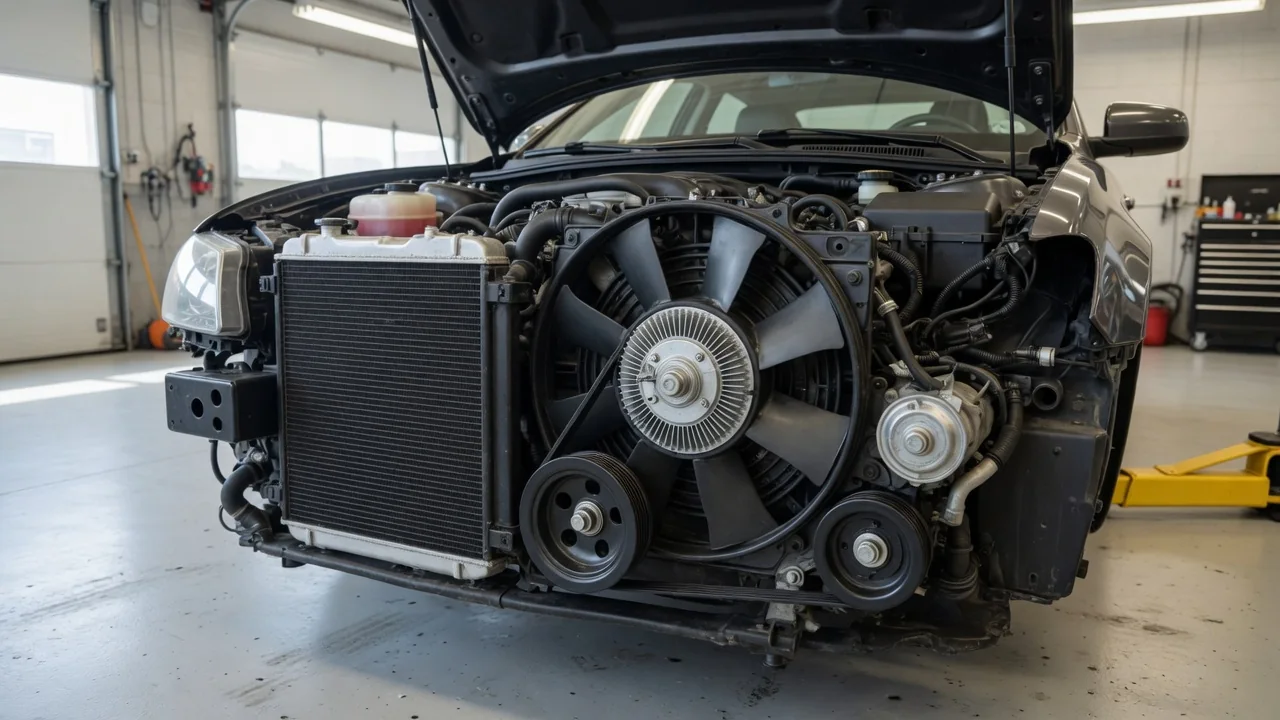
A mechanical cooling fan is a radiator fan driven by the engine rather than by an electric motor. It is often called an engine driven cooling fan. It turns whenever the crankshaft turns, using a belt and pulley, and it pulls air through the radiator. The design is common on older cars, on many rear-wheel-drive vehicles with front-to-back engine layouts, and on many trucks. Its performance depends on three things: how it is driven, how it moves air, and how its clutch behaves.
Belt Drive: How the Engine Turns the Fan
The fan usually mounts on the front of the water pump. It is either bolted to the pump's pulley hub or attached through a fan clutch that threads or bolts onto the pump shaft. A belt from the crankshaft pulley drives the pump pulley, so the fan and pump rotate together. Older engines typically use one or more V-belts. Later designs often use a single serpentine belt that also drives accessories such as the alternator, power steering pump, and air conditioning compressor. On some engines the fan sits on a separate bracket instead of the pump, but it works the same way.
Because the connection is mechanical, fan speed follows engine speed. Pulley diameters set the relationship between the two. A smaller pump pulley relative to the crankshaft pulley spins the fan faster at a given engine speed, while a larger one slows it. The manufacturer chooses this ratio to balance cooling against noise and power consumption, and it varies between engines. Belt condition also matters. A glazed, cracked, or loose belt can slip under load, which slows the fan and water pump exactly when cooling demand is high. Some installations add a spacer between the hub and the fan to place the blades correctly relative to the radiator and shroud.
Airflow: Moving Air Through the Radiator
Most mechanical fans are pullers. They sit between the radiator and the engine and draw air rearward through the radiator core. Blade count, blade pitch, and diameter determine how much air the fan moves at a given speed. They also determine how much noise it makes and how much power it absorbs. Some fans use flexible blades, often called flex fans, which flatten as speed rises. This reduces drag at higher engine speeds but keeps a steeper pitch at idle, when the fan does most of its useful work.
The fan shroud is as important as the blades. Without a shroud, a fan mainly pulls air through the circular area its blades sweep, and it can recirculate warm air around the blade tips. A shroud seals the space between the fan and the radiator, so air is drawn across more of the core. Blade position within the shroud opening affects efficiency. Follow the service information for the specific engine when fitting a fan, spacer, or shroud.
How much the fan matters depends on vehicle speed. At highway speeds, air forced through the grille by the vehicle's motion often supplies much of the radiator's airflow, and the fan contributes less. At idle, in slow traffic, while towing, or with the air conditioning running, the fan becomes the main source of airflow. That is why fan problems usually show up first as a rising temperature gauge when the vehicle is stopped or moving slowly.
Clutch Variation: Rigid, Viscous, and Controlled Fans
The simplest arrangement is a rigid, or direct-drive, fan bolted solidly to the pump hub. It always turns at pulley speed, so it moves air whether the engine needs it or not. It is mechanically simple, but it draws power continuously and can be noisy at higher engine speeds.
Many engine driven fans use a viscous fan clutch instead. Inside the clutch, a silicone fluid transmits torque between the driven body and the fan side and allows controlled slip. A thermostatic viscous clutch has a bimetallic spring or strip on its front face that senses the temperature of the air leaving the radiator. When that air is cool, the clutch limits the fluid in its working area, so the fan slips and turns slower than the pulley. As the air warms, the clutch admits more fluid and the fan engages more fully. A non-thermal viscous clutch has no temperature sensor. It simply slips more as speed rises, which limits the fan's top speed. Many owners notice a brief fan roar right after a cold start. This is often normal while the fluid redistributes, though the behavior varies by design.
Some later vehicles use an electronically controlled viscous clutch. The engine control module regulates engagement through a solenoid and often monitors fan speed. Some heavy-duty trucks use on/off fan clutches, often air-actuated, that either lock the fan to the drive or release it completely. Which type a vehicle has, and how it is meant to engage, is specific to that engine; check its service documentation.
Practical Implications and Limits
A mechanical fan provides direct, dependable airflow without an electric motor, relay, or wiring, and it can move substantial air at idle on engines that need it. The trade-offs are power drawn from the engine, noise, and the fact that it stops when the engine stops. Its speed is tied to engine speed, not coolant temperature. At a slow idle in extreme heat, it may move less air than the cooling system needs. At high engine speed, a rigid fan may move more air than necessary.
Wear in one part affects others. The fan's weight and any imbalance load the water pump bearing. A bent or cracked blade, a loose clutch, or excessive wobble should be fixed promptly, because damaged blades can break off at speed. A viscous clutch that loses fluid, or whose thermostatic control fails, may slip too much and cause overheating at idle. It may also stay locked, causing a constant roar and worse fuel economy. Diagnose problems using the vehicle's service procedure, since normal free-spin and engagement feel differ between designs.
Safety deserves emphasis. The fan spins whenever the engine runs, regardless of temperature, so keep hands, tools, clothing, and hair clear of the blades and belt. Avoid standing in line with the fan when revving the engine. Swapping a mechanical fan for electric fans, or changing the blade type, pulley size, or clutch, changes airflow and load. The results depend on the specific vehicle, radiator, and use. Evaluate any such change against that vehicle's cooling needs rather than assuming it is an improvement.