How Do Rear Cabin Vents Get Air? Duct Routing, Fan Supply and Balancing
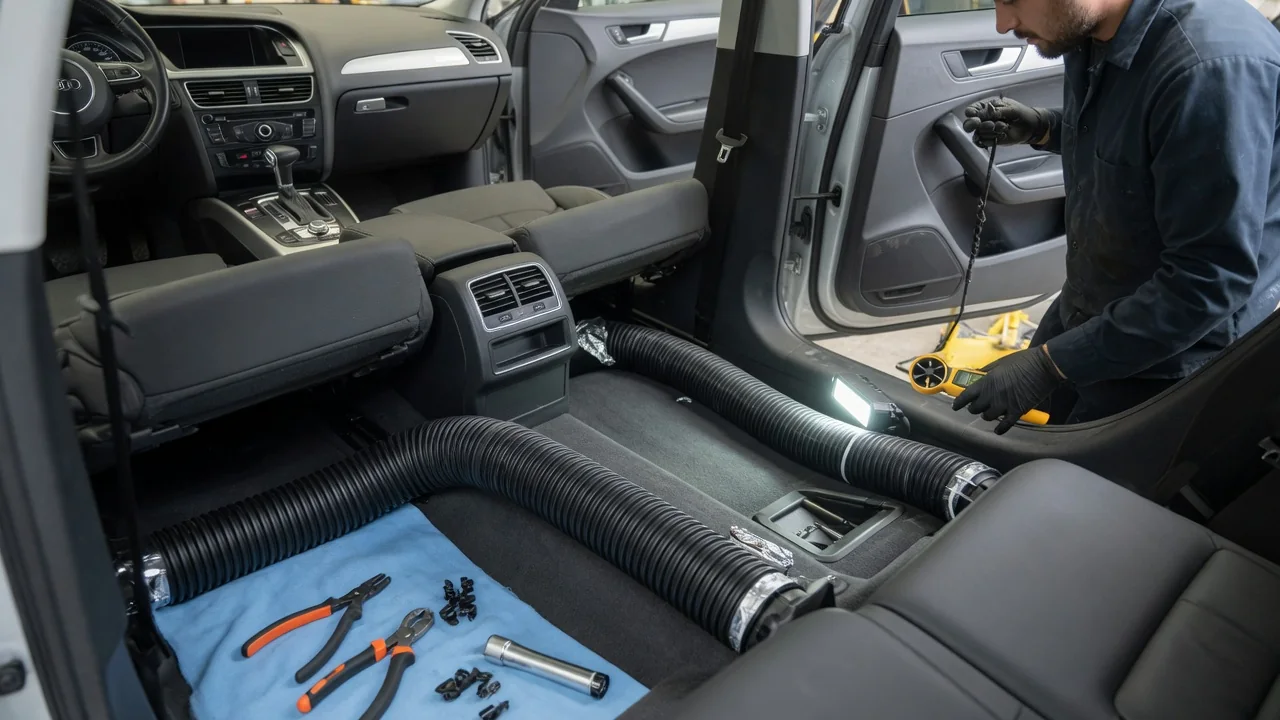
In most cars, rear cabin vents do not make their own air. They are the far ends of a duct network that starts at the main heating, ventilation, and air conditioning module behind the dashboard. There, a single blower pushes air through the cabin filter, the evaporator, and the heater core. How much of that air reaches the back seat depends on three things: the path the ducts take, how the fan supplies them, and how the system divides flow between outlets.
Duct routing: the path from dashboard to back seat
The HVAC module sits behind the instrument panel, and its outlet side splits into several branches. Doors inside the module, usually called mode doors, decide which branches receive air: the panel vents, the floor outlets, or the defroster. Rear outlets connect to these same branches rather than to a separate source. A rear console vent is typically fed from the panel side of the module, so it delivers air when the system is set to a face or bi-level mode. Rear floor outlets are typically fed from the floor side, so they are most active in floor and mixed modes.
The car rear vent duct path has to pass through a crowded space. A common route runs from the bottom of the module down along the transmission tunnel, under or inside the center console, and ends at an outlet on the back of the console. Floor ducts often run beneath the carpet or under the front seats, sometimes as flat molded channels shaped to fit the floor pan. Vehicles with tall cabins may instead route air through the pillars or along the roof to outlets in the headliner. A long vertical or overhead run reaches third-row passengers more easily than a floor duct would.
Larger vehicles such as three-row SUVs and passenger vans may add an auxiliary rear unit, usually mounted in a rear quarter panel or under the floor. This unit has its own blower and often its own evaporator and heater core. Additional lines connect it to the main refrigerant and coolant circuits. In that design the rear vents are fed locally, and the front module supplies only part of the rear airflow, if any. Whether a given vehicle uses shared ducts, a rear unit, or both is a design choice that the owner's manual or service information can confirm.
Fan supply: where the airflow pressure comes from
In a shared-duct system, the front blower is the only source of pressure for every outlet, including the ones in the back. This blower is usually a centrifugal fan, often called a squirrel-cage wheel. That type is well suited to pushing air against the resistance of a filter, two heat exchangers, and long ducts. Its speed is set either by a resistor pack that gives a few fixed steps or by an electronic power module that varies speed more smoothly, often under automatic climate control. At low fan settings, little pressure is left at the end of a long duct, so the rear outlets feel weak sooner than the front ones.
The blower also determines where the air comes from. In fresh-air mode it draws from the cowl area at the base of the windshield, and in recirculation mode it draws from inside the cabin. Either way, the air passes the cabin air filter before it reaches the fan. A heavily loaded filter therefore reduces total output, and every branch, front and rear, shares the loss. Systems with an auxiliary rear unit add a second blower with its own speed control. That is why some vehicles provide separate rear climate controls or let the driver lock them out.
Balancing: how airflow is divided between front and rear
Air follows the path of least resistance, and the duct to the back seat is longer and usually has more bends than the short run to the dashboard vents. Without compensation, most of the flow would leave through the nearest outlets. Engineers balance the system by sizing duct cross-sections, shaping transitions, and sometimes adding restrictions so that each branch receives an intended share at typical fan speeds. Exhaust vents, often hidden behind the rear bumper or in the rear quarter area, let air leave the cabin. Without them, pressure would build up inside and hold back the incoming flow.
Temperature balance matters as much as volume. Air in a long duct can gain or lose heat to the surrounding floor, console, or body panels, so rear outlets may run slightly warmer or cooler than the front ones. Some systems address this with separate blend doors for the rear branch or with dedicated rear temperature control. At the outlet itself, louvers and thumbwheel shutoffs give passengers the final say. Closing one outlet raises resistance in that branch and tends to push some of the flow toward the others, though the exact effect depends on the duct layout.
Practical implications and limits
Knowing the feed path helps explain common complaints. If the rear console vent is weak only in floor or defrost mode, that is often normal, because those modes may close the panel branch that supplies it. If rear airflow is weak in every mode while the front is strong, check these likely causes: • a closed or broken outlet shutoff; • a duct joint that has separated under the console; • a floor duct crushed by cargo or a seat rail; • objects under the front seats blocking floor outlets; If the vehicle has an auxiliary unit, its blower, controls, and fuse are separate items to check.
A few habits help the rear seats get more air. Running the fan a step higher gives long duct runs more pressure to work with. Choosing a mode that opens the branch feeding the rear outlets matters more than adjusting the louvers alone. Keeping the area under the front seats clear helps the floor outlets. Replacing the cabin filter at the interval in the owner's manual helps preserve total flow to every seat.
General principles only go so far. Duct routes, mode-door logic, outlet locations, and whether a rear unit exists all vary between vehicles, and even trims of the same model can differ. Diagnosing a fault inside the dashboard or console usually requires the vehicle's service information, because access often means removing trim panels or the console itself. This overview explains how rear vents get air in general; check the documentation for your vehicle before taking anything apart.