Why Do Wheels Turn at Different Angles in a Corner?
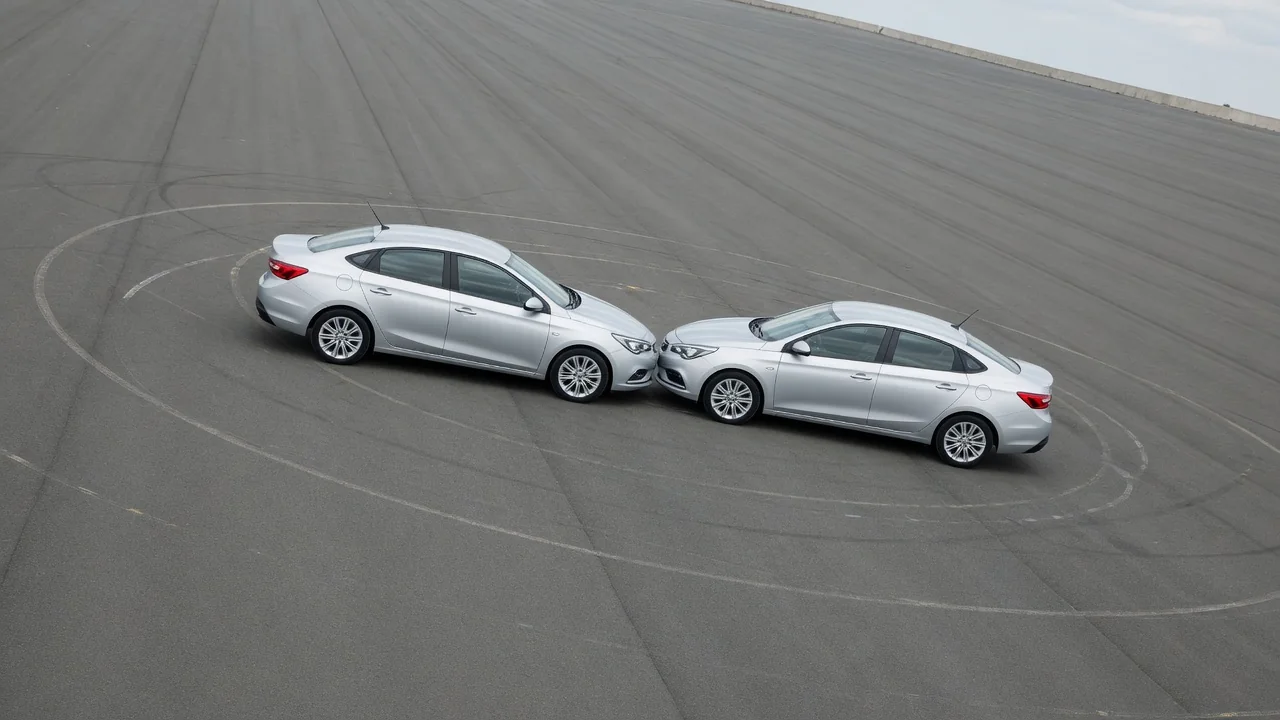
When you turn the steering wheel, the two front wheels do not point in exactly the same direction. The inner wheel turns more sharply than the outer one, and that difference is deliberate. It comes from simple geometry: in a corner, each front wheel travels around a different circle. This article explains why the wheels turn at different angles in a corner, how the steering linkage creates that difference, what happens to tires when the geometry is off, and where the general principle stops applying.
Turning radii
Picture a car making a slow turn in an empty parking lot. All four wheels move around a common center point located off to the side of the car, on the inside of the turn. For the tires to roll cleanly without being dragged sideways, each one should roll in a direction perpendicular to an imaginary line drawn from that center point to the tire. Because the inner front wheel sits closer to the center, it travels on a smaller circle than the outer front wheel. To stay tangent to its tighter circle, the inner wheel has to be turned to a larger angle than the outer wheel.
On a conventional car, the rear wheels do not steer, so the turn center has to lie on a line extending sideways from the rear axle. The ideal front steering angles are the ones whose wheel axis lines, extended inward, meet at that same point. This arrangement is known as Ackermann steering geometry, named after Rudolph Ackermann, who patented the concept in the early 1800s on behalf of its inventor, Georg Lankensperger. The required gap between inner and outer wheel steering angles depends on the vehicle's proportions. A wider track or a shorter wheelbase calls for a larger difference at a given turn radius. During gentle steering inputs the difference is small, but near full lock it becomes significant.
Link geometry
The steering system creates this difference mechanically rather than through any active control. Each front wheel has a steering arm attached to its knuckle, and the arms are connected by a tie rod or, on a rack-and-pinion system, by two tie rods running to the ends of the rack. In the classic layout, the steering arms are not parallel to the car's centerline. Viewed from above, they angle inward, and a common rule of thumb places the extended lines of both arms meeting near the center of the rear axle. Together with the tie rod, the arms form a trapezoid rather than a rectangle.
When the wheels are steered, that trapezoid distorts. Because the arms start at an angle, equal sideways movement at the tie rod ends does not produce equal rotation at each knuckle. The arm on the inside of the turn rotates through a larger angle, while the arm on the outside rotates through a smaller one. The effect grows as steering angle increases, which matches what the turning circles require.
Linkage geometry only approximates the ideal. A trapezoid can match true Ackermann closely over part of the steering range, but not perfectly at every angle. Rack position, tie rod length and arm placement all shift the result, so engineers choose a compromise rather than the textbook layout. Some vehicles use less than full Ackermann, often described as a percentage of the ideal. Some racing setups use parallel or even reverse Ackermann, because at high cornering forces the tires run at slip angles and the heavily loaded outer tire may work better at an angle that pure low-speed geometry would not suggest. The right choice is specific to each vehicle and its intended use.
Tire wear
When the inner and outer angles do not suit the path the car is actually taking, at least one front tire is forced to slide partly sideways while it rolls. This is called scrub. A small amount during tight, slow maneuvers is a normal consequence of compromise geometry, but persistent or excessive scrub wears tread faster and can leave irregular patterns. Common signs include feathered tread ribs, where one edge of each rib feels sharper than the other, and wear concentrated on the shoulders of the front tires. These patterns overlap with other alignment problems, such as incorrect static toe, so wear alone does not prove a turning-angle fault.
Alignment technicians check this relationship with a measurement often called toe-out on turns, or turning angle. With the front wheels resting on turntables, one wheel is steered to a reference angle specified for the vehicle, and the angle of the opposite wheel is read and compared with the specification. Because the difference comes from the fixed shape and position of the steering arms, there is usually no direct adjustment for it. An out-of-spec reading typically points to a bent steering arm, knuckle or related component, often after a curb strike or other impact. Static toe can look correct while toe-out on turns is wrong, which is why a straight-ahead alignment by itself may not explain uneven wear.
Practical implications and limits
For everyday driving, the takeaway is that differing steering angles are a design feature, not a defect, and owners generally cannot see or feel them directly. Some front tire noise or slight hop at full lock on dry, grippy surfaces, such as smooth parking garage floors, can occur even on a healthy vehicle, because no linkage matches the ideal at every angle. Clicking or grinding is a different symptom and usually points elsewhere. A change in how the car behaves at full lock, a steering wheel that sits off center after an impact, or newly uneven front tire wear is a better reason for inspection than ordinary low-speed tire noise.
Modifications can alter the relationship. Substantial ride height changes, lift or lowering kits, aftermarket steering arms or tie rods, and wheels with a different offset may change how the linkage moves or how the tires meet the road. Whether that matters, and by how much, depends on the specific suspension design and should be judged against the manufacturer's alignment data for that vehicle.
The principle also has limits. Ackermann geometry describes low-speed rolling without slip. At highway speeds steering angles are small, the angle difference becomes minor, and tire slip angles, suspension compliance and load transfer dominate handling. Vehicles with rear-wheel steering, or with chassis layouts that differ from the conventional front-steer design, place the turn center elsewhere, so the simple rear-axle rule does not apply to them in the same way. For any particular car, the service manual's specifications remain the reference.