What Is a Manual Steering Box? Gears, Linkages and Wear Explained
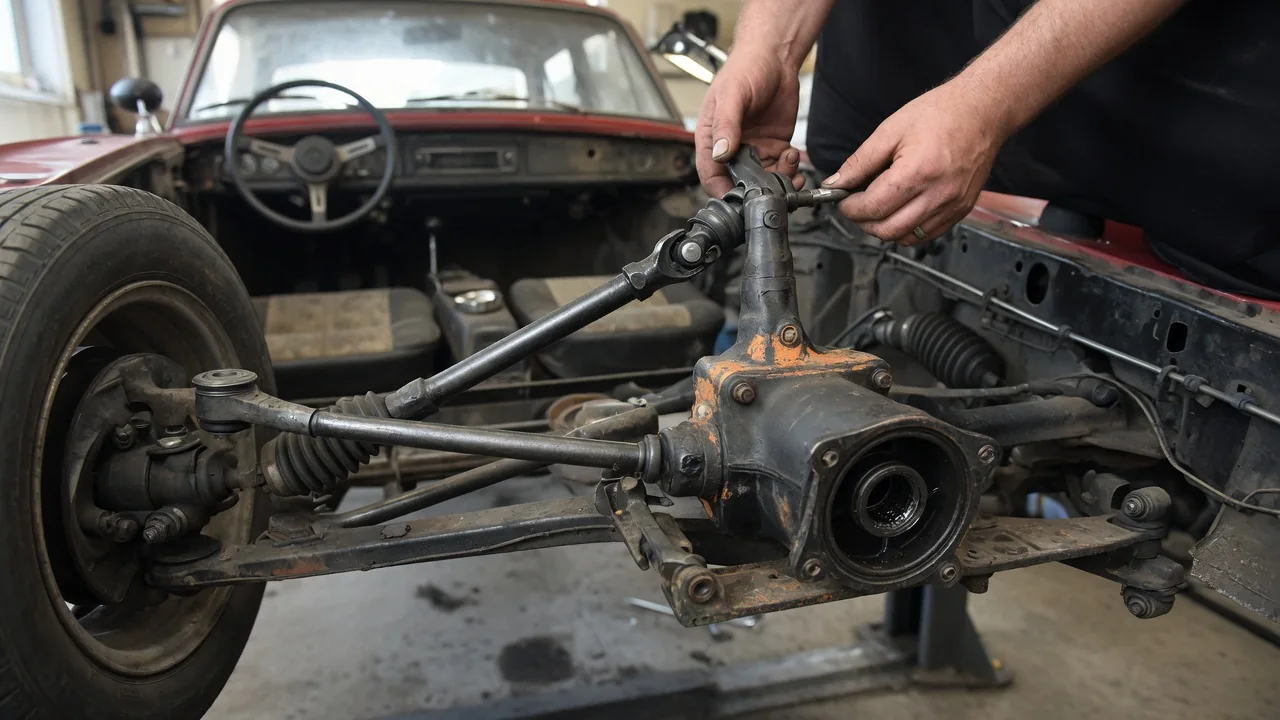
A manual steering box is the gear unit that converts the rotation of the steering wheel into the motion that turns a vehicle's front wheels, without hydraulic or electric assistance. It was common on classic cars and trucks and remains on many original and restored vehicles. Understanding a classic car steering box means looking at three things: the gears inside the housing, the linkages that carry its motion to the wheels, and the wear that gradually adds play and changes how the car steers.
Gear mechanism
Inside the housing, the steering shaft ends in a worm, a gear cut with a spiral thread. When the driver turns the wheel, the worm rotates in place. Meshing with it is an element connected to the output shaft, often called the sector shaft or cross shaft. Because the worm's thread works like a screw, a full turn of the steering wheel produces only a small rotation of the sector shaft. This reduction multiplies the driver's effort, which is how a manual box makes it possible to turn heavy front wheels without power assistance.
Several designs have been used. In worm and sector or worm and roller arrangements, the output member engages the worm directly; the roller version uses a rotating element to reduce sliding friction. Cam and lever designs use a peg or stud that follows a spiral groove. The recirculating ball type, widely used on larger vehicles, places a nut on the worm with steel balls running in the grooves between them. As the worm turns, the balls roll and circulate through a return guide, moving the nut along the worm. Teeth on the outside of the nut mesh with a toothed sector, turning the output shaft with relatively low friction.
The ratio between steering wheel rotation and sector rotation is set by the gear geometry and varies by application. Some boxes are built with a variable ratio, while many classic units use a constant one. The housing is filled with lubricant and sealed where the shafts exit, and it usually includes provisions for adjusting the worm bearings and the mesh between the worm or ball nut and the sector.
Linkages
The sector shaft exits the box and carries the pitman arm, a lever splined to the shaft. When the sector rotates, the pitman arm swings in an arc. The steering linkage turns that arc into motion that pivots each front wheel around its steering axis, acting through the steering arms attached to the spindles or knuckles.
On many cars with independent front suspension, a parallelogram linkage is used. The pitman arm drives one end of a center link, while an idler arm mounted to the frame supports the other end and mirrors the pitman arm's movement. Tie rods connect the center link to each steering arm, and threaded adjusting sleeves on the tie rods are used to set toe. On vehicles with a solid front axle, a common layout uses a drag link running from the pitman arm to a steering arm on one knuckle, with a single tie rod connecting both knuckles so they turn together.
Every connection in the linkage relies on a pivoting joint, usually a ball socket in a tie rod end or similar fitting, along with bushings or bearings at the idler arm. These joints must allow movement as the suspension travels and the wheels steer, yet hold the parts closely enough that steering input reaches the tires without delay. The steering box itself is bolted to the frame or body structure, so its mounting is also part of the load path.
Wear
The most familiar sign of wear is free play: the steering wheel moves some distance before the front wheels respond. Inside the box, play develops as gear teeth, balls, grooves, rollers and bearings wear, and as worm bearing preload loosens. Wear tends to concentrate in the center of travel, because that is where the gears spend most of their time during straight-ahead driving. As a result, a box can be noticeably looser at center than near the ends of its travel.
Most manual boxes have an adjuster, often a screw and locknut on the housing, that changes how tightly the sector meshes with the worm or ball nut. Many designs are built so the mesh is tightest at center, which allows some compensation for wear there. However, if center wear is significant, tightening enough to remove the slack can make the gears bind away from center. Worm bearing preload is a separate adjustment on many units. Adjustment sequences and values are specific to each box, so the vehicle's service manual is the reference.
Outside the gears, seals at the input and sector shafts can harden and leak, letting lubricant escape and contamination enter, which speeds internal wear. In the linkage, worn tie rod ends, idler arm bushings and drag link sockets add their own play, and loose or cracked box mounting can let the whole unit shift under load. The looseness a driver feels is the sum of all of these sources.
Practical implications and limits
Driving with a manual steering box means effort changes with speed. At walking pace or when parking, the tires scrub against the surface and the wheel can feel heavy; once the car is rolling, effort usually drops considerably. Factors outside the box, such as tire width and pressure, front-end weight and alignment settings like caster, also influence steering weight, so a stiff wheel does not automatically indicate a box problem. A quicker ratio would demand more force at the wheel, which is why manual boxes have often been paired with slower ratios and more turns lock to lock than power-assisted designs.
When diagnosing free play, it helps to separate the sources. With the engine off and the wheels on the ground, a helper can rock the steering wheel slightly while someone watches the input shaft, the pitman arm and each joint in turn. Movement at the input shaft with no matching pitman arm movement points to the box; movement across a joint points to that joint. Hard steering or a wheel that does not return toward center can come from an overtightened box, dry or seized joints, or a binding column, not only from gear wear.
Adjustment has limits. It can take up modest, even wear, but it cannot restore pitted or chipped gear surfaces, and overtightening to chase play can cause binding, a notchy feel and faster wear. Badly worn boxes are typically rebuilt or replaced. Because designs, ratios and procedures differ between vehicles, specific values and steps should come from the documentation for the car in question rather than from general rules.