Why Do Some Old Cars Have Non-Synchronized Gears?
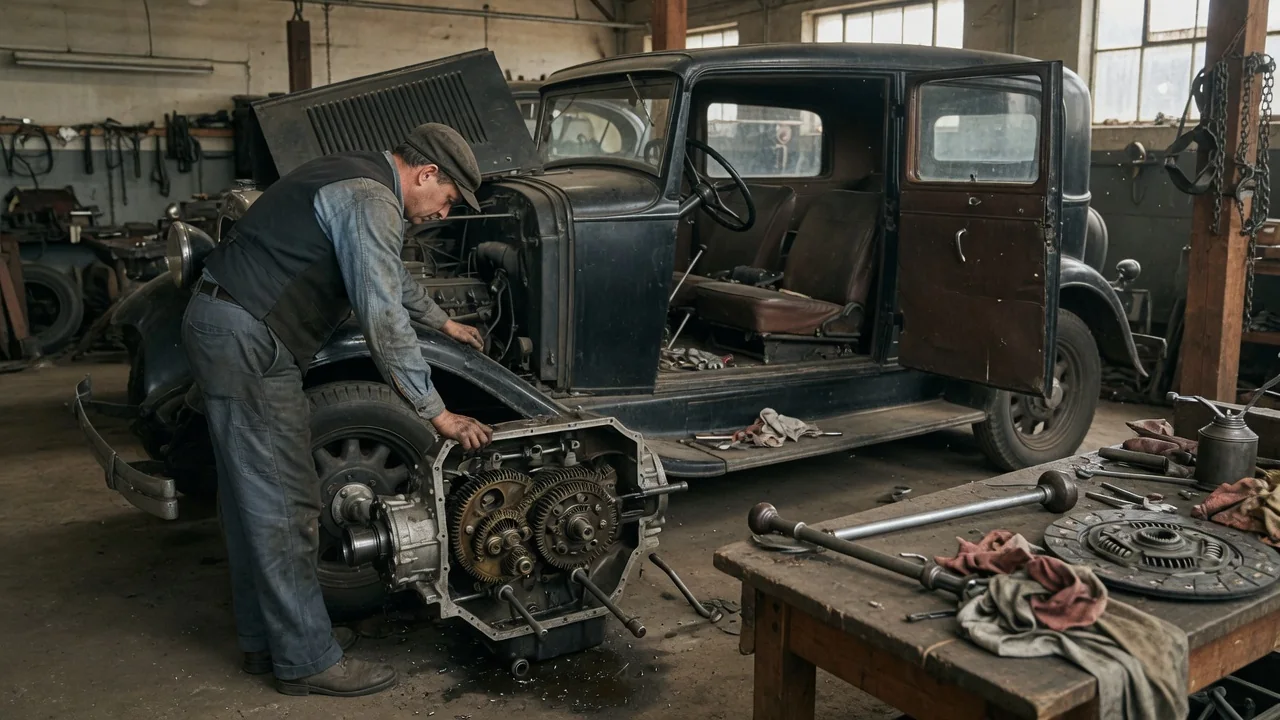
Many early cars were built without synchronizers, and some later ones lacked them in their lowest gears. Synchronizers are the small friction devices that make modern manual shifting easy. Without them, the gearbox relied on the driver to bring the rotating parts to matching speeds before the gears engaged. Understanding why some old cars have non-synchronized gears comes down to three things: how gear-speed matching works, what technique the driver must supply, and how mistakes show up as wear inside a non synchronized manual gearbox.
Gear-speed matching
A manual gearbox connects two sides that can turn at different speeds. The engine drives the input side through the clutch. The output side is tied to the driveshaft and, ultimately, the road wheels. Each gear ratio requires a different relationship between those two speeds. When the driver selects a new gear, the part being engaged must turn at the same speed as the part it is meeting. That part may be a sliding gear or a set of dog teeth on a collar. If the speeds differ, the teeth strike each other instead of slipping cleanly into place. This produces the grinding or clashing sound associated with older transmissions.
A synchronizer solves this mechanically. Before the engagement teeth meet, a friction cone drags the two parts toward a common speed, and a blocking ring prevents engagement until the speeds match. Early gearboxes did not have this step. Some used sliding-mesh designs, in which whole gears moved along a shaft into mesh with their partners. Others used constant-mesh gears locked to the shaft by simple dog clutches. Both approaches were mechanically straightforward and used fewer parts. They also asked less of manufacturing precision, which suited the materials and production methods available when they were common. Synchronizers were adopted gradually. Even after they became widespread, some designs left first gear and reverse unsynchronized, because those gears are normally selected while the car is stopped.
When the clutch is released for a shift, nothing actively controls the speed of the input shaft and the gears attached to it. They coast, and how quickly they slow depends on their own inertia, on bearing drag and on the oil they turn through. The output side, meanwhile, keeps turning with the wheels. In a non-synchronized box, closing that speed gap is the driver's job, done with the clutch, the throttle and careful timing.
Driver technique
The classic method is double-clutching, sometimes called double-declutching. For an upshift, the driver presses the clutch and moves the lever to neutral, then releases the clutch briefly. The driver then presses the clutch again and selects the higher gear. The pause in neutral lets the input side slow toward the speed the higher gear will need. At the same road speed, a higher gear turns the input shaft more slowly, so the shaft has to lose speed before engagement. Waiting is how that happens.
Downshifts need the opposite correction. A lower gear requires the input side to spin faster. The driver presses the clutch, shifts to neutral, releases the clutch and blips the throttle to raise engine speed. In neutral with the clutch released, the engine is connected to the input shaft, so the extra revs spin up the gears inside. The driver then presses the clutch again and moves the lever into the lower gear. How much throttle is needed depends on the road speed, the ratio gap between gears and the particular engine. The right amount is therefore learned by feel and sound rather than by a fixed rule.
Good technique also means not forcing the lever. If the teeth refuse to engage or begin to grind, return to neutral and correct the speed rather than pushing harder. Selecting a gear from a standstill has its own quirk. The input shaft may still be spinning just after the clutch is pressed, so drivers often wait a moment before engaging first or reverse. Details vary between designs, so the owner's manual or service literature for a particular vehicle is the best guide to its recommended procedure.
Wear
Every clash puts a sharp impact load on the leading edges of gear teeth or dog teeth. Occasional minor clashes may cause little visible harm, but repeated grinding can chip, round or burr those edges. Rounded engagement teeth hold less securely, and in some gearboxes this contributes to a gear jumping out of engagement. Fragments broken from teeth also circulate in the oil, where they can damage bearings and other gears.
There is a trade-off here. A non-synchronized gearbox has no synchronizer rings to wear out, and worn synchronizers are a common reason later manual gearboxes become difficult to shift. In older designs, the job of protecting the engagement surfaces moves from a replaceable friction part to the driver's skill. A gearbox that has been shifted carefully can stay in good condition. One that has been routinely forced may show damage regardless of its basic design.
Shifting difficulty is not always caused by the gears themselves. A clutch that does not fully disengage, known as clutch drag, keeps turning the input shaft and makes speed matching harder. Worn or misadjusted linkage, worn shift forks and the wrong grade of gear oil can produce similar symptoms. Oil thickness affects how quickly the input side slows, so a gearbox may behave differently when cold than when warm. Checking these causes before blaming technique or the gearset helps avoid unnecessary repairs.
Practical implications and limits
For anyone driving or buying an older car with a non-synchronized gearbox, the main implication is a learning curve. Smooth shifts require attention to road speed, engine speed and timing, all of which a synchromesh gearbox handles automatically. That attention becomes routine with practice. It still adds workload in traffic, on hills and anywhere a quick downshift is needed. Planning shifts earlier reduces the number of rushed changes. For example, choose a gear before reaching a corner or slope.
Condition matters as much as design. Two cars with the same type of gearbox can feel very different. Clutch adjustment, linkage condition and the history of the gears inside all affect how they shift. If a gearbox is noisy or reluctant, have someone familiar with that specific design inspect it rather than assuming the behavior is normal for its age. Replacement parts for older transmissions may be harder to source than parts for common modern units. Careful use is therefore a practical way to preserve the original components.
This explanation covers general principles only. Gearbox layouts, ratios, lubricants and recommended shifting procedures differ between vehicles. Some cars combine synchronized and unsynchronized gears in the same transmission. Fitting a synchronized gearbox to a car designed without one is not a simple swap. It may also affect originality and other drivetrain components. For any specific vehicle, rely on the manufacturer's documentation and a qualified specialist.