Why Do Brake Systems Have Two Hydraulic Circuits?
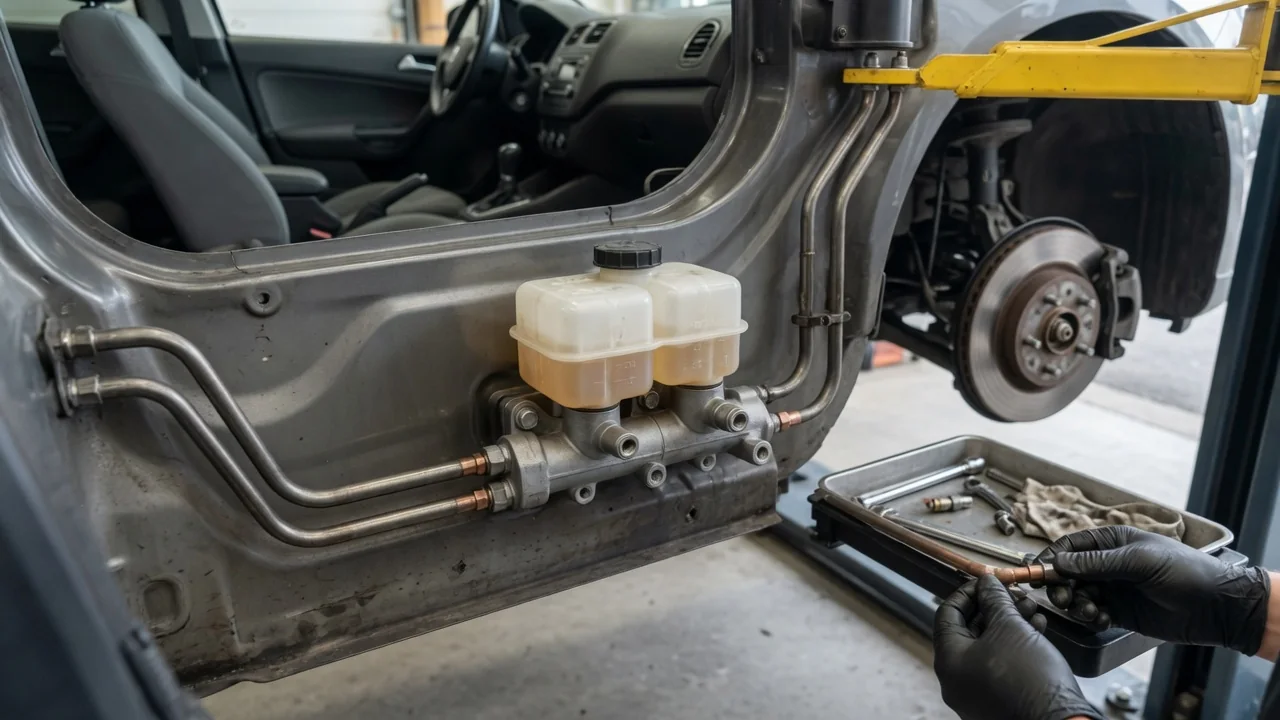
Modern passenger vehicles divide their hydraulic brakes into two separate circuits, each fed by its own chamber in a tandem master cylinder. The main reason is safety: a single leak should not leave the driver with no hydraulic brakes at all. Dual circuit brakes also shape how the pedal behaves when something goes wrong, and they change how the system is bled and maintained. This guide explains how the split works and what it means for everyday ownership.
Redundancy: why one leak should not disable every wheel
In a single-circuit system, the master cylinder pushes fluid through one network of lines to all four wheels. Brake fluid transmits force well only while it stays contained. A ruptured line, a leaking caliper seal, or a failed wheel cylinder lets fluid escape, and pressing the pedal then simply pushes more fluid out of the leak. Every wheel loses hydraulic braking at the same moment. The dual-circuit design addresses this directly: it divides the wheels into two independent groups, each with its own pressure chamber and lines, so a leak drains only one group.
The heart of the arrangement is the tandem master cylinder, which places two pistons in a single bore. The primary piston is moved by the pedal pushrod, while the secondary piston floats ahead of it and is driven by fluid pressure trapped between the two. The reservoir is divided or partitioned so that a leak in one circuit cannot empty the supply for the other. Two layouts are common. A front/rear split assigns one circuit to each axle. A diagonal split pairs one front wheel with the opposite rear wheel, which keeps a front brake in each circuit; this matters because the front brakes do most of the stopping work. Other arrangements exist, and the layout of a specific vehicle is documented in its service information.
The redundancy also has a mechanical backstop. If the primary circuit leaks, the primary piston travels forward until it contacts the secondary piston and pushes it directly. If the secondary circuit leaks, the secondary piston moves forward until it bottoms in the bore, after which the primary circuit can build pressure. In either case one circuit remains usable. Safety regulations in many markets require vehicles to retain a defined level of stopping ability after a partial hydraulic failure, which helps explain why the split design became standard.
Pedal feel: what the driver notices with one or both circuits
When both circuits are intact, the floating secondary piston keeps the pressure in the two chambers essentially balanced. Both circuits build pressure together, the pedal firms up after a short amount of travel, and the driver feels one consistent pedal rather than two separate systems. Nothing in normal driving reveals that the brakes are split.
After one circuit fails, the pedal typically travels noticeably farther before resistance builds, because the piston on the failed side has to move through extra stroke before it engages mechanically. Once it does, the pedal may feel reasonably firm but sits lower than usual. Slowing down requires more pedal force, and stopping distances grow because only part of the brakes are working. With a diagonal split, the vehicle may pull toward the side whose front brake still works. With a front/rear split, losing the front circuit removes the larger share of braking capacity, while losing the rear circuit keeps more capacity but changes the front-to-rear balance.
Not every change in pedal feel means a circuit has failed. A soft, spongy pedal often points to air in the lines or to fluid that has absorbed moisture and boiled under heat. A pedal that slowly sinks under steady pressure, with no visible external leak, can indicate worn seals inside the master cylinder letting fluid bypass a piston. A hard pedal with short travel usually involves the power brake booster, which assists pedal force but is separate from the hydraulic split. Many vehicles also illuminate a brake warning light, triggered by a fluid level sensor or, on some older designs, a pressure differential switch. Exact warning behavior varies by vehicle.
Service: bleeding, master cylinders and inspection
Each circuit must be purged of air on its own, in the sequence the vehicle manufacturer specifies. The familiar guideline of starting at the wheel farthest from the master cylinder is common but not universal; diagonal-split and ABS-equipped vehicles may call for a different order, and some ABS hydraulic units need a scan-tool-commanded procedure to clear air from internal passages. Both reservoir sections should stay topped up throughout. Letting one chamber run dry draws air into the master cylinder and the circuit it feeds.
Replacement master cylinders are commonly bench bled before installation so that both chambers are filled and free of air; the instructions supplied with the part should be followed. When bleeding an older master cylinder with the pedal, many technicians avoid pushing the pedal all the way to the floor, because the pistons can travel into a section of the bore that normally sees no movement and may carry corrosion or deposits that damage the seals. Some older systems use a pressure differential valve that may need to be re-centered after a repair, or the warning light can stay on.
Routine inspection should cover the lines, hoses, calipers, and wheel cylinders of both circuits, not only the side that prompted the visit. Steel lines are checked for corrosion and hoses for cracking or swelling. Brake fluid should be replaced on the schedule given in the owner's manual or service information, since both circuits share the same fluid type and usually the same reservoir.
Practical implications and limits
Dual circuit brakes provide a degraded mode, not a spare system. Their purpose is to let the driver bring the vehicle to a controlled stop and get off the road, not to keep driving normally. A lit brake warning light or a sudden increase in pedal travel is a reason to stop when it is safe and have the vehicle inspected before further use. The working circuit is carrying the entire load, so its brakes heat up faster, especially on long descents or in repeated stops. Depending on the vehicle, ABS and stability control may also store fault codes or behave differently while a circuit is down.
The split also has blind spots. It does not protect against problems that affect both circuits at once: contaminated or incorrect fluid, fluid that boils from overheating, a neglected reservoir that runs low, worn pads on every wheel, or a mechanical fault in the pedal linkage. A failed brake booster leaves both circuits working but demands far more pedal effort. The parking brake offers only limited backup, since it is designed mainly to hold a stopped vehicle, and its behavior when applied while moving differs between mechanical and electronic designs; the owner's manual describes what a specific vehicle allows. Two circuits reduce the chance of a total hydraulic loss, but they do not replace regular inspection and maintenance.