Why Did Car Door Handles Become Flush? Styling, Airflow, and Mechanisms
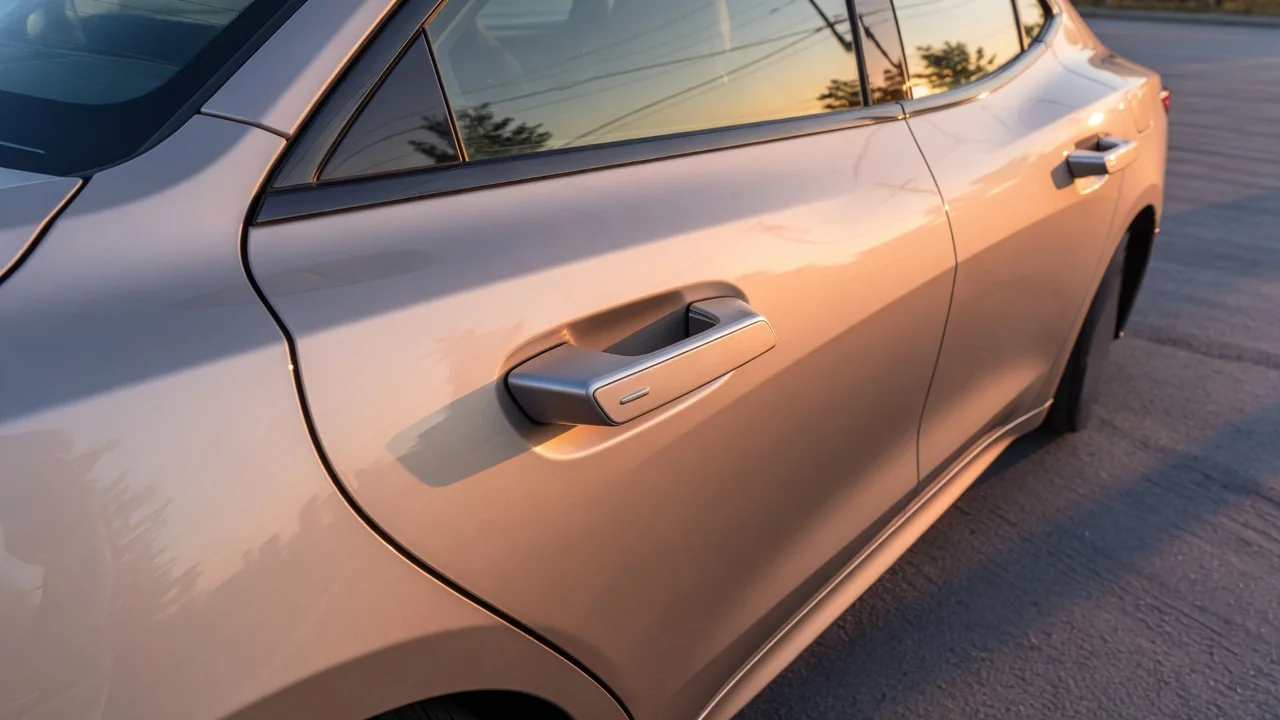
On many newer cars, you won't find a conventional door handle. You find a smooth panel that offers a grip only when you need one. Flush door handles did not take over for a single reason. They came from three things together: styling goals, aerodynamic refinement, and new mechanisms made practical by electrified door systems. This guide explains each factor and what it means for everyday ownership.
Styling
The door handle is one of the few parts that breaks up a car's side profile. For decades, designers worked around it with chrome pull bars, recessed cups, or handles tucked into a body crease. Flush handles take that idea as far as it can go. When closed, the handle sits level with the surrounding sheet metal, so the eye moves along the door without a visible break. That clean surface fits the minimalist design language that has become common, especially on vehicles meant to look high-tech and modern. A flush handle also stands out as a deliberate detail. Some light up or move as the driver approaches, which turns a purely functional part into a small moment of interaction.
Flush car door handles have a longer history than many drivers realize. Designers tried concealed and flush-fitting handles on concept cars and some production vehicles long before the design became widespread. What changed is the context. As side panels grew smoother and design details grew simpler, a protruding handle stood out more. Buyers also came to want sleek, uncluttered exteriors. Together, these shifts gave designers a reason to adopt a solution that once seemed exotic or expensive.
Aerodynamics
Anything that sticks out from a car's body disturbs the air flowing past it. A conventional handle creates a small pocket of turbulence and gives the air one more obstacle to flow around. A flush handle removes that disturbance, so air passes along the door more smoothly. On its own, a single handle has only a modest effect on overall drag, and the benefit varies with vehicle shape and speed. Engineers generally treat it as one of many small refinements, along with smooth underbodies, shaped mirrors, and closed grilles. Together, these lower the drag coefficient.
Those small gains matter more when efficiency is a main selling point. In electric vehicles, lower aerodynamic drag can help extend driving range at highway speeds, where air resistance becomes the main force the motor works against. In combustion vehicles, it can improve fuel economy. Flush handles can also cut wind noise, because the edges of a protruding handle can whistle or roar at speed. A quieter cabin is especially noticeable in an electric vehicle, where no engine sound covers up the noise of the air.
Mechanisms
Flush handles work in several different ways. The most familiar is the deploying handle. An electric motor or actuator pushes it out when the car is unlocked or the driver approaches with a key, then pulls it back in after the door closes or the car starts moving. Another common design is the pivoting handle: press one end, and the other end swings out so your fingers can grab it. This type can be purely mechanical or spring-assisted, and it needs no motor to extend the grip.
Some vehicles use a fixed recess with a small flap, or a pocket behind a flush surface. Others drop the pulling motion entirely in favor of an electronic release. In these systems, a touch sensor or button tells a control unit to unlatch the door electrically. The door may then pop open slightly so the user can pull it by its edge. A keyless entry system often ties these parts together, so the handle or latch responds when it detects an authorized key nearby.
Because many of these designs depend on electricity, they usually include a backup. A mechanical release inside the cabin, an emergency cable, or a hidden key cylinder can let the door open if power is lost. Where these backups are and how they work differ from one vehicle to the next. The owner's manual is the authoritative source for any specific car.
Practical implications and limits
In daily use, flush handles trade simplicity for complexity. Compared with a simple mechanical pull, motors, sensors, seals, and wiring add more parts that can wear out or fail. When a deploying handle stops working, the repair may involve an actuator or control module rather than a basic mechanical linkage, and replacement parts may cost more. Cold climates add another challenge. Ice and freezing rain can lock a retractable handle in place, so owners may need to clear the area before the handle can move.
Safety and accessibility are the most widely discussed concerns. If a vehicle loses electrical power after a collision, occupants and rescuers need a reliable way to open the doors, so clear, well-placed manual releases matter. Passengers who don't know the car may also struggle to find an interior release that is hidden or unconventional. These concerns have prompted safety discussions within the industry and among regulators in some markets. The practical steps for owners are simple. Learn where the mechanical release is for every door, and show passengers how to use it. Keep the 12-volt battery in good condition, too, since it often powers the door electronics.