Where to Find CNG Refueling Stations in the US
Compressed natural gas (CNG) fueling stations exist across the United States, but they are far less common than gasoline or diesel stations, and many of them are not open to the general public. If you drive or are considering a CNG vehicle, the practical question is not only where stations are but which ones you can actually use: whether access is public, whether the nozzle fits your vehicle, whether the station delivers the fill pressure your tanks are rated for, and whether you can pay there. This guide explains how to find CNG stations in the USA and how to judge whether a listed station will work for you.
The Short Answer
The most widely used starting point is the Alternative Fuels Data Center (AFDC) Station Locator, maintained by the US Department of Energy. It lets you filter by fuel type, including CNG, and shows access type, hours, connector type, fill pressure and payment methods where that information has been reported. Fueling apps, fleet fuel card networks and the station operators themselves are useful secondary sources. Because CNG availability is uneven and listings can lag behind real-world changes, the safest habit is to confirm a station's status directly before depending on it, especially on long trips.
Ways to Find Compressed Natural Gas Fueling Stations
Government station locator: The AFDC Station Locator covers public and private alternative fuel stations nationwide and supports route planning, so you can see CNG stations along a planned drive. Station operator locators: Companies that build and run natural gas stations, along with some gas utilities, publish their own station maps and status information. Fleet fuel card networks: If you pay with a fleet card, the card provider's locator shows where the card is accepted, which matters at stations that do not take ordinary credit cards. General fueling and navigation apps: Some consumer apps include CNG as a fuel filter. Coverage and accuracy vary, so treat them as a cross-check rather than the only source. Direct contact: A phone call to the station or operator is the most reliable way to confirm that a station is open, dispensing at full pressure and accessible to your vehicle.
How to Read a CNG Station Listing
A station appearing on a map does not mean it suits your vehicle. The details in the listing determine whether a stop is worthwhile.
Listing detail | What it tells you | Why it matters; Access type | Public, or private/restricted to specific fleets | Private stations may refuse unauthorized vehicles or require prior arrangement; Hours | Whether the station is staffed or self-serve and when it operates | Some sites are 24-hour self-serve; others follow business hours; Fill pressure | The pressure rating the dispenser delivers | Your vehicle's tank rating should match the station's rating for a full, safe fill; Connector type | The nozzle standard used at the dispenser | Light-duty and heavy-duty vehicles commonly use different receptacle sizes; Fill type | Fast-fill or time-fill | Fast-fill works like a normal fuel stop; time-fill is designed for vehicles parked for hours; Payment methods | Credit cards, fleet cards or account-only | Some stations accept only specific fleet cards or pre-registered accounts; Vehicle size limits | Whether large trucks can maneuver and fuel | Lane height and layout can limit access for heavy vehicles
Fill Pressure and Why Partial Fills Happen
CNG is stored on the vehicle in high-pressure cylinders, and stations dispense gas at a rated fuel pressure. Common ratings in the US are 3,000 psi and 3,600 psi. A vehicle's fuel system is designed around a specific rating, which is usually shown on a label near the fill receptacle and in the vehicle documentation. Using a station rated at a lower pressure than your tanks typically results in a partial fill and shorter range. Never attempt to exceed the rating of your vehicle's cylinders.
Even at a correctly rated station, a fill may fall short of full because compressing gas heats it. As the gas cools after fueling, its pressure drops. Many dispensers apply temperature compensation to reduce this effect, but drivers often notice that the gauge reads slightly lower some time after a fast fill. Station compressors that are overloaded or underperforming can also deliver less than full pressure, which is another reason to check recent station status.
Recognizing a CNG Pump and Avoiding Confusion With Other Gaseous Fuels
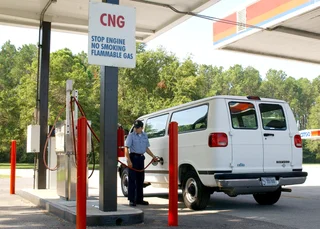
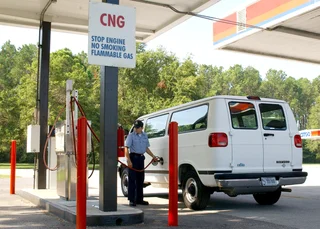
CNG dispensers are usually clearly labeled "CNG" or "Compressed Natural Gas" and often sit on their own island or at a separate part of a truck stop or fleet yard. CNG is easily confused with two other gaseous fuels that may share a site or appear on the same locator map.
Fuel | Common abbreviation | How it is stored | Interchangeable with CNG? Compressed natural gas | CNG | Natural gas compressed to high pressure in cylinders | Not applicable; Liquefied natural gas | LNG | Natural gas chilled to a cryogenic liquid in insulated tanks, mostly used by heavy trucks | No; it requires a different fuel system and dispenser; Propane / liquefied petroleum gas | LPG, autogas | A liquid under moderate pressure; a different fuel from natural gas | No; different fuel, tanks and nozzles
On the vehicle side, CNG-powered vehicles in the US typically carry a diamond-shaped "CNG" label, often on the rear, to alert first responders. When filtering a station locator, select CNG specifically rather than a general "natural gas" or "gaseous fuels" category, so LNG-only or propane-only sites do not appear as false options.
Where CNG Stations Tend to Be
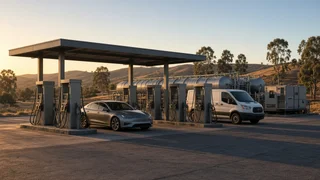
Coverage is uneven. Stations tend to cluster where there is steady fleet demand: transit agencies, refuse haulers, delivery fleets, airport shuttles and regional trucking. As a result, you are more likely to find CNG in and around metropolitan areas, near industrial zones, at some truck stops along freight corridors, and in regions where natural gas production or state clean-fleet programs have encouraged investment. Large rural stretches may have no public CNG at all, and the gaps between stations can exceed the range of many vehicles.
Many CNG stations are built primarily for a fleet and then opened to the public as a secondary service. That is why a station may be listed with limited hours, restricted lanes or account-only payment. Some utility-owned stations operate similarly. A smaller number of owners use home refueling compressors, which perform a slow time-fill overnight; this can reduce dependence on public stations but involves equipment, installation and permitting considerations specific to the home and utility service.
Planning a Trip Around CNG Availability
Map the full route in a station locator before leaving, not just the first stop. Confirm each station's access type, fill pressure, connector type and accepted payment. Identify a backup station within range for each leg in case your first choice is offline or dispensing at reduced pressure. Call ahead for any station that is critical to completing the trip. Plan to refuel with margin rather than running low, since a partial fill can shorten the next leg. If your vehicle is bi-fuel, with both CNG and gasoline capability, understand how it switches between fuels so you are not stranded when CNG is unavailable.
Fueling Etiquette and Basic Safety at the Dispenser
Follow the instructions posted at the dispenser, as procedures differ between equipment makers. In general, the engine should be off, the nozzle must be fully seated and locked onto the receptacle before fueling begins, and you should wait for the dispenser to stop and vent before disconnecting. A brief hiss when disconnecting is normal; a persistent hiss or a natural gas odor near the vehicle or dispenser is not. In that case, stop fueling, move away and alert station staff or the operator. A professional leak check of the vehicle's fuel system is appropriate if you suspect a leak on the vehicle side.
When Fueling Problems Point to the Vehicle
If you consistently get short fills or poor range at stations that serve other drivers well, the cause may lie with the vehicle rather than the station. Possible areas a qualified technician may inspect include a restricted fuel filter in the high-pressure line, a malfunctioning pressure regulator, a faulty fill valve or check valve, or sensor and injector issues that show up as abnormal fuel trim readings. Diagnosis and repair of high-pressure CNG systems should be left to technicians trained in natural gas vehicles, and cylinders have inspection requirements and service lives indicated on their labels.
Bottom Line
To find CNG stations in the US, start with the Department of Energy's Alternative Fuels Data Center Station Locator, then cross-check with operator maps, fleet card locators and, for critical stops, a direct call. Filter specifically for CNG, and check access type, fill pressure, connector type and payment before you drive there. Because availability varies widely by region, plan routes with a backup station on each leg and build in a range margin.