What Makes a Restoration Reversible?
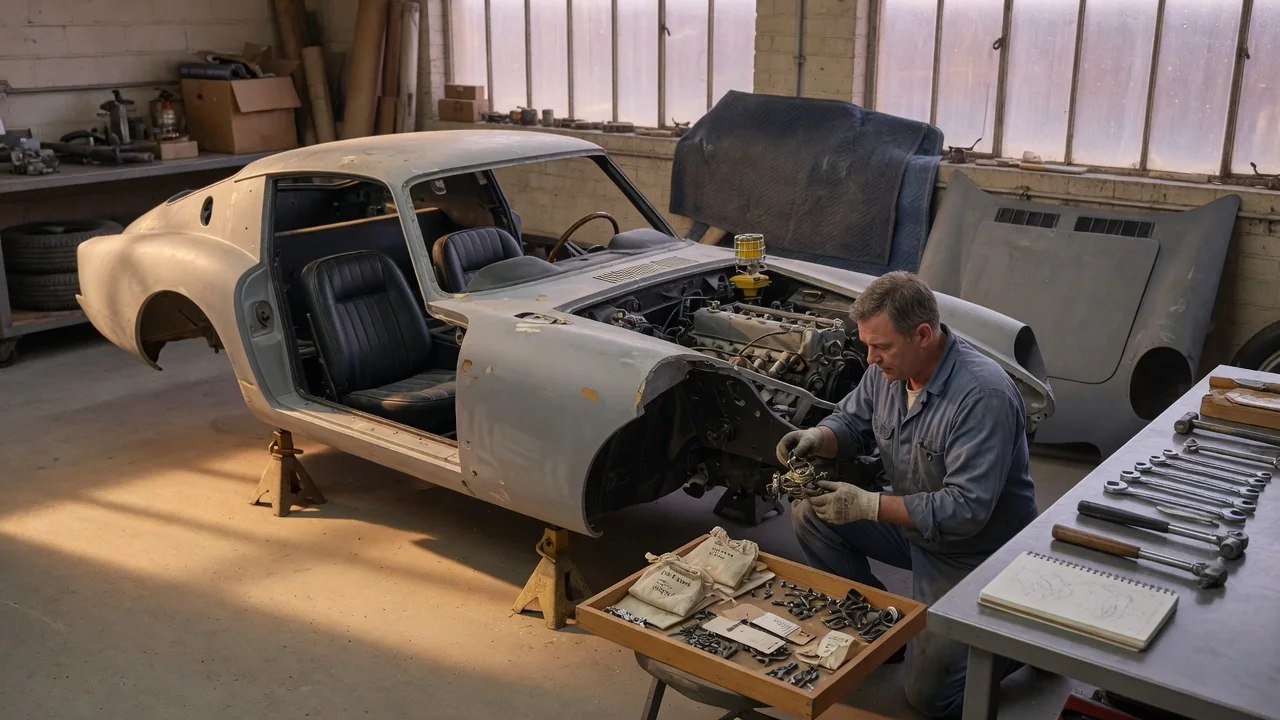
A reversible restoration improves or preserves a car while leaving a clear path back to its original configuration. In reversible classic car restoration, the goal is not to freeze a vehicle in time. The goal is to avoid decisions that permanently erase what came from the factory or from the car's documented history. Three factors largely decide whether that path exists: what happens to original parts, whether changes are non-destructive, and how thoroughly the work is documented.
Original parts
Original parts are the foundation of reversibility. Once a factory component is discarded, cut apart, or reworked beyond recognition, returning the car to its earlier state usually means finding a replacement. A replacement is rarely the same thing as the part that left the factory with the car. Components that carry identifying details, such as date codes, casting numbers, stampings, or tags, can be especially difficult to substitute convincingly. For that reason, many restorers make removal and storage the default whenever an original part is replaced, instead of selling or scrapping it.
Keeping parts only helps if they survive storage. Clean, dry conditions, protection against corrosion, and labels that tie each item to its location on the car all help. Bagging fasteners with the component they belong to prevents a common problem: a box of loose hardware that no one can place years later. Repair is another consideration. Restoring an original part by straightening, rebuilding, or refinishing it often keeps more of its identity than swapping it for a new reproduction. Repairs can still be more or less invasive, though, which leads directly to how changes are made.
Non-destructive changes
A change is non-destructive when it can be undone without leaving permanent damage and without new fabrication to restore what was there. Typical examples include bolt-on components that use existing mounting points, plug-in adapters in place of cut and spliced wiring, and parts that fit within factory clearances. Other changes cannot simply be unbolted, such as drilling new holes in a body panel, cutting the original wiring harness, welding brackets to the frame, or enlarging openings in the dash or firewall. Even if the added part is later removed, evidence of the modification remains and must be repaired.
Reversibility also depends on how materials and finishes are handled. Aggressive stripping or sanding can remove original markings, factory finishes, and inspection details along with old paint. Fillers and adhesives differ in how easily they can be removed. Some upgrades that seem purely cosmetic, such as new upholstery or trim, are reversible only if the original materials are kept. Before any change, it helps to ask what it would take to put the car back exactly as it was. If the answer involves welding, patching, or new fabrication, the change is probably not reversible in a practical sense.
When an upgrade is wanted for safety, reliability, or drivability, the reversible approach is to choose designs that mount in the same locations as the originals or that use removable adapters. Not every upgrade can be made reversible, because some systems do not allow a non-invasive installation on a given vehicle, and the details vary from car to car.
Documentation
Documentation is what makes stored parts and removable changes usable for reversing a restoration. Photographs taken before and during disassembly show how components were routed, oriented, and fastened, including details that general manuals and diagrams may not cover for a particular car. Notes on what was removed, repaired, or replaced, and on where the originals are stored, give a future owner or restorer a map of the work. Receipts and part numbers help identify which components are reproductions and which are original.
Good records are specific and organized. A log that ties each change to a date, a part, and a reason is far more useful than a general statement that the car was restored. Details recorded before disassembly, such as paint codes, tags, or alignment marks, can be difficult to recover once surfaces are refinished. Digital copies kept alongside paper records reduce the risk of losing the history. Passing the records along with the car preserves their value when ownership changes. Without documentation, even a carefully executed restoration can be hard to reverse, because no one remembers exactly what was there before.
Practical implications and limits
In practice, reversibility is a matter of degree, not a simple yes or no. Some work is permanent by nature. Rust repair usually means cutting out and replacing corroded metal, and a worn engine cannot be returned to its condition before the rebuild. Consumables such as fluids, gaskets, hoses, and tires are replaced as routine maintenance, and nobody normally expects them to be kept. A reversible approach focuses on avoiding unnecessary permanent changes. It does not mean preserving every worn component regardless of its condition or safety.
The approach also involves trade-offs. Storing original parts takes space, careful documentation takes time, and a non-invasive installation may cost more or perform differently than a modification that requires cutting. How much reversibility matters depends on the car, how original it is, the owner's goals, and any judging, registration, or market expectations that apply to it. These factors vary widely between vehicles and between regions. Decisions about specific components are best checked against the relevant factory documentation, applicable regulations, and qualified specialists who know that type of vehicle.