What Is a Points-to-Electronic Ignition Conversion?
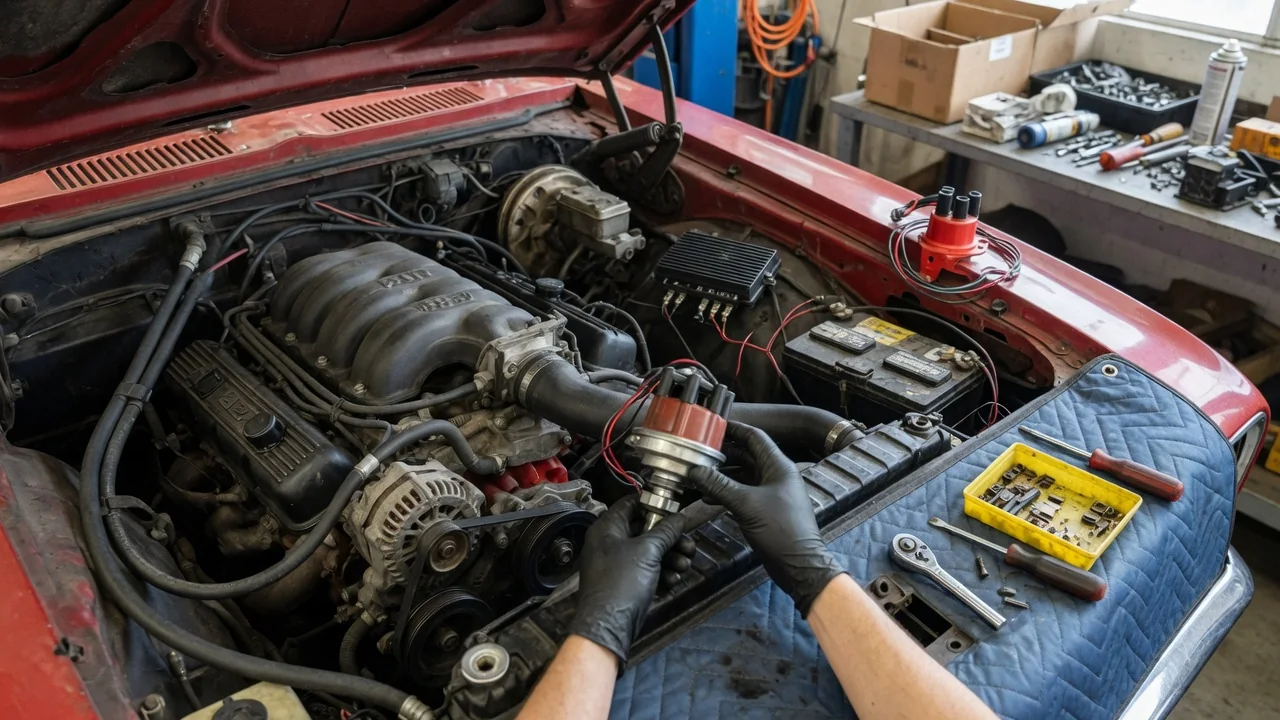
A points-to-electronic ignition conversion replaces the mechanical breaker points and condenser in a classic car's distributor with an electronic trigger and switching circuit. The engine still relies on a coil, distributor, cap, rotor, and spark plug wires, but the moment the coil fires is set by a sensor and a transistor instead of a pair of contacts that wear and drift. This article explains what the conversion changes in the ignition system, which parts it involves, and how reversible it usually is.
System change
In a conventional points ignition, the breaker points act as a mechanical switch in the coil's primary circuit. A cam on the distributor shaft pushes the points open once for each cylinder. While the points are closed, current flows through the coil's primary winding and builds a magnetic field. When the points open, that current stops abruptly, the field collapses, and the coil's secondary winding produces the high voltage that the rotor and cap route to the correct spark plug. The condenser wired across the points reduces arcing at the contacts so the field collapses cleanly. Because the points carry the full primary current and rely on a rubbing block riding against the cam, the contacts gradually pit and the block wears, which changes the point gap, the dwell, and the ignition timing over time.
An electronic conversion separates the job of sensing shaft position from the job of switching coil current. A sensor in the distributor detects shaft rotation without physical contact, commonly through a Hall-effect sensor paired with magnets or a slotted shutter, an optical sensor that reads a slotted disc, or a magnetic pickup that reacts to a toothed reluctor. The sensor sends a low-current signal to a transistor-based module, and the module switches the coil's primary current on and off. The switching itself no longer depends on contacts that physically open and close under load.
Much of the original system remains in place. The distributor still turns with the camshaft, the rotor still distributes high voltage through the cap, and in most conversions the centrifugal and vacuum advance mechanisms continue to adjust timing as before. In general terms, the conversion replaces the triggering and switching portion of the system, not the overall spark distribution layout or the advance curve, unless a complete replacement distributor with different internals is installed.
Parts
The most common form of a classic car electronic ignition conversion is a points-replacement kit that fits inside the existing distributor. These kits typically include a sensor and module assembly that mounts where the points and condenser were, plus a trigger component that fits over or around the distributor cam, such as a magnet sleeve, a slotted shutter, or a reluctor. Some kits integrate the switching electronics into the sensor housing under the distributor cap, while others place a separate module elsewhere in the engine bay. The kit is designed around a particular distributor family, so the correct match depends on the specific distributor fitted to the engine rather than simply on the vehicle's age or brand.
A second approach replaces the entire distributor with a complete unit that already contains an electronic trigger. This changes more parts at once, potentially including the shaft, bushings, advance mechanism, cap, and rotor. Some conversions are also sold with a matched ignition coil, because the switching module may be designed to work with a coil of a particular primary resistance. Pairing a module with an unsuitable coil can overload the electronics or reduce spark energy, so the kit maker's coil requirements matter.
Wiring is usually simple, often one or two leads connected to the coil's switched positive feed and to the coil negative terminal, but several compatibility details deserve attention. Many kits are made for a specific battery ground polarity, which is significant on older cars that use positive ground. Some modules require full battery voltage, while others are meant to work with an existing ballast resistor or resistance wire. Kit instructions may also specify suppression-type spark plug wires, since electrical noise from some solid-core wires can interfere with sensitive electronics. These requirements vary by product, so the installation instructions for the specific kit are the governing reference.
Reversibility
A points-to-electronic conversion is often designed to be reversible. In-distributor kits generally use the original mounting points for the breaker plate, require no drilling or cutting, and connect to existing terminals. Returning to points then means removing the sensor and trigger, reinstalling the points and condenser, setting the gap or dwell, and checking timing. A complete replacement distributor can also be reversed if the original distributor is kept intact, since it can be reinstalled in its place.
Reversibility is reduced by changes made around the kit rather than by the kit itself. Cutting or splicing the original wiring harness, removing or bypassing a ballast resistor, drilling new mounting holes, or discarding the original distributor, coil, or breaker plate parts all make a return to stock harder. Swapping in a coil with different electrical characteristics can also be a one-way step if the original coil is not retained. For owners who care about originality, such as those preparing a car for judged events, these details can matter as much as the trigger device.
A practical way to keep the conversion reversible is to store the removed points, condenser, and any replaced coil or distributor together, labeled and protected from corrosion, and to note any wiring changes in the vehicle's service records. Using connectors instead of cutting factory wiring, where the kit allows it, also helps. Some owners keep a correctly gapped set of points and a condenser in the car as a fallback, since a points setup can be reinstalled with basic hand tools if the electronic module fails.
Practical implications and limits
The main day-to-day change is that routine point gap and dwell adjustments disappear, and timing tends to stay more consistent between services because no rubbing block is wearing down. That does not make the ignition maintenance-free. The cap, rotor, plug wires, spark plugs, and advance mechanism still age, and ignition timing still needs to be checked and set after installation and at normal service intervals. Wear in the distributor shaft bushings can still cause timing scatter, because a wobbling shaft moves the trigger relative to the sensor much as it once moved the cam relative to the points.
Failure behavior also changes. Worn points typically degrade gradually, giving warning through rough running or hard starting, while an electronic module can stop working suddenly with little warning. Heat in the engine bay, incorrect supply voltage, reversed polarity, or an incompatible coil can shorten module life. This is one reason a spare module or a set of points can be worth carrying on a car that travels far from home. The conversion also does not increase engine output by itself; any improvement comes from more stable timing and dwell, and it will not correct problems in the fuel system, compression, or a worn distributor.
Some interactions are vehicle-specific and cannot be assumed. An older tachometer that reads its signal from the coil's negative terminal may or may not work correctly with a given module, and certain modules have minimum voltage requirements that can affect starting when cranking voltage drops. Before committing to a conversion, it is worth confirming the distributor type, ground polarity, coil specification, and any ballast arrangement against the kit's instructions and the vehicle's service manual, since those details determine whether the conversion will be straightforward on a particular car.