What Are Ignition Points? How Classic Car Breaker Points Work
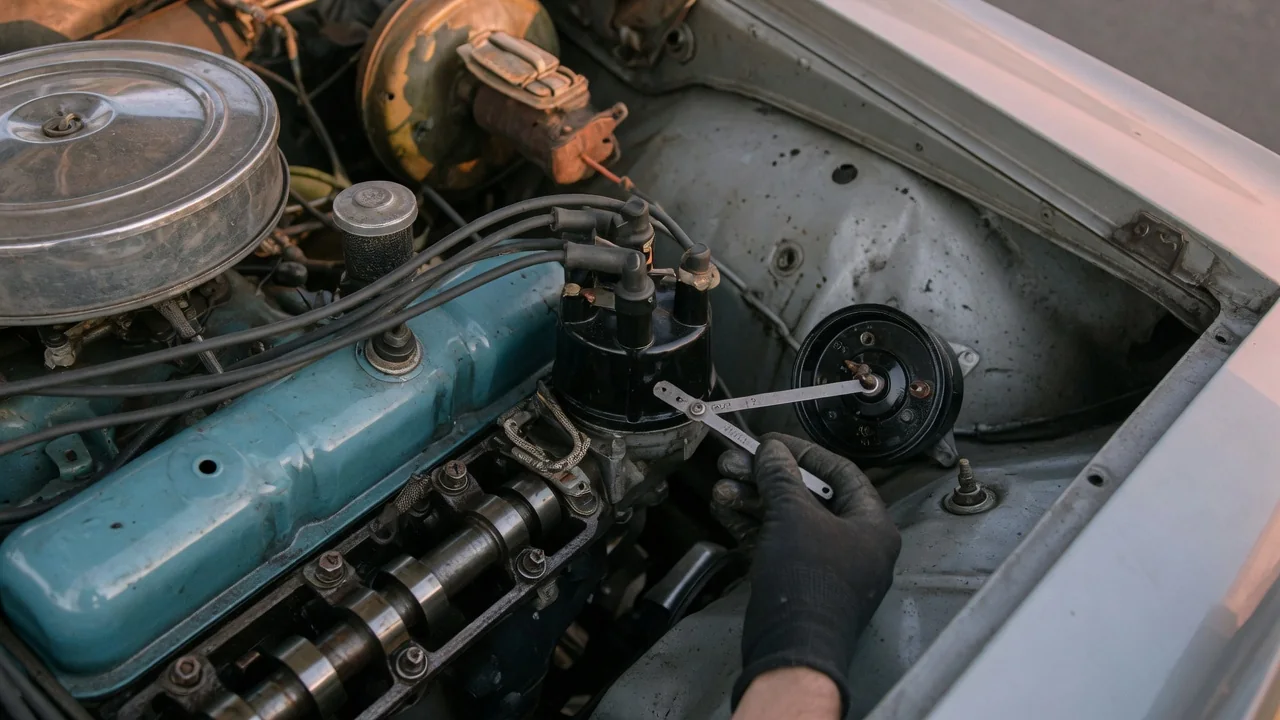
Ignition points are a mechanical switch inside the distributor. Before electronic ignition became common, they told the ignition coil when to fire on most gasoline engines. On a classic car, knowing how ignition points work explains why these engines needed regular tune-ups and why small adjustments could change how the engine started and ran. This guide covers how the contacts switch the coil, why the gap matters and what routine maintenance involves. It also notes where your vehicle's own manual must take over.
Contact switching: how the points control the coil
Ignition points are also called breaker points or contact breaker points. They sit on a plate inside the distributor, beneath the rotor. The assembly has two contacts. One is fixed to the plate, and the other is mounted on a spring-loaded arm that pivots. The movable arm carries a small rubbing block, usually made of fiber or plastic, that rides against a cam on the distributor shaft. In a typical distributor the cam has one lobe for each cylinder. As the shaft turns, the lobes push the arm away and the spring snaps it back, so the contacts open and close in step with engine rotation.
Electrically, the points act as a switch in the low-voltage primary circuit of the ignition coil. While the contacts are closed, current flows through the coil's primary winding and through the points to ground, building a magnetic field in the coil. When a cam lobe opens the points, that current stops abruptly and the magnetic field collapses. The collapse induces a very high voltage in the coil's secondary winding. That voltage travels through the coil wire, distributor cap and rotor to the spark plug of the cylinder that is due to fire.
A condenser, which is a capacitor, is wired across the points. Without it, the interrupted current would tend to jump across the separating contacts as an arc. That arc would burn the contact surfaces and slow the collapse of the magnetic field. The condenser briefly absorbs the surge, which helps the points open cleanly and supports a strong spark. The points and condenser work as a pair, so a fault in either one can cause a weak spark, misfiring or rapid contact wear.
Point gap and dwell
The point gap is the distance between the two contacts when they are fully open. This happens when the rubbing block rests on the highest part of a cam lobe. To set the gap, you loosen the fixed contact's mounting screw and move that contact. Depending on the distributor design, you do this with a screwdriver in an adjustment slot or by turning an adjusting screw. The correct gap is specified by the vehicle or distributor manufacturer and varies between engines, so use the figure in the service manual for your specific vehicle.
Gap is closely tied to dwell, which is how many degrees the distributor turns while the points stay closed. A wider gap makes the points open earlier on each lobe and close later, so dwell decreases. A narrower gap increases dwell. Dwell matters because the coil needs enough closed time to build its magnetic field, especially at higher engine speeds when each cycle is shorter. Changing the gap also shifts the moment the points open, which changes ignition timing. That is why gap or dwell is normally set before timing is checked.
There are two common ways to set the points. A feeler gauge measures the open gap directly with basic tools. On worn or pitted contacts it can be less accurate, because the gauge rests on the high spots. A dwell meter reads the closed angle electrically while the engine cranks or runs, so it reflects how the points actually behave. Some distributors let you adjust dwell with the engine running, through a window in the cap. Others require removing the cap for each adjustment.
Maintenance of classic car ignition points
Ignition points are a mechanical wear part, so they were treated as a routine tune-up item. Inspection starts with the contact faces. Light gray, evenly worn surfaces are normal. Heavy pitting on one contact with matching buildup on the other indicates metal transfer. Blackened or blued contacts suggest burning, which may point to a condenser problem, an incorrect gap or excessive current. Oil or grease on the contacts can also cause burning and poor switching. If the distributor is wet or dirty, find out where the contamination is coming from.
The rubbing block is the other main wear point. As it wears against the cam, the gap gradually closes, so correctly set points can drift out of adjustment over time. A small amount of suitable cam lubricant on the lobes reduces this wear, but too much can be flung onto the contacts. Many owners replace the points and condenser together, because the two parts work as a pair and a mismatched set can complicate diagnosis. After installing new points, set the gap or dwell first, then check ignition timing with a timing light.
Some people lightly dress slightly rough contacts with a clean point file as a temporary measure. Badly pitted or burned points are generally replaced instead. Before starting the engine, make sure the contacts are free of filings, oil and abrasive residue, and recheck the gap after any cleaning. Service intervals and exact procedures depend on the vehicle, so the owner's manual or service manual remains the reference.
Practical implications and limits
In everyday driving, point wear usually shows up gradually rather than as a sudden failure. As the rubbing block wears and the gap narrows, dwell increases and timing typically moves in the retarded direction. This can cause harder starting, softer throttle response or reduced fuel economy. Burned or pitted contacts can cause misfires, a rough idle or a no-start condition. However, other parts can produce the same complaints, including fuel delivery, spark plugs, wires, the cap and rotor, the coil and the distributor's advance mechanisms. Check the points as part of the whole ignition system instead of blaming them by default.
The design also has built-in limits. At high engine speeds the spring may not return the movable arm fast enough, so the points bounce or float and the engine misfires. Worn distributor shaft bushings let the cam wobble, which makes dwell and timing unstable. The contacts can carry only a limited current without excessive wear, which caps how much energy the coil can receive. Some engines used a ballast resistor or resistance wire in the primary circuit, and some distributors used two sets of points, so details differ between designs.
Some classic car owners keep their original ignition points for authenticity. Others install electronic conversion modules, which replace the contacts with a sensor and eliminate gap wear. Either choice can work, but each involves trade-offs in originality, ease of roadside repair and compatibility with the existing coil and wiring. Whatever the setup, take the correct gap, dwell and timing values from the specific vehicle's documentation, not from general rules. Recheck carefully after any ignition work to confirm the engine runs as intended.