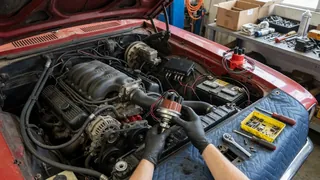
Points to Electronic Ignition Conversion: What to Check Before You Buy
The short answer
For most classic cars and trucks still running breaker points, a conversion kit that fits inside the existing distributor is the simplest upgrade. It removes the points' mechanical wear and the need for regular gap and dwell adjustment, and it usually gives more consistent spark. The right kit is not chosen by brand. It depends on four things: your distributor's exact make and model, your system voltage and ground polarity, the coil you will run with it, and how the car is wired between the ignition switch, ballast resistor and starter circuit. If any of these don't match the kit, the result can be a hard start, a misfire, or a failed module.
Two situations change the advice. If the distributor itself is worn, with a loose shaft, tired advance weights or a damaged housing, a drop-in module will not fix it, and a complete replacement distributor may be the better buy. If the vehicle is 6-volt or positive-ground, confirm that the kit supports it, because many in-distributor modules are built only for 12-volt negative-ground systems.
What a points conversion actually replaces
Breaker points are a mechanical switch. A cam on the distributor shaft opens and closes them, which switches the coil's primary circuit on and off. Each time the circuit opens, the coil fires a spark. A conversion kit replaces that mechanical switch with an electronic trigger, typically a magnetic or Hall-effect sensor, or an optical sensor in some designs. That trigger signals a small module, which switches the coil. The distributor cap, rotor, plug wires and mechanical or vacuum advance usually stay as they are.
Dwell is the period the coil is charging between sparks. With points it depends on the gap setting and wears out of adjustment over time. Electronic modules control dwell internally, which is the main reason timing and spark stay more stable between services.
The main conversion options
Option | What it is | Best suited to | Main trade-off; Drop-in module kit | Electronic trigger and module mounted on the existing breaker plate, with a magnet sleeve or trigger wheel on the cam | A sound original distributor where you want a hidden, period-looking upgrade | Only as good as the distributor it goes into; Complete electronic distributor | New distributor with the electronic trigger already built in, often sold under performance names such as PerTronix's Flame-Thrower line | Worn distributors or owners wanting fresh advance components | Higher cost, and advance curve and fitment must suit the engine; External ignition box with trigger | Separate control box, triggered by points or a pickup, sometimes adding multi-spark or rev limiting | Performance builds needing extra features | More wiring and mounting, plus added complexity to diagnose; Original-style electronic swap | A later factory electronic distributor and module from the same engine family | Owners who prefer OEM parts | Wiring changes and parts availability vary by model
About the product names you may be searching
Flame-Thrower is a name PerTronix uses for its ignition coils and complete distributors. When people search for flame-thrower electronic ignition, they usually mean pairing one of those coils with an in-distributor module, or buying a ready-built electronic distributor. Either way, check that the coil is listed as compatible with the specific module or distributor. The coil's primary resistance affects module current and heat.
The Crane XR700 is a points-to-electronic ignition conversion kit that has been sold for many years and is still widely discussed for classic engines. Product lines get revised, renamed or discontinued, so before you buy a Crane XR700 kit, new or used, confirm that the listing names your distributor and that replacement parts or support are still available. Searches for a D3000 electronic ignition may refer to a specific distributor or module part number. Part numbers are not consistent across brands, so match the number against the seller's application information for your vehicle rather than assuming what it means.
Compatibility checklist before buying
Distributor identity: kits are specific to the distributor's make and model and to the cylinder count, not just the engine. Engines from one manufacturer may have used different distributor suppliers across years, so identify the unit actually fitted, which may not be the original. Voltage and ground: confirm 12-volt negative ground, or check explicitly for 6-volt or positive-ground support. Coil requirements: note any minimum primary resistance the kit states, and whether it needs a ballast resistor or a specific coil. Running an unsuitable coil is a common cause of early module failure. Power feed: many modules need a supply that holds close to full battery voltage while cranking and running. Find out whether your ignition switch feed passes through a ballast resistor or resistance wire, and what the kit's instructions say to do about it. Distributor condition: check shaft side play, bushing wear and the advance mechanism. Excess play can affect trigger clearance and timing stability. Tachometer and accessories: some older tachometers, and some alarm or rev-limiter add-ons, rely on the points signal and may need an adapter or a different hookup. Physical clearance: confirm that the module and trigger parts clear the rotor, the cap and the advance weights through their full travel. Support and documentation: prefer kits with clear wiring diagrams for your application and readily available replacement modules.
Wiring, starting and the starter circuit
Most conversion complaints trace back to power supply rather than to the module itself. Points systems often used a ballast resistor or resistance wire to reduce coil voltage while running, with a bypass from the starter solenoid that delivered full voltage during cranking. Some electronic modules need full voltage at all times. Others work with the original ballast arrangement. Follow the kit's wiring instructions for your setup, and verify the voltage at the module feed both while cranking and with the key in run.
Battery state of charge and cranking speed matter more with electronic ignition than many owners expect. A weak battery, poor grounds or a tired starter can pull system voltage down far enough during cranking that the module doesn't fire reliably, even though the same car started on points. Clean battery terminals, sound engine and body grounds, and a healthy starter circuit are worth confirming before or alongside the conversion.
After installation
Set the trigger or air gap as the kit's instructions specify, if it is adjustable. Re-check and set ignition timing with a timing light. Changing the trigger can shift timing slightly, even if the distributor wasn't moved. Don't leave the ignition switched on with the engine stopped for long periods unless the kit states that this is safe, since some modules and coils can overheat. Keep the old points, condenser and a known-good feed wire in the car as a roadside backup if the distributor can still accept them.
Diagnostic checks if it won't start or runs poorly
Work through the basics in order rather than assuming the new module is faulty. First, check battery voltage and cranking speed. Next, check voltage at the module and coil feed during cranking, and confirm the module's ground. Then confirm the trigger polarity and wire colors against the diagram. Test for spark at the coil wire and at a plug. If spark is present and strong, move on to fuel delivery and timing. A conversion done during a broader tune-up sometimes gets blamed for a fuel or timing issue that started at the same time.
Choosing your next step
If the distributor is in good condition and you want an invisible, low-maintenance upgrade, a drop-in conversion kit matched to that distributor and paired with a compatible coil is usually the sensible choice. If the distributor is worn or the advance needs rework, compare the cost of a complete electronic distributor against rebuilding plus a module. In both cases, identify the distributor accurately, confirm voltage, polarity and coil requirements, and sort out the power feed and battery health before you order.