What Is Structural Foam in a Car Body?
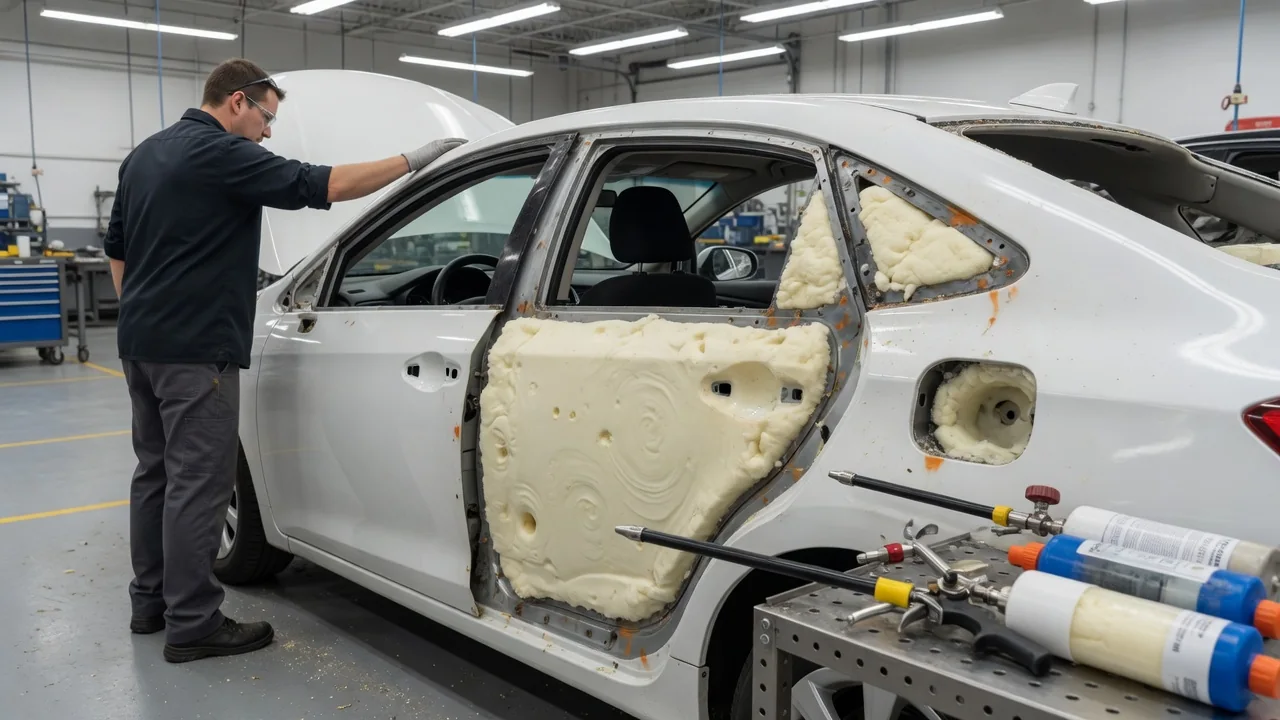
Structural foam in a car body is a rigid, lightweight material placed inside hollow sections of the body structure, such as pillars, rails, and rocker panels, to help those thin-walled members keep their shape under load. Unlike soft acoustic foam, which mainly blocks noise and air paths, automotive structural foam is engineered to bond to the surrounding metal and add stiffness. Knowing where it sits, what it does, and how it is handled during collision repair helps owners make sense of body repair estimates and procedures.
Cavity placement
A modern unibody is largely built from stamped sheet-metal panels joined into closed box sections. These hollow members give the body its strength without the weight of solid metal, but their thin walls are also their weak point. Structural foam is placed inside selected cavities where engineers want extra local support. Typical candidates include the A-pillars and B-pillars, roof rails, rocker panels (sills), front frame rails, the cowl area, and zones around door hinges or suspension mounting points. Which cavities receive foam, and how much, varies from one vehicle design to another. The only reliable way to know the exact locations for a given vehicle is the manufacturer's body repair information, which usually shows them in diagrams.
There are two general ways the material gets into a cavity. In the first, a heat-activated reinforcement is installed during body assembly: an expandable material, often epoxy-based, is mounted on a molded carrier that clips into the cavity before the section is closed. A small gap is left around it so corrosion-protection coatings can reach the metal. When the body passes through the paint ovens, the material expands, fills the gap, and cures against the walls. In the second approach, a two-component foam, commonly polyurethane-based, is injected through access holes, where it mixes, expands, and cures at room temperature. Injection is used both in some production processes and in body repair.
Stiffness
To understand why foam helps, consider how a thin-walled box section fails. Under bending, twisting, or a crash load, the flat walls of the section tend to buckle inward locally. Once a wall folds, the cross-section loses its shape and the member collapses at a load well below what the steel itself could otherwise carry. Structural foam supports the walls from the inside, resisting that inward buckling and helping the section hold its geometry longer. Because the material is bonded to the metal, it also helps the separate panels of the section work together as one unit rather than flexing independently at their joints.
The effects show up in several ways. Added local stiffness can contribute to the overall bending and torsional rigidity of the body, which influences how precisely the suspension can do its job and how much vibration and noise travel through the structure. In a collision, a reinforced pillar or rail can resist intrusion or deform in a more controlled pattern. Foam also lets engineers strengthen a specific area without making an entire panel thicker and heavier. However, placement is deliberate rather than generous. Crush zones are designed to fold in a planned sequence, and stiffening the wrong area could change how energy is absorbed. More foam is not automatically better.
Repair
Structural foam matters most to a car owner when the body is damaged. If a pillar, rail, or rocker panel containing foam must be sectioned or replaced, the foam in the repair zone has to be dealt with first. Welding heat can burn the material, producing smoke and fumes, contaminating the weld, and damaging the bond and corrosion protection nearby. Manufacturer repair procedures typically state how far back the foam must be removed from a cut or weld location, what removal methods are acceptable, and what protective equipment is needed. Skipping these steps can compromise both the weld quality and the health of the technician.
Restoring the foam is a separate question. A heat-activated reinforcement cures during the factory oven cycle, which a body shop generally cannot reproduce on a finished vehicle. For that reason, procedures usually specify a replacement material, often a two-component structural foam or a structural adhesive from an approved product list, along with where and how to inject it. In some cases the procedure may call for no replacement at all. Structural foams and acoustic or flexible foams look similar but behave very differently, so one is not a substitute for the other. Replacement body parts may or may not arrive with reinforcements already fitted.
Sequence also matters. Once a section is welded closed and foamed, the inside of the cavity cannot be inspected or re-treated easily, so corrosion protection such as cavity wax and the foam injection itself must be done in the order the procedure specifies. Because requirements differ between manufacturers and even between models, a generic approach based on what worked on another car is a risk. The vehicle-specific repair information is the governing reference.
Practical implications and limits
For day-to-day ownership, structural foam requires nothing from the driver. It is hidden inside sealed sections, has no service interval, and is not something an owner is expected to inspect or add. Where it becomes visible is on a collision repair estimate, which may list separate operations for removing foam, restoring it, and applying cavity protection. Those lines usually reflect documented procedure rather than padding. A reasonable question to ask any body shop is whether it is working from the manufacturer's repair information for that specific vehicle.
Foam also has clear limits. It reinforces sound metal; it does not restore strength to rusted, cracked, or poorly welded panels. Filling a corroded rocker panel with foam can hide the damage and may trap moisture against the remaining steel. Aftermarket chassis foam, sometimes used by enthusiasts to stiffen a body, is a different practice from factory engineering. Its effect depends on the vehicle, it has not been validated by the manufacturer, and it could alter crash behavior and complicate later repairs.
When evaluating a used car, signs such as non-factory drill holes in pillars or rockers, or foam that looks unlike the surrounding factory material, can suggest earlier body work. They are hints, not proof of a good or bad repair, and a qualified inspection is the better way to judge. General explanations like this one describe how structural foam works across the industry; they cannot confirm where a particular model uses it, which only that vehicle's documentation can answer.