What Is a Structural Casting in a Car? Large Parts, Joining and Repair Limits
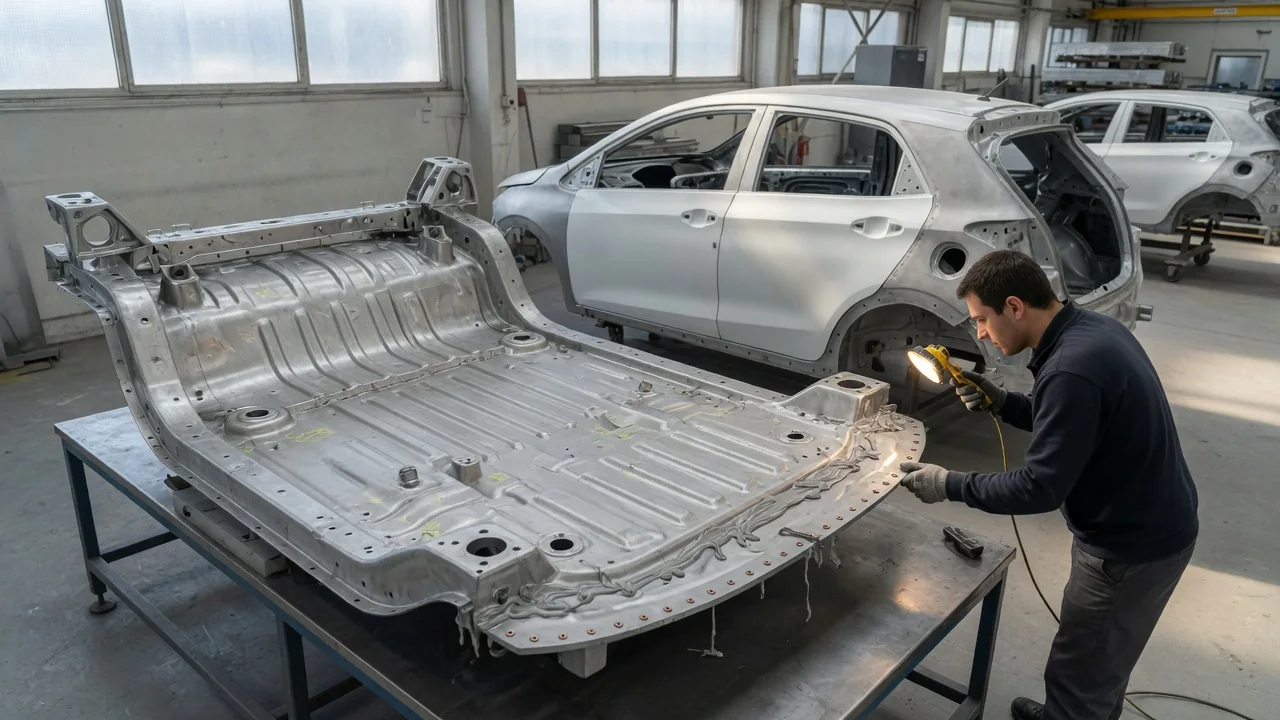
A structural casting in a car is a large metal component, usually made from an aluminum alloy, that is formed by forcing molten metal into a mold and then built into the vehicle's load-bearing structure. Instead of assembling a body area from many stamped panels, a manufacturer can produce part of that area as one piece. Knowing what an automotive structural casting is helps explain how it attaches to the rest of the body and why collision repair options for it are often narrower than for conventional sheet metal.
A Large Metal Part in the Body Structure
Structural castings appear in areas that carry significant loads or connect several structural members. Typical locations include shock towers, suspension mounting points, junctions between front rails and the cowl, hinge pillar areas, and sections of the rear underbody. Most are produced by high-pressure die casting: molten aluminum alloy is injected into a hardened steel die under high pressure and solidifies quickly. The process allows complex geometry, including stiffening ribs, varying wall thickness, bosses for fasteners, and integrated mounting points, all in a single part.
The main engineering motivation is part consolidation. One casting can replace a cluster of stamped and welded pieces, which reduces the number of joints, simplifies assembly, and can improve dimensional consistency from vehicle to vehicle. Aluminum also offers a weight advantage compared with an equivalent steel structure, which matters for efficiency and, in electric vehicles, for offsetting battery mass. Some manufacturers use relatively small cast nodes, while others have moved toward very large single-piece castings that form an entire front or rear underbody section. The term covers both approaches, so the size and role of a casting depend on the specific vehicle design.
Cast aluminum behaves differently from stamped sheet metal. Casting alloys and any heat treatment are selected to balance strength and ductility, but a cast part generally has less capacity to stretch and fold than formed sheet before it fractures. Castings can also contain internal porosity from trapped gas or shrinkage during solidification. Engineers account for these traits in the design, often placing castings where stiffness and precise geometry are needed while letting other members absorb crash energy through controlled deformation.
How Structural Castings Are Joined to the Body
A casting rarely works alone. It connects to stamped steel or aluminum panels, extruded aluminum rails, and sometimes other castings, so joining methods must handle mixed materials. Common techniques include self-piercing rivets, flow-drill screws, conventional bolts, and structural adhesives, frequently used in combination at the same joint. Adhesive spreads loads over a wider area, seals the seam against moisture, and helps separate dissimilar metals. Mechanical fasteners hold the parts in position while the adhesive cures and provide additional strength.
Welding is more restricted. Conventional fusion welding on many high-pressure die castings is difficult because gas trapped inside the metal can expand when heated and create porosity or blistering in the weld zone. Vacuum-assisted casting processes reduce trapped gas, and some castings are specifically designed to be welded during factory assembly under controlled conditions. Aluminum cannot be fusion welded directly to steel by ordinary methods, so mixed-material joints rely on mechanical fastening, adhesives, and coatings or isolators that limit galvanic corrosion where the two metals meet.
Joint type and location are part of the crash design. Fastener spacing, adhesive bead placement, and the order in which parts are assembled all influence how loads travel through the structure. That is why a joint on a casting cannot simply be reproduced with whatever fastener or welding process is convenient; a different method can change stiffness, durability, and crash behavior.
Repair Limits for Structural Castings
Many manufacturer body repair procedures treat structural castings as replace-only components. Straightening a bent casting risks cracking, and some cracks may be too small to see. Applying heat to make straightening easier can alter the properties of heat-treated alloys and weaken the part. Welding a crack in a casting is generally not an approved repair unless the manufacturer's procedure specifically permits it. As a result, a casting that is bent, cracked, or out of dimension is commonly replaced rather than repaired.
What replacement involves varies widely. Some designs bolt the casting in place, making removal relatively direct. Others require drilling out rivets, separating bonded joints, and installing the new part with specified rivets, screws, and adhesives. Some manufacturers publish approved sectioning locations so that only a damaged portion of a large structure is replaced, while others call for replacement of a complete assembly. With very large single-piece castings, damage limited to one corner can still require extensive work if no sectioning procedure exists. Any repair also depends on accurate three-dimensional measurement, correct riveting and bonding equipment, and work practices that keep aluminum free from steel contamination.
Because damage may be hidden, inspection is an important part of the process. Repair information often directs technicians to check castings and their joints near an impact area, verify mounting point positions, and confirm alignment after repairs. The exact requirements are vehicle-specific and come from the manufacturer's current repair documentation.
Practical Implications and Limits for Owners
In everyday driving, a structural casting does not require maintenance or change how the car is operated. Its effects show up mainly after a collision or a hard impact underneath the vehicle. A moderate crash that reaches a casting can produce a larger estimate than the visible damage suggests, because the work may involve structural replacement, specialized fasteners, and alignment checks rather than panel repair. Owners can reasonably ask a body shop whether it has access to the manufacturer's repair procedures for that specific vehicle, the equipment to work on aluminum and mixed-material structures, and a plan to inspect cast components near the damage.
Some limits apply to any general explanation. Not every car uses structural castings, and those that do may use them in very different sizes and locations. It is not possible to tell from outside the car whether a given area is cast, stamped, or extruded, and the owner's manual usually does not cover body construction in detail. Body repair manuals and manufacturer repair information are the authoritative sources for a particular vehicle. Heating, straightening, drilling, or welding a casting at home is not a suitable approach, since the outcome cannot be verified without the manufacturer's criteria.
Routine habits still help. Lifting the car only at the designated lift and jacking points avoids putting unintended loads on structural areas. After any underbody strike, such as a hard contact with a curb or road debris, a professional inspection can identify cracks or misaligned mounting points before they affect suspension geometry or tire wear. A structural casting is neither a weakness nor a guarantee of strength on its own; it is one design choice whose benefits depend on correct manufacturing, proper joining, and repairs that follow the manufacturer's procedures.