What Is High-Strength Steel in a Car Body?
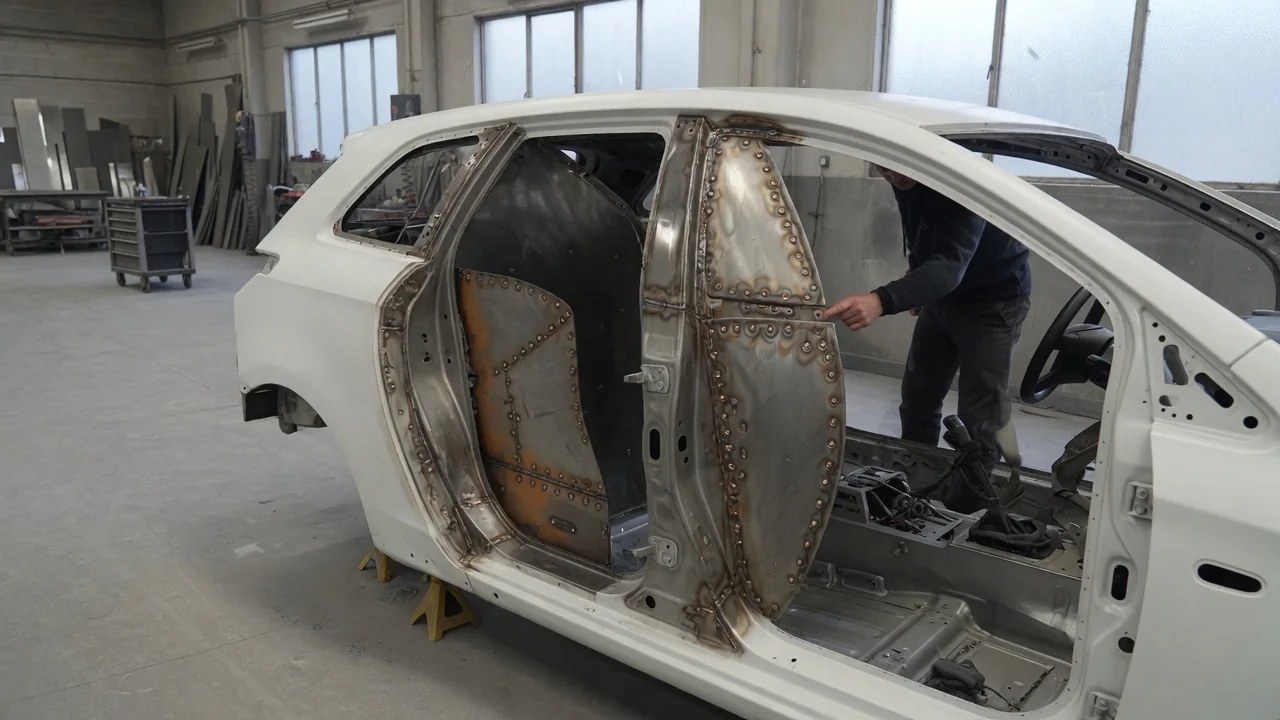
Anyone asking what is high strength steel in a car body is really asking how modern vehicles protect occupants without becoming excessively heavy. These steel grades resist deformation far better than conventional mild steel, allowing thinner, lighter panels and reinforcements to carry crash loads. That same strength changes how the structure must be repaired after a collision, which is why the material matters long after the car leaves the factory.
Strength and forming
High-strength steel is a broad family rather than a single material. It ranges from moderately stronger grades used in outer and inner panels to advanced and ultra-high-strength grades, including press-hardened boron steel, used in the safety cage. Strength comes from alloying elements and carefully controlled heating and cooling, which change the internal microstructure of the metal. The result is a sheet that resists bending and stretching at loads that would permanently deform ordinary mild steel of the same thickness.
That strength comes with a trade-off in formability. Stronger grades are harder to stamp into deep, complex shapes and tend to spring back after pressing, so automakers use specialized processes. Hot stamping, for example, heats a blank until it is easily shaped, then quenches it inside the die to lock in very high strength. Because the properties depend on that thermal history, later exposure to high heat can undo them, which is the root of many repair restrictions.
Typical body areas
The strongest grades are usually concentrated in the passenger compartment, where the goal is to prevent intrusion. Typical locations include the A-pillars and B-pillars, roof rails, rocker reinforcements, door intrusion beams, floor cross members, and bumper reinforcement beams. These parts form a rigid cell around the occupants. In a side impact, for instance, the B-pillar and rocker must hold their shape because there is very little space between the striking object and the person inside.
Other zones are designed to behave differently. Front and rear rails often use grades chosen to fold progressively and absorb energy before loads reach the cabin, so a single structure may mix several steels along its length. Some parts are tailor-welded or selectively hardened to combine soft and hard regions in one stamping. The exact map of materials differs between manufacturers, models, and even generations, and many vehicles also blend in aluminum or composite components, so assumptions from one car rarely transfer to another.
Repair boundaries
Conventional body repair often relied on pulling, hammering, and heating damaged metal back into shape. Many high-strength grades do not tolerate that approach. Heat can soften hardened steel or make it brittle, and cold straightening a kinked ultra-high-strength part can leave cracks that are difficult to see. For this reason, manufacturers frequently classify certain reinforcements as replace-only, meaning a bent pillar reinforcement or door beam is exchanged for a new part rather than reworked.
Replacement itself has boundaries. Body repair manuals typically specify where a structural part may be cut and joined, and where sectioning is prohibited because a seam would sit in a critical load path. They also define the joining method, which may involve resistance spot welds, lower-heat brazing, structural adhesive, rivets, or a combination. Ordinary welding techniques applied in the wrong place can create a weak zone beside the joint. These rules are vehicle-specific, so the correct procedure must come from the documentation for that exact model.
Everyday Use and Observations
In daily driving, high-strength steel is invisible. It sits beneath paint, sealer, and trim, and it looks the same as any other sheet metal. Owners experience it indirectly through a stiff body that resists flexing over bumps, doors that close with a solid feel, and relatively slim pillars that still support roof-crush and side-impact requirements. Thinner gauges also trim weight, which helps fuel economy or driving range without giving up structural performance.
A few practical clues appear during ordinary ownership and service. Drilling into a pillar or rocker to mount accessories can be surprisingly difficult, and doing so in a structural member is generally unwise without manufacturer guidance. Emergency responders also pay attention to these areas because hardened reinforcements resist cutting tools. Some manufacturers publish body structure diagrams showing which zones use which grades, but the level of detail available to owners varies, and nothing on the surface of the car reliably identifies the steel beneath.
Limits and Next Steps
High-strength steel has limits worth understanding. Greater strength does not make a car indestructible, and a hardened part that has done its job in a crash may have absorbed damage that cannot be reversed. Thinner sheet also means corrosion protection matters, so coatings, sealers, and cavity wax disturbed during repair need to be restored. Visual inspection alone cannot confirm that a structure is sound, because distortion in a rigid safety cage can be small yet significant and often requires dimensional measuring.
After a collision involving structural areas, the sensible next step is to ask how the repair will be performed. A qualified shop should be able to explain which parts are being replaced rather than straightened, which joining methods are specified, and whether the manufacturer's body repair procedures for that vehicle are being followed. Reviewing the repair estimate for those details, and asking about post-repair measurement and corrosion protection, helps ensure the body will manage crash energy the way its engineers intended.