What Is Automatic High-Beam Control?
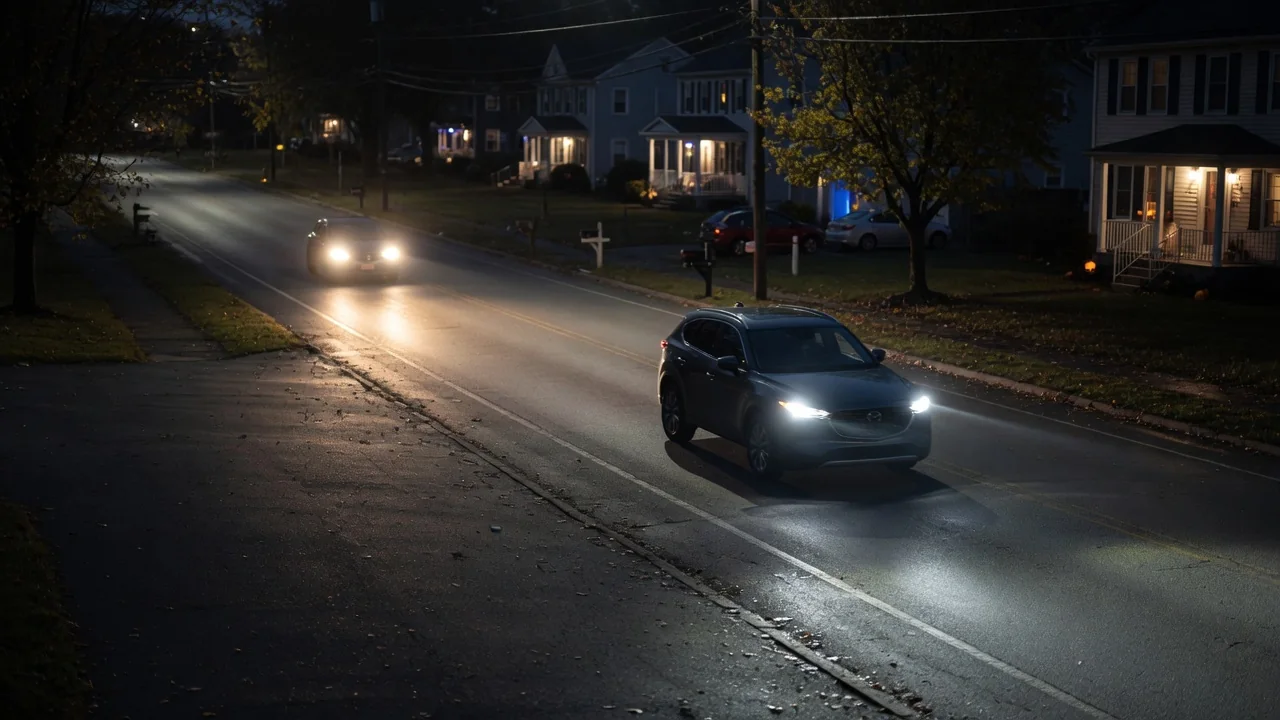
If you have wondered what is automatic high beam control, the short answer is that it is a driver-assistance feature that switches between high and low beams for you. A forward-facing camera watches the road for other vehicles' lights and dips the headlights when needed, then restores full illumination once the road ahead is clear again.
Detection
Most systems rely on a camera mounted high on the windshield, usually near the rearview mirror, often the same unit that supports lane-keeping or traffic sign recognition. Software analyzes each image for bright points that behave like headlights or taillights, judging their color, intensity, and movement across the frame. When it identifies an oncoming car or a vehicle ahead in the same lane, the control module commands the headlights to drop to low beam so the other driver is not dazzled.
The camera also reads ambient brightness. Rows of streetlights or a well-lit town generally tell the system that high beams are unnecessary, so it stays on low beam in built-up areas. Many vehicles also require a minimum road speed before the function becomes active, though the threshold differs by manufacturer. Drivers can observe the logic at work on a dark rural road: the beams lift after a short delay when the road empties, then dip as distant lights come over a hill.
Driver override
Automatic control never removes the driver's authority over the headlights. On most vehicles, pulling or pushing the turn signal stalk in the usual way switches the beams manually, and that input typically takes priority over the camera's decision. This matters when the driver sees something the system has not, such as a cyclist with a dim lamp, a pedestrian on the shoulder, or a vehicle cresting a rise whose lights are not yet visible to the lens.
How the feature is switched on and what happens after an override varies considerably. Some vehicles use a dedicated button or a position on the headlight switch, while others place the setting in an infotainment menu and require the light switch to sit in its automatic position. A manual override may pause the function until it is reselected, or the system may resume by itself. An instrument cluster indicator, often a headlight symbol with an A or the word AUTO, usually shows whether it is armed.
Limitations in weather
Because the system depends on a camera's view, anything that degrades that view affects its performance. Heavy rain, falling snow, and fog scatter light and reduce contrast, making it harder to distinguish distant taillights from reflections. In fog especially, high beams bounce back off the water droplets and create glare for the driver, so a system that keeps them on may actually be reducing visibility. In those conditions, selecting low beams manually is generally the sounder choice.
The windshield area in front of the camera is equally important. Ice, road salt film, condensation on the inside of the glass, or a worn wiper that leaves streaks can blur the image and cause late or erratic switching. Some vehicles display a message when the camera is blocked or temporarily unavailable, while others simply stop raising the beams without announcing it. Wet pavement can also confuse detection, since reflections from signs and puddles may be bright enough to resemble another vehicle's lamps.
Everyday Use and Observations
In daily driving, the feature is most useful on unlit highways and country roads where traffic comes and goes. Instead of flicking the stalk repeatedly, the driver gets high-beam illumination for more of the trip, which helps reveal animals, curves, and debris earlier. Owners often notice a brief hesitation before the beams rise again after a car passes; that delay is intentional, since it prevents rapid flickering when traffic is spaced closely together.
A few quirks show up with regular use. Highly reflective road signs can trigger a momentary dip, and the system may react late to a vehicle emerging from a sharp bend or side road because the camera cannot see around corners. Some vehicles go beyond simple on-off switching with adaptive or matrix headlights that shade only part of the beam around other road users, leaving the rest of the road lit. Whether a particular car has basic switching or this more advanced version depends on its equipment.
Limits and Next Steps
Automatic high-beam control is an aid, not a replacement for attention. It can miss road users whose lights are weak, obscured, or absent, including pedestrians, cyclists, and horse riders, and it may be slow to respond to trucks whose lamps sit outside the area the camera weighs most heavily. The driver remains responsible for dimming the lights whenever others could be dazzled, and local traffic rules about high-beam use apply regardless of what the system does.
If the feature stops working or behaves inconsistently, start with simple observations: check that the setting is enabled, the windshield is clean around the camera, and no warning messages are present. The owner's manual explains the activation steps, indicator symbols, and operating conditions for that specific model. Persistent problems, particularly after a windshield replacement or front-end repair, are worth raising with a qualified technician, because forward cameras often need calibration to see the road accurately, and the correct procedure is vehicle-specific.