What Is Headlight Leveling?
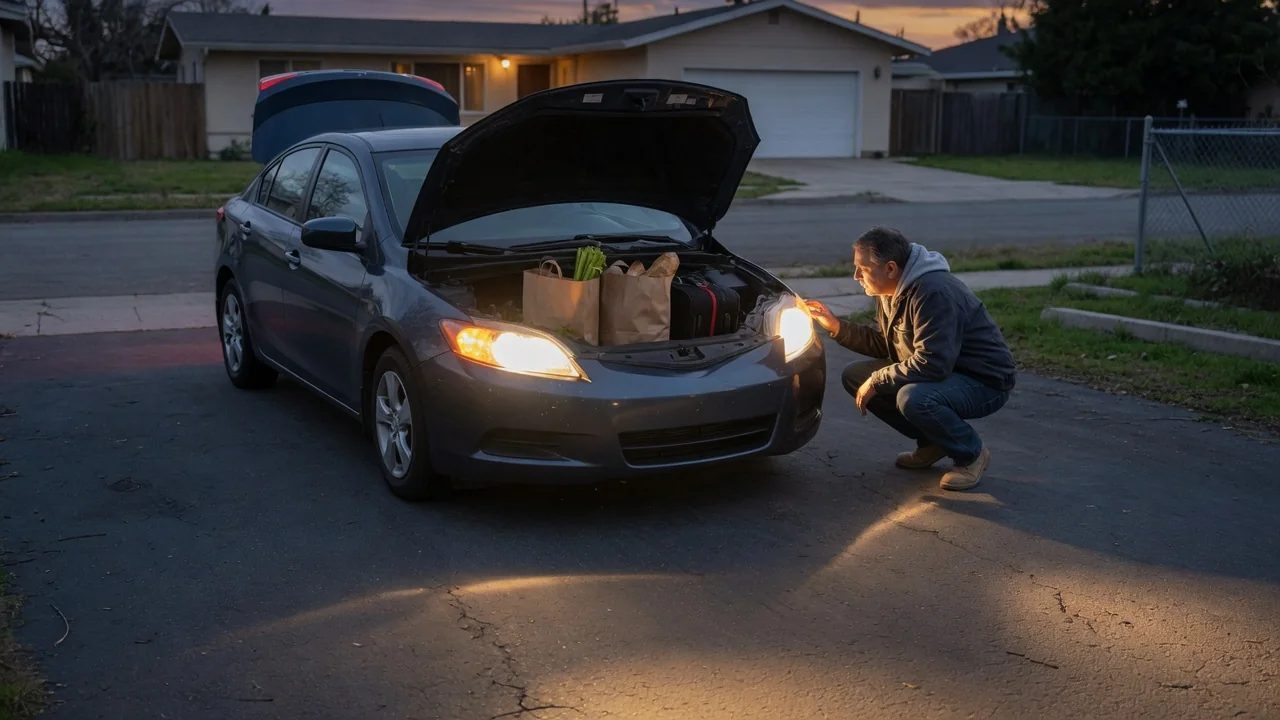
Anyone asking what is headlight leveling is really asking how a vehicle keeps its low beams pointed at the road when weight shifts the body. Leveling is the adjustment of the beam's vertical angle to compensate for cargo, passengers, or a trailer, so the light reaches the pavement ahead without glaring into the eyes of oncoming drivers.
Load effect
Headlights are fixed to the body, so their aim follows whatever the suspension does. When heavy luggage fills the trunk or adults occupy the rear seat, the rear springs compress and the tail sits lower. The nose rises by a small amount, and that slight change in pitch tilts the beams upward. Because a low beam is projected over a long distance, even a modest tilt at the lamp moves the bright part of the pattern noticeably higher down the road.
The opposite happens when weight sits over the front axle or the rear is unloaded after a heavy haul, since the beams then drop and shorten the lit stretch of road. Towing is a common example, because tongue weight pushes the rear down much like a full trunk. How much a given vehicle pitches depends on spring stiffness, wheelbase, and whether it has self-leveling suspension, so a softly sprung wagon and a stiff pickup can respond very differently to the same load.
Manual and automatic systems
A manual system gives the driver a control, often a thumbwheel or dial near the headlight switch, marked with numbered positions. Turning it sends a signal to small electric motors behind each lamp that tilt the reflector or projector downward in steps. The lowest number usually represents an unloaded car, with higher settings lowering the beam for heavier loads. The owner's manual typically explains which position matches which combination of passengers and cargo for that particular model.
Automatic systems remove the guesswork by using ride height sensors attached to the suspension, commonly at the front and rear axles. A control module compares the readings, calculates body pitch, and commands the lamp motors to correct the angle. Some versions adjust only when the vehicle is loaded and started, while more advanced dynamic designs also react to pitch during acceleration and braking. Whether a vehicle has manual, automatic, or no leveling varies by market, trim level, and lamp technology.
Aiming concerns
Leveling is not the same as basic headlight aim. Every lamp has a baseline aim set mechanically, and the leveling system only shifts the beam around that starting point. If the baseline is wrong, perhaps after a front-end repair, a lamp replacement, or a suspension modification, the leveling range may not be able to bring the beam back where it belongs. A lifted truck or lowered car can end up with a pattern that sits outside what the motors can correct.
Beams aimed too high create glare for oncoming traffic and for drivers ahead who catch the light in their mirrors, while beams aimed too low cut the distance a driver can see at night. Bright light sources with a sharp cutoff line make errors more obvious, because the edge between light and dark is so distinct. Proper aiming is normally checked with the vehicle on level ground at its normal ride height, using equipment or procedures specified for that vehicle.
Everyday Use and Observations
On a car with a manual dial, the effect is easy to see when parked facing a wall or garage door at night. Rotating the control moves the cutoff line down in visible steps, and a faint motor sound may come from the lamps. Drivers who load up for a road trip can use this to lower the beams before leaving, then return the dial to its normal position once the cargo is unloaded, since forgetting leaves the road ahead dimly lit.
Automatic systems often show themselves at startup, when the beams sweep down and back up as the motors find their reference position. After that the corrections are usually subtle enough to go unnoticed. Signs worth attention include oncoming drivers flashing their lights repeatedly, a beam that seems to light only the area just ahead of the bumper, one lamp sitting higher than the other, or a warning message on the instrument cluster on vehicles that monitor the system.
Limits and Next Steps
Leveling has a limited range of travel and compensates only for pitch, so it cannot fix a cloudy lens, a weak bulb, a damaged lamp housing, or sagging springs. A vehicle overloaded beyond its rated capacity may tilt further than the system can correct. Faults can also arise from the system itself, such as a seized adjuster motor, a bent or disconnected sensor linkage, or wiring damage, and any of these can leave the beams stuck at one angle.
When a warning appears or a stored fault code points to the leveling system, the code should be treated as a starting clue rather than proof that a specific part has failed, and its meaning should be confirmed for that exact vehicle. A sensible next step is to read the owner's manual for the correct dial settings and to have beam aim checked by a qualified shop, particularly after suspension work, collision repair, or lamp replacement, where recalibration may be required.