What Is a Solid Front Axle?
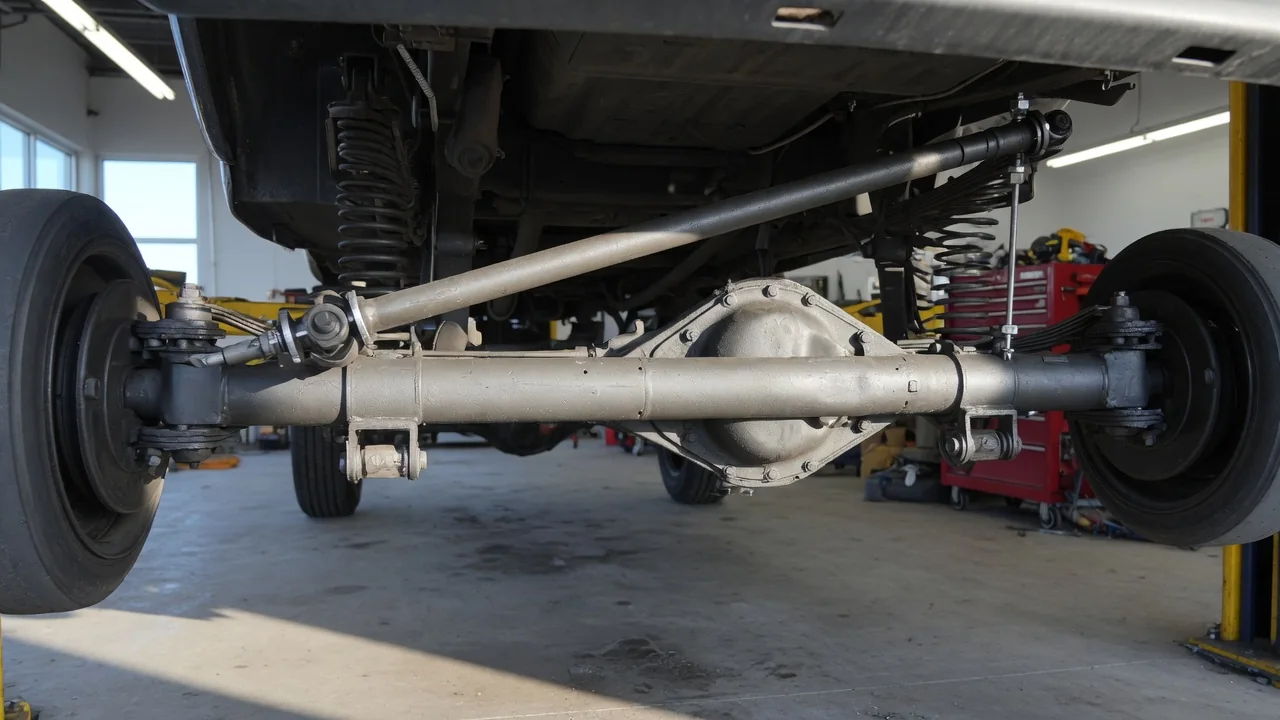
Anyone asking what is a solid front axle is really asking how two front wheels can share one rigid structure. Instead of each wheel moving on its own set of arms, both are tied to a single beam or housing that spans the width of the vehicle. That simple idea brings real strength and some clear compromises, and understanding both helps explain why the design persists in certain trucks and off-road vehicles.
Construction
A solid front axle, also called a beam axle or live axle when it drives the wheels, is a rigid assembly running from one front wheel to the other. On a four-wheel-drive vehicle, the beam is usually a hollow housing containing a differential and two axle shafts. On a two-wheel-drive truck, it may be a plain forged or tubular beam with no gears inside. At each end, a steering knuckle pivots on ball joints or kingpins so the wheels can turn while the beam itself stays fixed in width.
The axle does not bolt directly to the frame. It is located by leaf springs, or by coil springs working with control arms and a lateral bar often called a track bar or Panhard rod. A steering linkage made of a drag link and tie rod connects the steering box to the knuckles. Looking under the front of a vehicle, a solid axle is easy to spot as one continuous tube or beam, often with a rounded differential bulge offset to one side. Exact layouts differ between manufacturers and model years.
Movement
Because both wheels share one beam, what happens to one side affects the other. When the left wheel climbs over a rock or drops into a pothole, the entire axle tilts, which changes the angle of the right wheel as well. Independent front suspension, by contrast, lets each wheel rise and fall with little influence on its partner. The linked motion of a solid axle is the root of most of its strengths and weaknesses, on pavement and on the trail alike.
That tilting motion is called articulation, and it is valuable on uneven ground. As one wheel is pushed up into the fender, the beam pivots and presses the opposite wheel down, helping both tires stay in contact with the surface. Ground clearance under the differential also stays fairly constant as the suspension compresses, since the housing moves with the wheels. The cost is that the whole heavy assembly moves as unsprung weight, so a sharp bump on one side can be felt across the front of the vehicle.
Applications
Solid front axles appear most often where durability and load capacity matter more than refined ride quality. Heavy-duty pickups, some dedicated off-road utility vehicles, commercial trucks and many older four-wheel-drive models use them. The design has few moving joints compared with independent setups, and the stout housing tolerates heavy front-end loads such as plows, winches and large tires. Many passenger cars and lighter trucks moved to independent front suspension over time for better handling and comfort on paved roads.
The design also appeals to people who modify vehicles. Raising ride height on a solid axle generally involves different springs and adjusted locating links rather than changing the angles of multiple control arms and halfshafts. Stronger shafts, lower gearing and locking differentials are widely fitted to beam axles in off-road builds. Whether any particular vehicle uses a solid front axle, and which type, depends on its generation, drivetrain and trim, so the owner's documentation or a look underneath is the reliable way to confirm it.
Everyday Use and Observations
On the road, a vehicle with a solid front axle tends to feel firmer and busier than one with independent suspension. Bumps that strike one wheel can produce a side-to-side head toss, and steering may feel less precise because the linkage must accommodate the axle moving up and down. Rough pavement can send more feedback through the steering wheel. Well-tuned springs, shock absorbers and a steering damper reduce these traits considerably, and some modern designs ride far better than older ones, though the basic character usually remains.
Certain observations deserve attention rather than acceptance. A violent front-end shake after hitting a bump at speed, commonly nicknamed death wobble, points to looseness somewhere in the steering or suspension rather than normal behavior. Wandering on the highway, clunks when turning or uneven tire wear can indicate worn track bar bushings, tie rod ends, ball joints or steering components. Grease or gear oil around the knuckles or along the housing suggests a seal concern. These signs narrow the possibilities but do not identify a single failed part by themselves.
Limits and Next Steps
The limits of a solid front axle follow directly from its construction. High unsprung weight makes it harder for the tires to follow small, rapid bumps, which affects ride comfort and grip on broken pavement. Linked wheels mean camber cannot be tuned independently, and the assembly takes up space that could otherwise hold an engine set lower in the chassis. Handling at speed is generally less sharp than with an independent layout. For drivers who rarely leave pavement or carry heavy loads, those tradeoffs may outweigh the toughness.
For anyone deciding between vehicles, the sensible next step is matching the axle type to actual use. Frequent rock crawling, towing or front-mounted equipment favors the beam design, while commuting and highway travel favor independent suspension. Current owners benefit from having the steering and suspension joints inspected periodically according to the manufacturer's maintenance schedule, especially after fitting larger tires or a lift, which add stress to every link. Any persistent shake, looseness or leak warrants a professional inspection, since several components can produce similar symptoms on this kind of front end.