What Is a Headlight Relay?
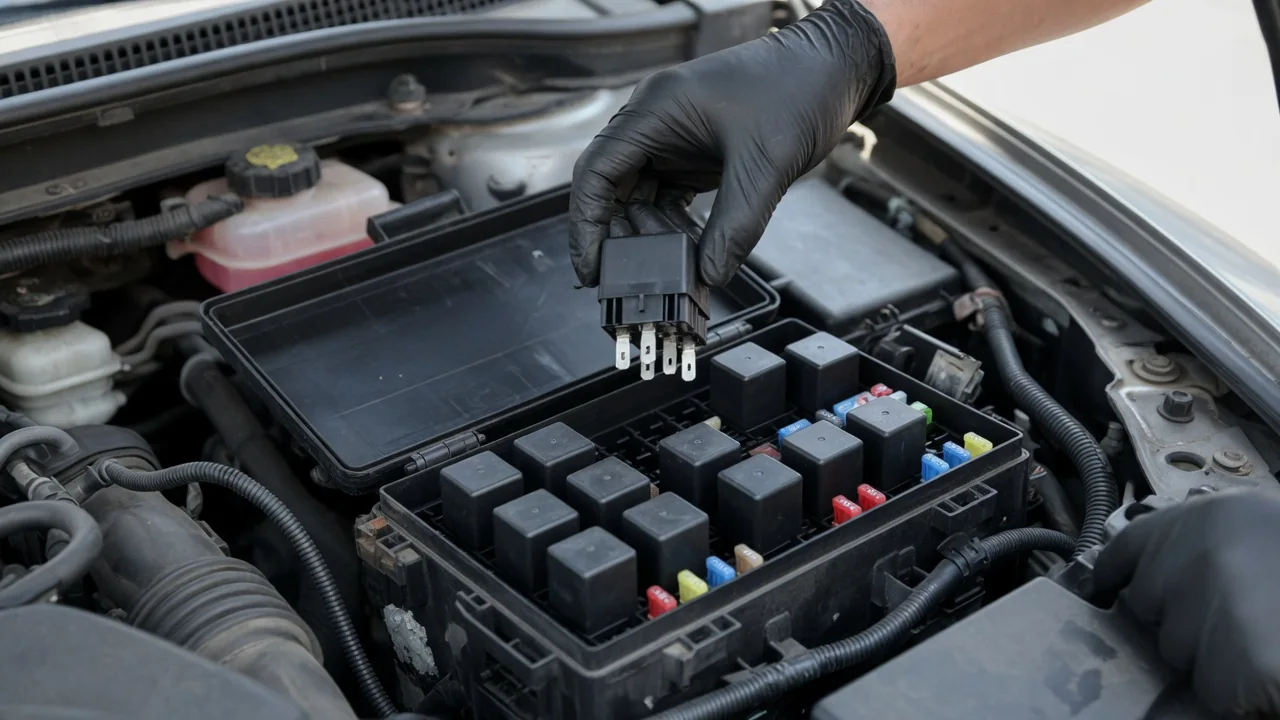
What is a headlight relay? It is an electrically operated switch that lets a small control signal turn on the much larger current the headlamps draw. Instead of routing full lamp current through the switch on the steering column or dash, many vehicles use a relay near the battery or fuse box to do the heavy work, protecting delicate controls and helping the lamps receive steadier voltage.
Control path
A headlight relay has two separate sides. The control side is a small coil of fine wire that becomes an electromagnet when it is energized. The load side is a set of heavier contacts that close when the magnet pulls a movable arm toward them. When the driver turns the headlamp switch, only a light current flows through the coil. That gentle signal closes the contacts, and the contacts carry the high current from the battery supply to the low beam or high beam circuits.
How the coil gets its signal depends on the vehicle. In older and simpler designs, the headlamp switch or dimmer switch feeds or grounds the coil directly. In many newer vehicles, the switch only sends a request to a body control module, which then energizes the relay or drives the lamps through solid-state electronics with no serviceable relay at all. Automatic lighting, daytime running lamps and separate high and low beam circuits can each add their own control path, so the wiring diagram for the specific vehicle is the reliable reference.
Fuse and relay
The fuse and the relay do different jobs in the same circuit. A fuse is a protection device that opens permanently when current rises beyond what the wiring can safely carry, such as during a short to ground. A relay is a switching device that turns the circuit on and off on command. In a typical layout, battery power passes through a fuse or fusible link, reaches the relay contacts, and continues to the lamps only while the coil is energized.
Vehicles differ in how they arrange these parts. Some use one relay for both headlamps with separate fuses for the left and right sides, so a single blown fuse darkens one lamp while the other stays lit. Others use dedicated relays for low and high beams. Relays and fuses usually sit in an underhood power distribution box or an interior fuse panel, and the cover or owner's manual normally carries a diagram identifying each position. Labels and locations are not standardized, so they should be confirmed for the exact model.
Fault clues
Because a relay commonly feeds more than one lamp, the pattern of a failure is a useful clue. Both low beams going dark together while the high beams still work points toward something the low beams share, such as a relay, a fuse, the switch or a control module output. A single dead lamp more often suggests a bulb, connector, ground or side-specific fuse. Contacts that stick closed can leave the headlamps on after the switch is turned off, draining the battery.
Intermittent behavior deserves attention too. Lamps that flicker over bumps, cut out when warm or work only after several tries may reflect worn relay contacts, a loose terminal in the fuse box or corrosion in a socket. A relay that clicks is showing that its coil works, but pitted contacts can still fail to pass enough current. On vehicles that store lighting fault codes, a code is evidence that narrows the search rather than proof that a particular part has failed, and manufacturer-specific codes need vehicle-specific interpretation.
Everyday Use and Observations
In normal driving, a healthy headlight relay goes unnoticed. Some drivers hear a faint click from the fuse box when the lamps come on or when switching between low and high beams, which is simply the contact arm moving. Others hear nothing because the relay is well insulated or because the vehicle uses electronic drivers instead. The practical benefit shows up as consistent brightness, since a short, heavy path from battery to lamp loses less voltage than a long run through the cabin switch.
That same principle explains why relays matter most with power-hungry lighting. Traditional halogen bulbs draw considerable current, and passing it through a small column switch for years can heat and wear the switch contacts. Using the switch only to signal a relay keeps that load out of the cabin wiring. Vehicles with LED or high-intensity discharge headlamps often manage power differently, with ballasts, driver modules or computer-controlled outputs, so the presence, number and role of relays varies widely from one design to another.
Limits and Next Steps
Understanding the relay's role helps frame a lighting problem, but it does not replace proper diagnosis. Dark headlamps can stem from bulbs, fuses, grounds, connectors, switches, modules or wiring damage, and replacing a relay on suspicion alone can waste money while the real fault remains. Reasonable owner-level checks include confirming which lamps and beams are affected, looking over the relevant fuses identified in the manual and noting whether the problem is constant or intermittent, including any conditions that seem to trigger it.
Beyond those observations, testing belongs with the correct wiring information and suitable equipment. Substituting parts, bridging terminals or fitting a higher-rated fuse can overheat wiring or damage control modules. A repeatedly blown fuse signals a fault that needs to be found rather than bypassed. Because working headlamps are essential for seeing and being seen, a vehicle with unreliable lighting should not be driven at night until the cause is confirmed. A qualified technician with the vehicle-specific diagram can verify power, ground and control signals at the relay and trace the circuit accurately.