What Is a Car Relay?
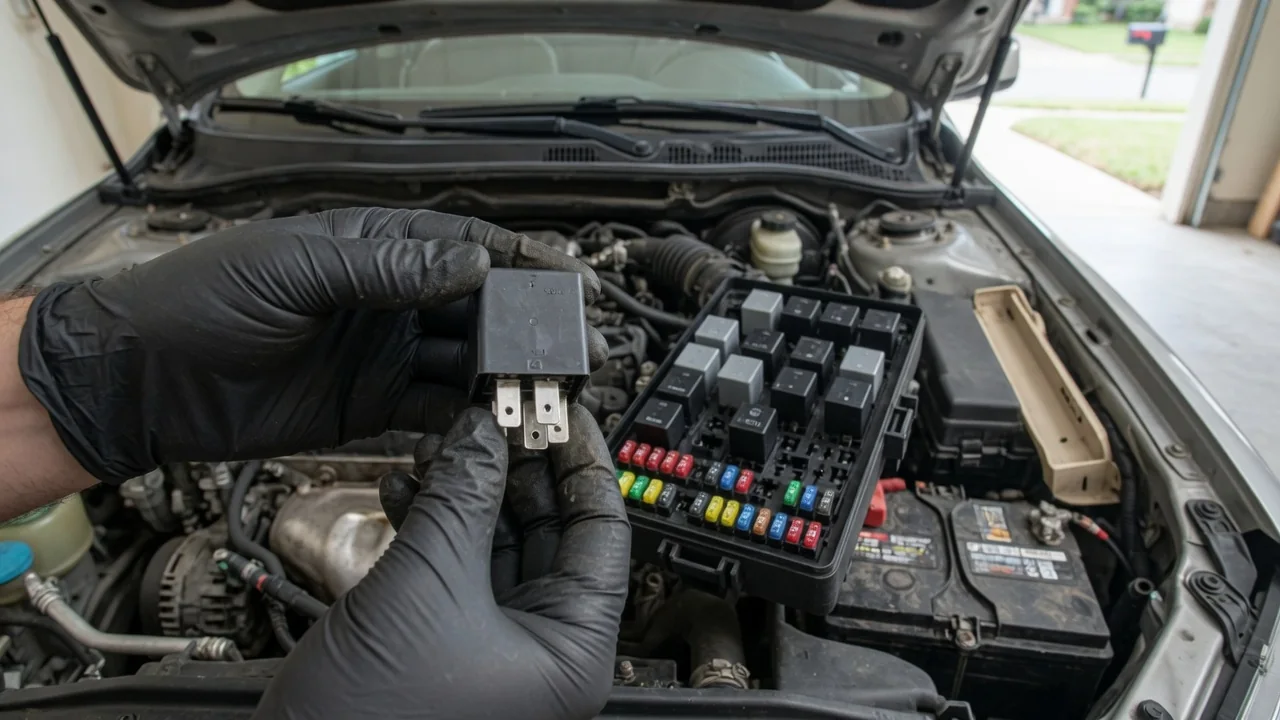
What is a car relay? It is an electrically operated switch that lets a small current control a much larger one. Instead of routing heavy current through a dashboard switch or a control module, the vehicle uses a relay to do the heavy switching near the load. Understanding this simple device makes fuse box labels, clicking sounds, and many electrical symptoms easier to interpret.
Control and load circuits
A typical electromechanical relay contains two separate circuits. The control circuit is a coil of fine wire; when a switch or control module sends a small current through it, the coil becomes an electromagnet. That magnetic field pulls a movable arm, closing a set of contacts. Those contacts belong to the load circuit, which carries the heavier current from the battery, through a fuse, to a component such as a cooling fan motor or headlamp. The two circuits are not electrically joined inside the relay; they are linked only by magnetism.
This separation is the reason relays exist. A headlamp switch or engine computer can be built with thin wiring and delicate electronics because it only needs to energize the coil, while thick cable handles the load over a short path. Many relays have four or five terminals, and a diagram is often printed on the housing showing coil and contact positions. Terminal numbering, contact arrangement, and whether the relay rests open or closed differ between designs, so the vehicle's wiring diagram remains the reliable reference.
Common uses
Relays appear wherever a component draws more current than a switch or module should carry directly. Common examples include the electric fuel pump, radiator cooling fans, starter solenoid circuit, horn, headlamps, rear window defroster, air conditioning compressor clutch, and blower motor. Pressing the horn pad, for instance, typically completes only a small coil circuit; the relay then connects the horn to battery power. The same logic lets an engine control module switch the fuel pump on without passing pump current through its own circuit board.
Where these relays live depends on the manufacturer. Many vehicles group them in an underhood fuse and relay box, with others in a cabin panel, and the lid or owner's manual usually carries a legend identifying each position. Newer vehicles increasingly use solid-state switching inside control modules or integrated power distribution units, so a function that had a plug-in relay on an older car may have no serviceable relay at all. Checking the documentation for the specific vehicle avoids hunting for a part that isn't there.
Diagnosis boundary
A relay sits in the middle of a chain, and that position sets a boundary on what it can explain. When a fan, pump, or lamp does not work, the cause may be a blown fuse, a failed component, damaged wiring, a poor ground, a faulty switch, or a module that never commanded the relay on. A relay that stays quiet may simply be receiving no control signal. Likewise, a relay that clicks proves the coil is moving the contacts, not that the contacts are passing adequate current to the load.
Fault codes deserve the same caution. A stored code referencing a relay control circuit indicates that a module saw an electrical value outside its expected range; it is evidence pointing toward a circuit, not proof that the relay itself has failed. Wiring faults, connector corrosion, or the driven component can set similar codes, and many definitions are manufacturer-specific and need confirmation against vehicle-specific service information. Confirming the cause generally involves measuring voltage and continuity with the correct diagram, which is where professional diagnosis becomes worthwhile.
Everyday Use and Observations
In daily driving, relays mostly go unnoticed, but they do leave clues. A soft click from the fuse box when the ignition is switched on, or when the air conditioning or headlamps engage, is often a relay pulling in. Many cars produce a brief hum from the fuel pump at key-on as its relay closes for a moment. Turn signal ticking was traditionally produced by a flasher unit, though in many modern vehicles that sound is generated electronically through a speaker rather than by a mechanical part.
Changes in those familiar behaviors can be worth noting. An accessory that works intermittently, a fan that keeps running after shutdown longer than usual, rapid chattering from the relay box, or a component that stays on and drains the battery can all involve a relay whose contacts are worn, pitted, or stuck. Each of these symptoms has other possible causes too, including low battery voltage, which can make a healthy relay chatter. Writing down when the symptom occurs, and under what conditions, gives a technician useful starting information.
Limits and Next Steps
A relay can only switch; it cannot protect a circuit, regulate voltage, or compensate for a failing load. Fuses and fusible links handle overcurrent protection, and a motor that draws excessive current may overheat relay contacts repeatedly until the underlying problem is fixed. Relays that look alike are also not necessarily interchangeable, since current rating, terminal layout, and internal features such as suppression diodes or resistors can differ. Fitting a look-alike part with the wrong internals may damage wiring or sensitive control electronics.
Sensible next steps start with the owner's manual: locate the relevant fuse and relay, check the fuse visually, and note any heat discoloration, melted plastic, or corrosion around the socket. If a replacement is needed, match the part number specified for the vehicle rather than relying on appearance. Bypassing a relay with improvised jumper wires risks short circuits and unintended operation of components, so anything beyond basic inspection is best left to a qualified technician with the correct wiring diagram and test equipment.