What Is a Trunk Release Solenoid?
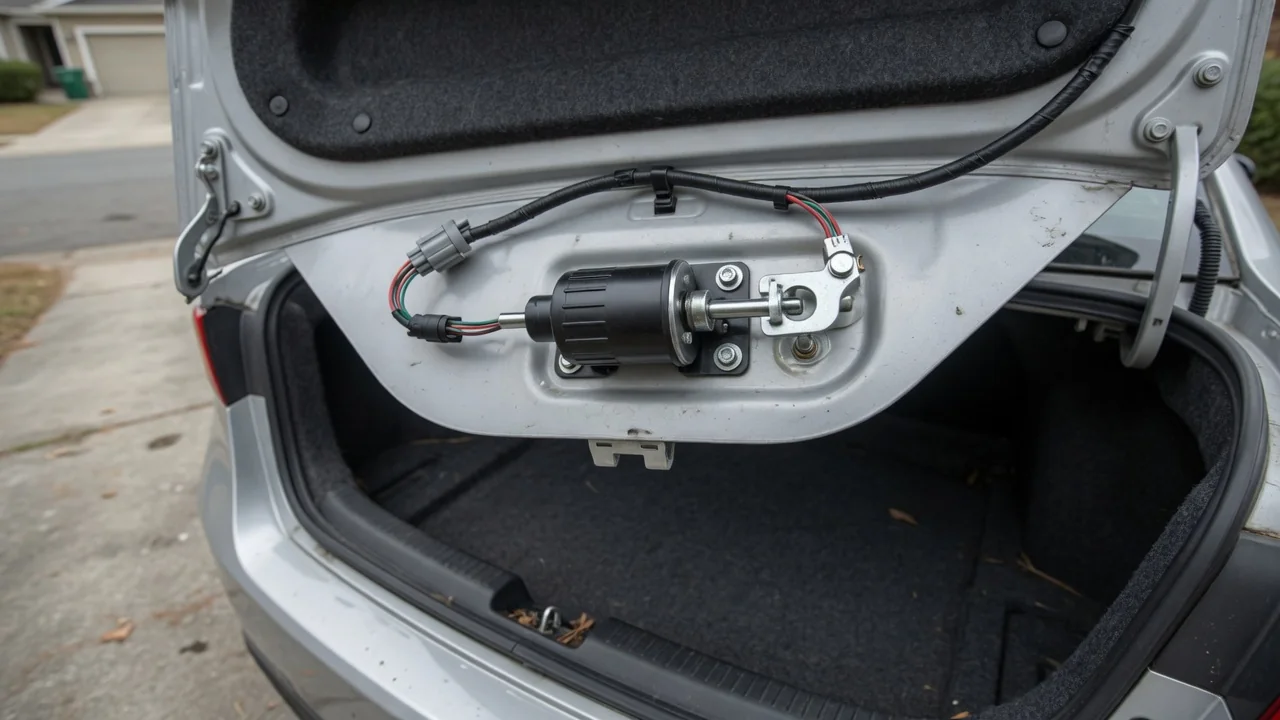
What is a trunk release solenoid? It is a small electromagnetic device mounted at or near the trunk latch that converts an electrical signal into a short mechanical pull, freeing the latch so the lid can open without a key in the lock. Understanding how it receives its command, how it moves, and what backs it up helps drivers interpret everyday trunk behavior.
Switch command
The release sequence begins with a request. That request may come from a button on the dashboard or driver's door, a key fob, or a touch pad hidden above the license plate. On older or simpler designs, the switch may feed current toward the solenoid more or less directly through a fuse and relay. On many newer vehicles, the switch only sends a low-current signal to a body control module, which decides whether to energize the latch circuit.
That decision often depends on conditions. A module may ignore the command while the vehicle is moving, when the doors are locked, when a valet lockout switch is engaged, or when the anti-theft system is armed. From the driver's seat, this looks like a button that works sometimes and not others, which is frequently normal logic rather than a fault. The exact rules differ between manufacturers and even trim levels, so the owner's manual is the best guide to what a given car expects.
Actuator
A solenoid in the strict sense is a coil of wire wrapped around a movable iron plunger. When current flows, the coil generates a magnetic field that draws the plunger inward, and that short, sharp stroke pulls a lever or rod connected to the latch pawl. With the pawl moved aside, the latch releases the striker and the lid's springs or struts lift it slightly. When current stops, a return spring resets the plunger for the next cycle.
Not every vehicle uses a true solenoid. Many modern latches contain a small electric motor with gears that performs the same release, and the part may be listed as a trunk latch actuator or integrated into the latch assembly itself. Drivers and parts catalogs often use the terms interchangeably. A solenoid tends to produce a single crisp click, while a motor-driven unit makes a brief whirring sound. Vehicles with power-operated lids add a separate drive mechanism that raises and lowers the lid after release.
Manual access
Because an electrical release depends on battery power, wiring, and a working actuator, vehicles generally provide some mechanical alternative. Common examples include a key cylinder in the trunk lid, a cable-operated lever beside the driver's seat, or a mechanical key blade tucked inside the fob that fits a concealed lock. Some designs rely on folding the rear seatbacks to reach the cargo area from the cabin. Which of these exist on a particular model varies widely, and some cars offer only one.
Passenger cars with enclosed trunks also commonly include an emergency release handle inside the trunk, typically a glow-in-the-dark pull that mechanically trips the latch from within. That handle bypasses the solenoid entirely, which makes it useful for confirming whether the latch itself still moves freely. Knowing where the manual options are before trouble arises matters most when the battery is dead, since a discharged battery leaves the electric release inoperative, and on some vehicles the battery itself sits in the trunk.
Everyday Use and Observations
In normal operation, pressing the release produces an audible click or thunk from the rear of the car, and the lid pops up an inch or so. The solenoid is energized only for a moment, so the sound is brief. Many vehicles accompany the release with a flash of the lights or a trunk-ajar indicator on the instrument cluster, which comes from a switch in the latch reporting that the lid is no longer fully closed.
Small changes in that routine are worth noticing. A click with no pop suggests the actuator is being commanded but the latch is not letting go, perhaps because of stiffness, misalignment, or a load pressing against the lid. Silence from the rear points more toward the command side: a lockout setting, a fuse, a switch, or wiring. Release that works from the fob but not the dash button, or the reverse, hints at the input rather than the actuator. Cold weather and frozen seals can mimic these symptoms.
Limits and Next Steps
These observations narrow possibilities but do not prove which part is at fault. The wiring harness that passes through the trunk hinge flexes every time the lid moves and can develop broken conductors, producing symptoms identical to a failed solenoid. On module-controlled systems, a scan tool may show body codes related to the latch circuit; such a code indicates where the module saw something unexpected and should be treated as a starting point for testing, with its definition confirmed for the specific vehicle.
Sensible first steps are simple ones: check the lockout or valet switch, try every available release method, and consult the owner's manual for fuse location and operating conditions. If the electric release stays dead, a technician can verify whether power and ground reach the actuator when commanded before any part is replaced. Because the solenoid is often built into the latch, replacement parts and procedures depend on the model, and correct fitment should be confirmed using the vehicle's identification details rather than assumed.