Why Does a Car Trunk Have an Interior Release?
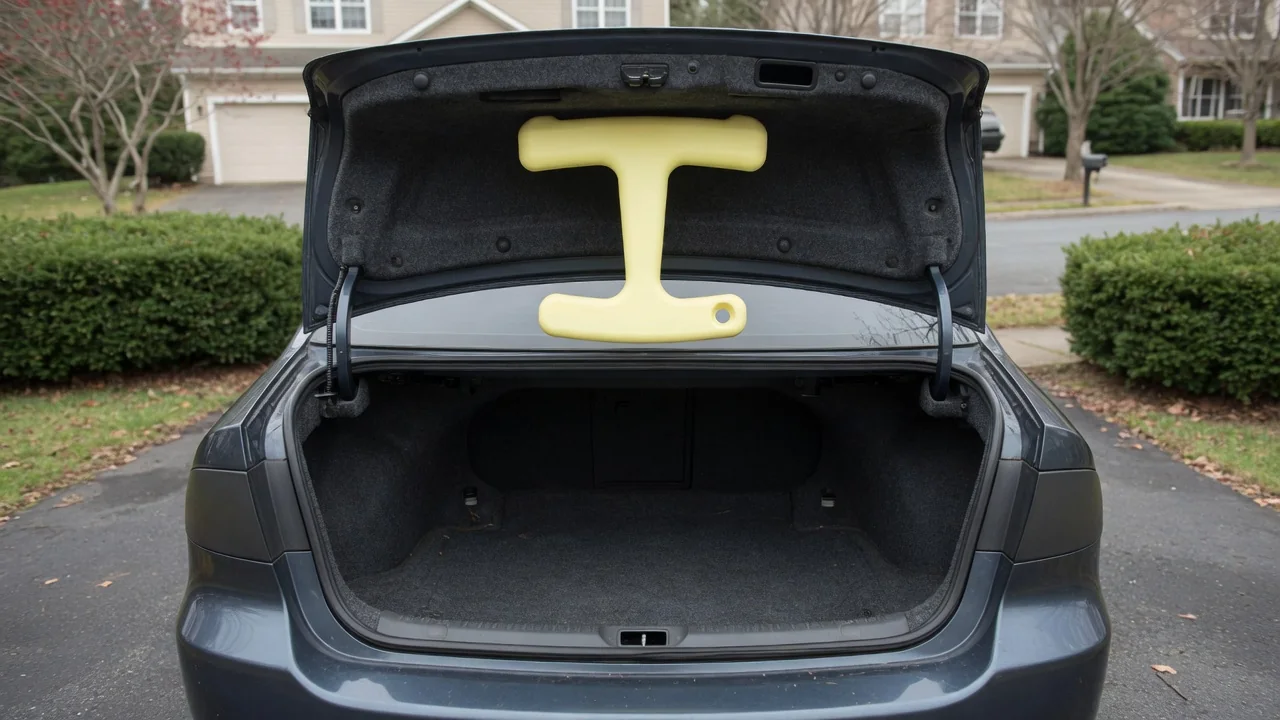
Anyone who has noticed a small handle inside the luggage compartment may wonder why does a car trunk have an interior release. The short answer is escape: a closed trunk is a sealed, dark space that cannot otherwise be opened from within. This handle gives a trapped person, often a child, a simple way to unlatch the lid and get out.
Release location
On most sedans and coupes, the interior release sits on or very near the latch itself, usually on the inner face of the trunk lid or along its lower edge. That placement is practical because the handle can act directly on the latch mechanism through a short cable or lever, with few parts between the pull and the latch. A short mechanical path means less that can stretch, bind, or disconnect over the life of the car, which matters for a device that may never be used until an emergency.
Location does vary by body style and manufacturer. Some vehicles mount the handle on the latch housing at the rear sill, while others hang it from the lid on a short tether. Hatchbacks, wagons, and SUVs often handle the question differently because the cargo area is open to the cabin, so an occupant can usually climb forward instead. The owner's manual normally shows where the release is on a particular vehicle, and it is worth opening the trunk in daylight to find it before it is ever needed.
Visibility
A release that cannot be found in the dark would be of little use, so visibility is a core part of the design. Many handles are molded from material that glows after being exposed to light, giving off a pale yellow or green tint once the lid closes. Each time the trunk is opened, daylight or the cargo lamp recharges that glow. Some vehicles use an illuminated handle instead, and the shape is often a simple T or loop that a small hand can grip without instruction.
Many handles also carry a pictogram, commonly a figure stepping out of a car, so that the purpose is clear to someone who cannot read or does not speak the language. Owners can check this for themselves by looking at the handle after the trunk has been open for a while, then viewing it in a dim garage. A handle that has faded, been painted over, or been covered by aftermarket trim or a trunk liner will be much harder to spot, which defeats much of its purpose.
Keeping cargo clear
The release only helps if it can be reached and pulled through its full travel. Tall luggage, stacked boxes, or a cargo organizer pushed against the latch area can pin the handle or block access to it. Soft items are less of a concern than rigid ones, but anything wedged tightly against the lid's lower edge can interfere. When loading the trunk, it helps to leave a little space around the latch so the handle hangs freely and the lid can swing upward without resistance.
Cargo can also damage the release over time. Heavy or sharp-edged loads that shift during braking may strike the handle, bend its bracket, or snag the tether or cable. Cargo nets, tie-down straps, and bungee cords should never be hooked to the handle, since it is not an anchor point and may be pulled out of position. After hauling bulky items, a quick glance to confirm the handle is intact and hanging where it should takes only a moment and catches most problems early.
Everyday Use and Observations
In daily driving, most owners never touch the interior release, and that is normal. It works independently of the key fob, the dashboard button, and the exterior touch pad, which are the usual ways to open the lid. Because it is a separate path to the latch, it may still operate when the battery is weak or an electrical switch has stopped responding, depending on whether the vehicle's design is purely mechanical or electrically assisted. That detail varies, so the manual is the right place to confirm how a given car behaves.
The handle is also a useful talking point for families. Children are drawn to trunks during play, and a closed compartment heats up quickly in warm weather while offering little fresh air. Showing children the glowing handle, explaining what it does, and making clear that the trunk is not a place to hide gives them knowledge they can use if the worst happens. Keeping the car locked and the keys out of reach when parked at home further reduces the chance that anyone ends up inside.
Limits and Next Steps
An interior release is a backup, not a guarantee. It depends on the person inside being able to find it, understand it, and pull with enough force, which may be difficult for a very young child or someone who is panicking. It also cannot help if the latch is jammed, the lid is blocked from outside, or the handle has broken or come loose. Older vehicles may not have one at all, and retrofit kits exist for some models, though fitment should be confirmed for the specific car.
If the handle is missing, cracked, no longer glows, or feels slack when pulled with the trunk open, it deserves attention from a qualified technician rather than being ignored. Latch mechanisms contain springs and linkages that are easy to misalign, so repairs are best left to someone familiar with the vehicle. Asking for the release to be checked during routine service is a simple step. A dealership or the owner's manual can confirm the correct part and how the system should work on that model.