What Is an Exhaust Downpipe?
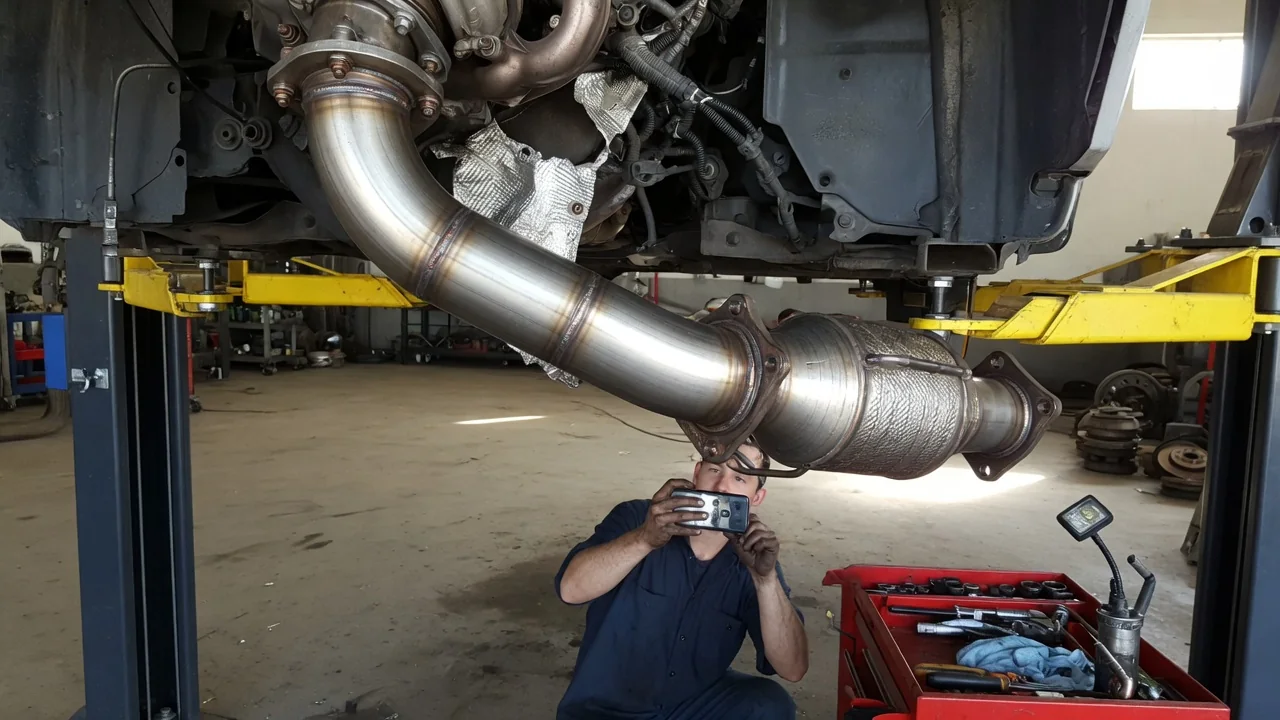
What is an exhaust downpipe? It is the section of pipe that carries hot gases away from the engine's exhaust manifold or, on a turbocharged vehicle, from the turbine outlet, and directs them down toward the rest of the exhaust system under the car. Knowing where it sits, how hot it runs, and how it is serviced helps make sense of noises, smells, and repair estimates.
Location
The downpipe gets its name from its direction of travel. Exhaust leaves the cylinder head high in the engine bay, and the pipe turns that flow downward, past the firewall or alongside the transmission, to meet the piping that runs beneath the floor. On a turbocharged engine it bolts directly to the turbine housing outlet. On a naturally aspirated engine, the equivalent piece attaches to the manifold or header collector and is sometimes called a front pipe instead.
Looking from above with the hood open, you may only see the upper flange, a heat shield, or an oxygen sensor wire disappearing downward. From underneath, the lower end is easier to spot where it joins a flex section or the mid-pipe. Layout varies widely: transverse engines may route the pipe at the front or the rear of the block, V engines can have one per cylinder bank, and many modern vehicles build a catalytic converter into this section.
Heat
Because it sits immediately after the engine or turbo outlet, the downpipe handles exhaust gas at close to its hottest point in the whole system. Gas leaving a turbine has given up some energy spinning the wheel, yet it remains hot enough to make the pipe glow under sustained heavy load on some engines. That is why manufacturers typically use thick-walled steel or stainless alloys here and surround the pipe with metal shields or insulating wraps.
That heat is also useful. Catalytic converters need to reach operating temperature before they clean up emissions effectively, so placing one in or just after the downpipe helps it warm quickly after a cold start. The trade-off is that nearby parts live in a harsh environment. Wiring, coolant hoses, steering components, and rubber boots rely on shields and air gaps for protection, so a missing or rattling shield deserves attention rather than removal. Discolored metal and surface rust on the pipe itself are common and not necessarily a fault.
Service context
In a workshop, the downpipe comes up most often as something in the way or something leaking. Technicians may need to remove it to reach a turbocharger, clutch, steering rack, or oil pan, depending on the vehicle. Its fasteners endure repeated heat cycles, so seized studs and nuts are a familiar complication that can add labor time. Gaskets or clamp-style seals at each end are usually replaced whenever the joint is disturbed, since reused seals can leak.
Emissions equipment adds another layer. Oxygen or air-fuel ratio sensors are frequently threaded into this pipe, and a catalytic converter may be part of it. A fault code relating to catalyst efficiency or sensor readings is evidence to interpret, not proof that the downpipe or converter has failed; exhaust leaks, sensor issues, and engine running problems can produce similar results. Some codes are manufacturer-dependent, so their meaning should be confirmed against information for the specific vehicle before any part is condemned.
Everyday Use and Observations
In normal driving a healthy downpipe goes unnoticed. Signs that something has changed tend to be audible first: a ticking or puffing sound that is loudest on a cold start and may fade as the metal expands, a deeper drone under acceleration, or a metallic buzz from a loose heat shield. An exhaust smell in the cabin or around the engine bay, especially when stationary, is a more serious hint because leaks this far forward are close to the ventilation intake.
Visual clues help too. Black soot streaks around a flange or along a flex section often mark the spot where gas is escaping. On any engine, a leak ahead of the oxygen sensor can upset fuel mixture readings, and drivers sometimes notice a warning light before they hear anything. How obvious these signs are depends on the vehicle; an engine cover, undertray, or tightly packed bay may hide the pipe entirely, making a lift inspection the only practical way to see it.
Limits and Next Steps
There are limits to what a general description can tell you. Pipe diameter, material, the number of catalytic converters, sensor positions, and even whether the manufacturer uses the term downpipe at all differ between makes and engines. Aftermarket versions sold for performance raise their own questions, because altering or removing a catalytic converter can violate emissions regulations, trigger warning lights, and may require engine calibration changes. Legality and compatibility need to be checked for the specific vehicle and location before buying anything.
A sensible next step is to locate the pipe on your own vehicle using the service information or a parts diagram for that exact model, then compare it with what you can see. Any inspection should wait until the exhaust is completely cold, since this section stays dangerously hot long after shutdown. Suspected leaks, persistent warning lights, or exhaust odors inside the cabin are best handed to a qualified technician, who can test the system and confirm the cause before parts are replaced.