What Is an Auto-Dimming Rearview Mirror?
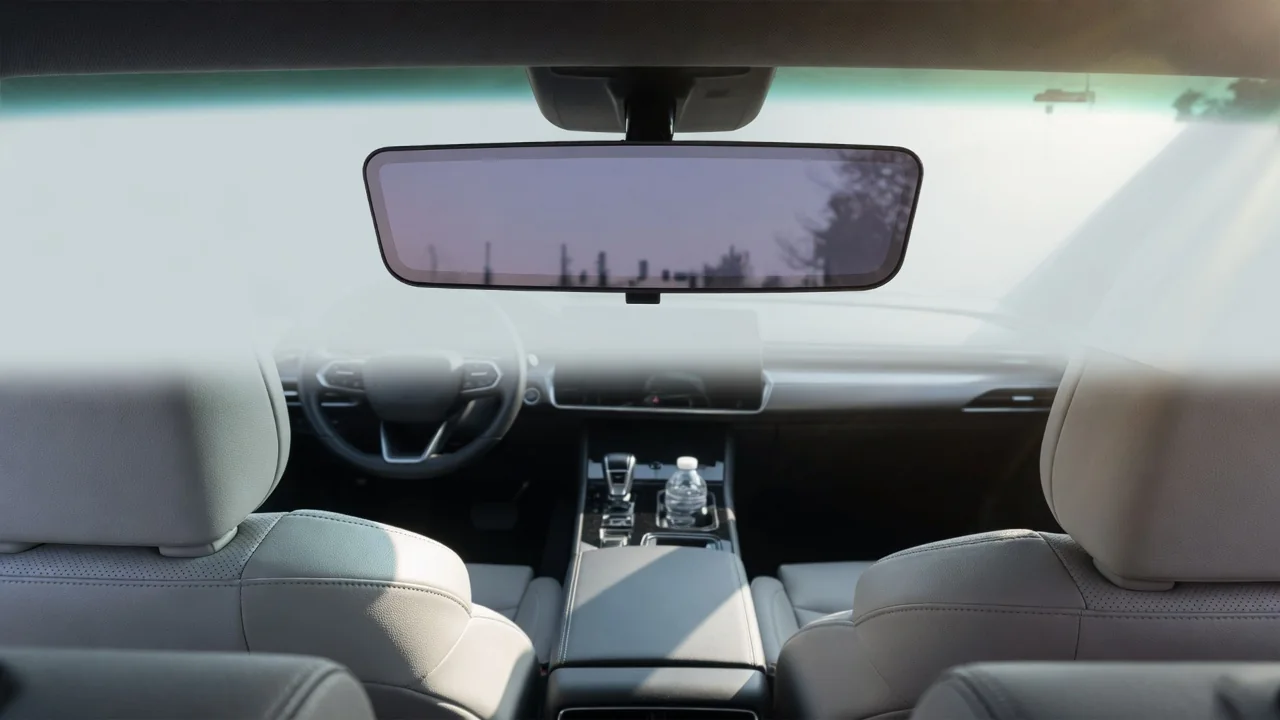
What is an auto-dimming rearview mirror? It is an interior mirror that darkens on its own when headlights from behind would otherwise glare into the driver's eyes, then clears again when the light fades. Instead of flipping a tab, the driver relies on sensors and an electrically reactive layer inside the glass. This guide explains how the sensing works, what the dimming looks like, and where the behavior differs.
Light sensors
Most auto-dimming mirrors rely on two light sensors working as a pair. One faces forward through the windshield and measures ambient light, telling the mirror whether it is day, dusk, or full night. The other faces rearward toward the back window and measures the light striking the mirror surface. The control circuit compares the two readings. When the surroundings are dark but the rear sensor sees strong light, the mirror concludes that headlights are producing glare and begins to darken.
You can usually spot the sensors as small round or rectangular openings, one on the mirror face or its lower bezel and one on the back of the housing. Their exact position varies by vehicle and mirror supplier, and some designs integrate them behind the glass where they are harder to see. Because the comparison depends on both readings, anything that blocks either opening, such as a toll transponder, a hanging tag, or a dash camera mount, can change how the mirror responds.
Dimming effect
The darkening comes from an electrochromic layer, typically a gel or thin film sandwiched between two pieces of glass. When the control circuit applies a small voltage, the material changes its chemistry and absorbs more light, so less of the headlight beam reflects back toward the driver. Remove the voltage and the layer gradually returns to its clear state. Nothing moves mechanically, which is why the change is silent and happens without any shift in the viewing angle.
What drivers see is a gradual tint rather than an on-off switch. The glass commonly takes on a bluish or greenish cast, and headlights behind shrink from harsh white bursts to softer, dimmer points. The amount of darkening usually scales with glare intensity, so a distant car produces a mild tint while high beams close behind produce a deeper one. The transition takes a few moments in each direction, and the speed and color differ between mirror designs.
Common exceptions
Several situations keep the mirror clear on purpose. In daylight the forward sensor reports bright surroundings, so the mirror does not dim even if sun reflects into it. Many vehicles also clear the mirror when reverse gear is selected so the driver gets the brightest possible view while backing up. Some mirrors have a power button and indicator light that let the driver switch the function off, while others stay active whenever the ignition is on with no visible control.
Equipment differences create further exceptions. On some vehicles the driver-side exterior mirror, or both exterior mirrors, dim together with the interior unit, while on others only the inside mirror is electrochromic. Mirrors that double as a camera display behave differently again: in display mode the screen shows a video feed and manages brightness electronically rather than by tinting reflective glass. Heavily tinted rear windows or privacy glass can also reduce the light reaching the rear sensor, making the dimming seem weak.
Everyday Use and Observations
In normal driving the feature asks nothing of the driver. On a dark highway, a pickup approaching from behind with tall headlights will trigger the tint within moments, and the glass clears after it passes or changes lanes. In well-lit city streets the mirror may barely react, because the forward sensor sees streetlights and storefronts and judges the scene as less dark. That behavior is expected; it reflects the comparison logic rather than a weak or failing mirror.
A simple observation can confirm the function works. In a dark garage or at night, with the ignition on, covering the forward-facing sensor with a hand while a flashlight shines toward the mirror face should cause the glass to darken visibly after a short pause. Uncovering it should let the tint fade. If a mirror has a small indicator light, it normally shows whether the function is enabled. Owner's manuals describe the specific controls, since button layout and indicators vary.
Limits and Next Steps
An auto-dimming mirror reduces glare but does not eliminate it. Very intense or poorly aimed headlights can still be uncomfortable, and light bouncing off non-dimming side mirrors is unaffected on vehicles without electrochromic exterior glass. Age can also take a toll: a mirror that shows a permanent discolored patch, a bubble-like boundary, or a line separating clear and dark areas may have a failing electrochromic cell. Any fluid seeping from the housing deserves prompt attention, since the material should not sit on skin or interior surfaces.
If the mirror never darkens, start with the simple checks: confirm the function is switched on, clear any obstruction from both sensors, and clean the openings gently. Should it still not respond, the cause could be the power supply, the wiring, the reverse signal input, or the mirror itself, and telling them apart takes vehicle-specific diagnosis. A qualified technician can test those circuits, and replacement units need to match the vehicle's connector and features such as a compass, garage door controls, or camera display.