What Is an Auto-Dimming Side Mirror?
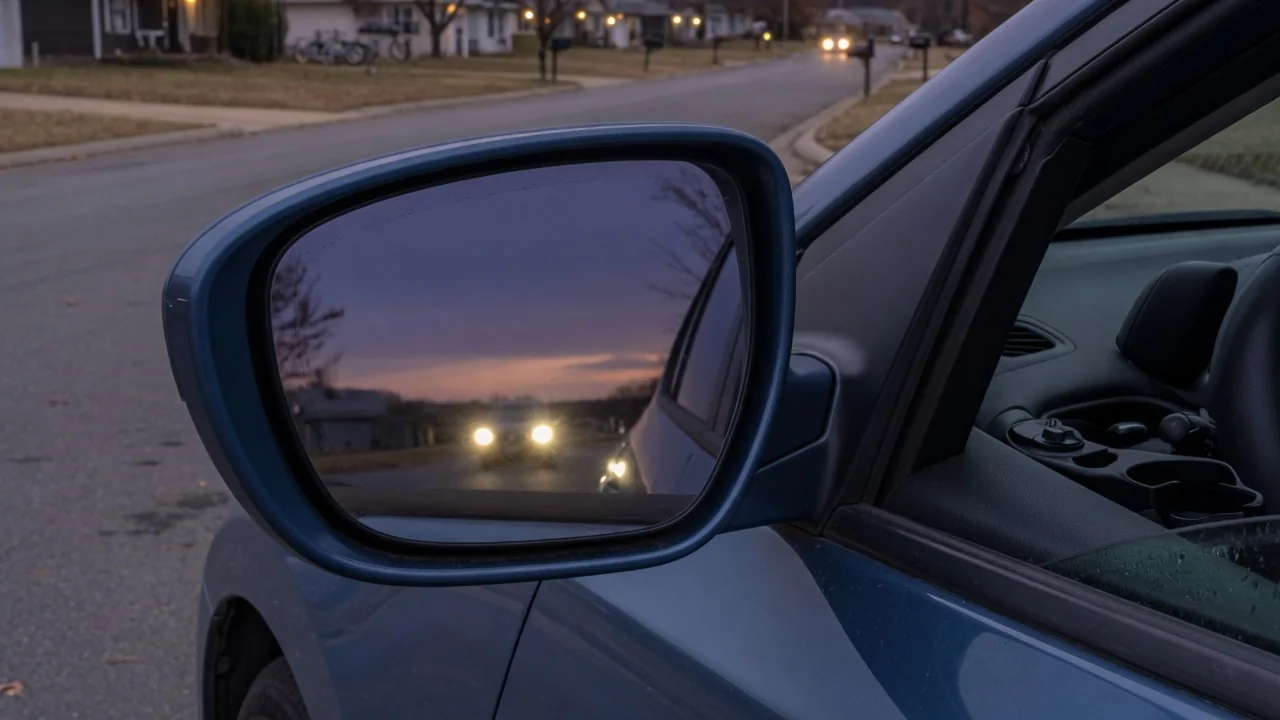
So what is an auto dimming side mirror? It is an exterior mirror whose glass darkens on its own when headlights from behind would otherwise dazzle the driver. Instead of relying on a manual adjustment, the glass uses an electrically controlled layer to cut glare at night, then returns to normal reflectivity once the bright light passes. Here is how it senses light, dims, and occasionally fails.
Light input
An auto-dimming system needs to know two things: how dark the surroundings are and how much light is arriving from behind. Many vehicles handle this with a pair of light sensors, one reading ambient light toward the front and another facing rearward to catch headlights. When the surroundings are dark and the rear-facing sensor sees a strong beam, the control circuit recognizes glare. In daylight the ambient reading stays high, so the mirrors remain clear.
On many designs those sensors live in the interior rearview mirror, and the exterior mirrors simply follow its command; other vehicles place sensing elsewhere, so the arrangement depends on the manufacturer. You can often spot a small lens or window on the face and back of the cabin mirror housing. A practical consequence follows: anything blocking those sensors, such as a hanging parking pass, a sticker, or cargo stacked high against the rear window, can change how the side mirrors respond.
Dimming
The darkening itself usually comes from electrochromic glass. A thin gel or film sits sandwiched between two pieces of glass with transparent conductive coatings, and when a small voltage is applied, the material turns darker and absorbs more of the light passing through to the reflective layer. The stronger the detected glare, the deeper the tint, so the response is graduated rather than a simple on-off switch. Remove the voltage and the layer clears again.
From the driver's seat, the change looks like the mirror taking on a blue-green or gray cast as a tailgating pickup's headlights fill the glass. The transition is gradual, taking a few moments rather than snapping instantly, and clearing takes similar time once the vehicle passes. Equipment varies: some models dim only the driver-side mirror, others both, and many base trims have none at all. The owner's manual or the build sheet confirms what a particular vehicle has.
Fault signs
A failing electrochromic mirror often announces itself visually. Common signs include a bubble-like ring or blotch spreading from one edge, a permanent yellow or brown tint, a clear line separating a dark zone from a light zone, or a mirror that stays dark in daylight. Fluid leaking from the glass edge is another warning, because the sealed layer has been breached. That material can mark paint and trim, so it deserves prompt attention and careful cleanup.
A mirror that never dims is harder to read, because the cause may sit outside the glass. A blocked sensor, a feature switched off, a wiring or connector problem in the door, or a fault in the interior mirror that sends the signal can all produce the same symptom. Heated mirror function and power adjustment may keep working normally while dimming fails, since they use separate circuits. Any stored fault code is a starting clue to interpret with vehicle-specific information, not proof that the glass itself has failed.
Everyday Use and Observations
In normal driving the feature works without any input. On a dark highway, headlights from a vehicle in the adjacent lane appear softened in the side mirror, while the vehicle's shape and position remain visible. Under streetlights in town, the mirrors may dim only slightly or not at all, because the ambient sensor reads the surroundings as fairly bright. Some vehicles also clear the mirrors automatically when reverse is selected, giving the brightest possible view for backing up.
A simple driveway observation can show whether the system is alive. At night, with the ignition on, covering the forward-facing sensor and shining a flashlight at the rear-facing one should make the mirrors darken visibly within several seconds on vehicles that use this layout. Some cabin mirrors include a power button with an indicator lamp, and that switch may control the exterior mirrors too. Routine care is ordinary: mild glass cleaner on a soft cloth, without scraping ice aggressively across the surface.
Limits and Next Steps
Auto-dimming reduces glare; it does not eliminate it, and it does nothing for blind spots or for dazzle coming through the windshield. Very bright or poorly aimed headlights can still be uncomfortable at maximum tint. A darkened mirror also shows unlit objects less clearly, which is one reason the system backs off quickly when the light source leaves. Cold weather can slow the transition in some mirrors, and window tint on the rear glass may alter what a cabin-mounted sensor sees.
If the feature seems absent or erratic, start by confirming the vehicle is actually equipped with it, then check that the function is enabled and the sensors are unobstructed. Persistent problems, visible discoloration, or leakage justify a professional inspection, where a technician can test the control signal before condemning the glass. Replacement parts must match the vehicle's connectors, heating, and any built-in turn signal or blind-spot indicator, so compatibility should be verified by the specific vehicle rather than assumed from appearance.