What Is a Wastegate Actuator and What Does It Do?
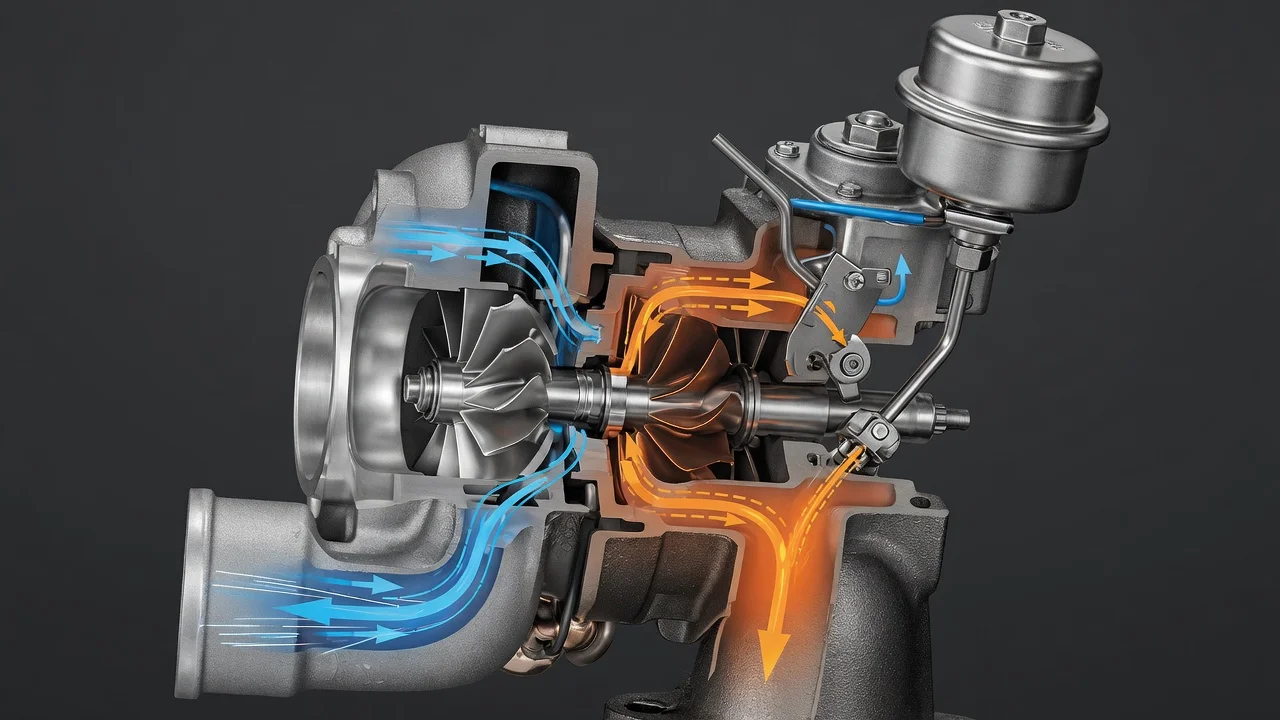
On a turbocharged engine, boost pressure has to stay within the limits the engine was designed for. The wastegate actuator makes that happen by opening a valve that lets part of the exhaust bypass the turbine. This guide explains what a wastegate actuator is, how it works and how designs differ between vehicles, including many VW models. It also covers what an owner can reasonably check before booking an inspection.
What a Wastegate Actuator Does
A wastegate actuator opens and closes the wastegate, a valve on the exhaust side of a turbocharger. When the wastegate is closed, nearly all exhaust gas flows through the turbine wheel. That spins the turbo faster and raises boost. When the wastegate opens, some exhaust is routed around the turbine, which slows the turbo and caps boost pressure. The actuator does not decide how much boost the engine gets. It is the part that physically moves the valve. Depending on the design, it responds to boost pressure, to vacuum or to commands from the engine control unit. In short, a turbocharger wastegate actuator protects the engine and turbo from overboost while still letting the system build pressure quickly when needed.
Not every turbocharged engine uses one in the same way. Some diesel engines regulate boost with movable vanes instead of a conventional wastegate, so the exact role depends on the vehicle configuration.
How the Turbo Wastegate Actuator Works
A typical wastegate actuator diagram shows a round canister mounted on the turbo or a nearby bracket, with a rod coming out of it. The rod connects to a lever on the turbine housing, and the lever is attached to a flap valve inside. Moving the rod rotates the lever, which swings the valve open or shut over a bypass port. On an internal wastegate, that port is cast into the turbine housing itself.
In a classic pressure-operated design, a hose feeds boost pressure to a diaphragm inside the canister. A spring holds the valve closed until pressure on the diaphragm overcomes the spring. At that point the rod extends and the valve begins to open. A boost control solenoid, managed by the engine computer, usually modulates that pressure signal. This lets the computer fine-tune boost according to load, temperature and other inputs. Electronic designs replace the diaphragm and spring with a small electric motor and a position sensor. The control unit can then set the valve position directly and confirm where the valve actually is.
Pneumatic, Vacuum and Electronic Designs
Pressure-operated actuators are common and simple. Their response depends on the hoses, the control solenoid and the condition of the diaphragm. Vacuum-operated actuators use vacuum from a pump or the intake, switched by an electrically controlled valve, so a leak anywhere in the vacuum supply can upset boost control. Electronic actuators are increasingly common on modern gasoline engines, including a number of turbocharged VW engines, because they allow more precise control. On some designs, the computer can hold the wastegate open at light load to reduce exhaust restriction, which a simple spring-and-diaphragm unit cannot do as freely.
Which type your car uses is part of its specific configuration. Two versions of the same model can differ by engine code, model year or market. A VW wastegate actuator for one engine may therefore not match another that looks similar. The engine code and the parts catalog for your exact vehicle are the reliable way to tell.
Other Factors That Change the Answer
The wastegate layout also matters. Most factory turbos use an internal wastegate built into the turbine housing. Many performance builds instead use an external wastegate, which is a separate valve with its own actuator mounted on the exhaust manifold or piping. Many modern diesel engines use variable geometry turbochargers, where an actuator moves vanes around the turbine rather than opening a bypass valve. The symptoms can look similar, but the parts and tests differ. Engine tuning that raises boost targets changes how hard the actuator and control system work. Hardware installed with modifications may also not match factory specifications.
Operating conditions matter as well. Actuators sit close to very hot exhaust components. Over time, repeated heat cycles, road salt and grime can affect linkages, bushings, hoses and electrical connectors. How quickly that happens depends on climate, driving pattern and design, so no single lifespan applies to every vehicle.
Signs of a Problem and What You Can Check
Several signs can point toward the wastegate system: • reduced power or boost that feels inconsistent; • a check engine light; • the engine entering a reduced-power mode; • a rattling or ticking sound from the turbo area, often most noticeable at idle or when lifting off the throttle; Overboost codes such as P0234 and underboost codes such as P0299 are generic codes that can involve the actuator. They can also be caused by boost leaks, sensor faults, a sticking valve or a control solenoid problem. A code identifies a condition, not a failed part.
With the engine off and fully cooled, an owner can do several useful things: • Read and record stored codes and freeze-frame data with a scan tool. • Look for cracked, disconnected or oil-soaked hoses running to a pneumatic actuator. • Check the electrical connector on an electronic unit for damage or corrosion. • Where the rod and lever are visible, look for obvious looseness or a disconnected linkage. It also helps to note when the symptoms appear, such as after cold starts, in hot weather or under heavy load. That pattern gives a technician a useful starting point.
Repair Decisions Worth Knowing About
Avoid adjusting the actuator rod length or forcing an electronic actuator by hand. Rod preload determines when the valve begins to open, and changing it can cause overboost or underboost. Electronic units can be damaged by being pushed manually. After replacement, they often need a basic setting or calibration with a capable scan tool, as described in the manufacturer service information. Depending on the design, the actuator may be sold as a separate part or supplied only with the turbocharger, which affects cost considerably. A rattle caused by worn linkage may call for a different repair than an actuator that has failed electrically. Diagnosis should come before buying parts.
Limitations and When to Get Professional Help
Wastegate actuators are generally not replaced on a fixed schedule, and there is no universal interval for inspecting them. Check the maintenance schedule and service history for your vehicle to see whether the manufacturer calls for turbo system inspection. The service history will also show whether related updates or campaigns have been performed. Diagnosing boost control properly usually needs live data, such as commanded versus actual boost or reported actuator position. It often also needs a smoke test for leaks, which goes well beyond a visual check.
Have the car inspected if it goes into reduced-power mode, shows boost-related codes or develops new mechanical noise from the turbo. Choose a technician with access to the manufacturer specifications for your exact engine. A wastegate stuck closed can allow excessive boost, so avoid hard acceleration and heavy loads until the system has been checked.