Internal Wastegate Actuator: Identifying the Mechanism
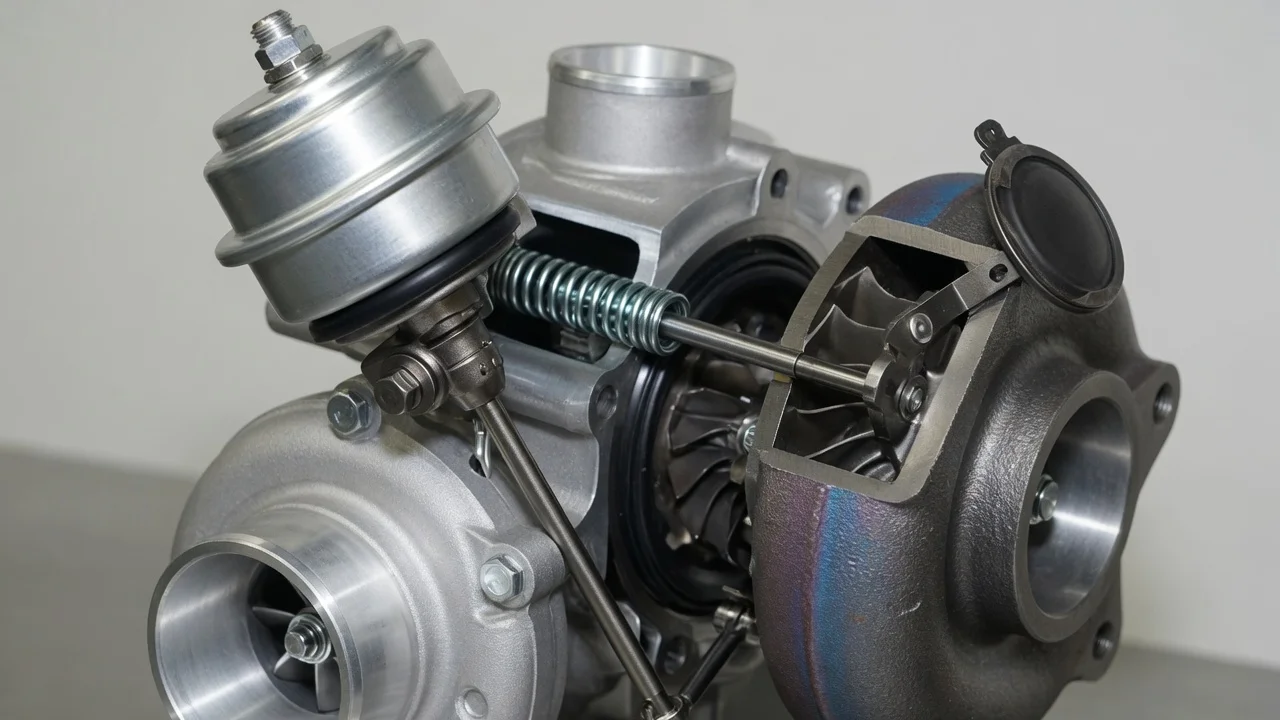
If you are looking at a turbocharged engine and trying to work out what controls boost, the internal wastegate actuator is usually the part to find first. This guide explains what the actuator is, how it moves the wastegate valve, how to tell it apart from similar-looking components, and what an owner can reasonably check before turning to vehicle-specific service information or a technician.
What an Internal Wastegate Actuator Is
An internal wastegate actuator is the device that opens and closes a bypass valve built into the turbocharger's turbine housing. The valve itself, often called a flapper or poppet, sits inside the housing and covers a port that lets some exhaust gas skip the turbine wheel. The actuator is mounted outside the turbo, usually on a bracket attached to the turbocharger body, and connects to the valve through a rod and a lever arm that passes through the turbine housing. If your turbo has a round canister or a compact electric motor unit linked by a rod to an arm on the hot exhaust side, you are almost certainly looking at an internal wastegate setup. Designs differ by vehicle configuration, so the factory service information remains the final authority for your engine.
How the Internal Wastegate Works
Exhaust gas spins the turbine wheel, which drives the compressor and builds boost in the intake. Without a way to divert some of that exhaust, boost would keep rising with engine speed and load. The wastegate provides a path around the turbine. When it opens, less exhaust energy reaches the turbine, so turbine speed and boost stop climbing. The actuator determines when and how far the valve opens.
In a common pressure-operated pneumatic actuator, a spring holds a diaphragm in position and keeps the valve closed. When boost pressure routed to the canister overcomes the spring, the diaphragm pushes the rod, rotating the arm and opening the valve. Many engines place a boost control solenoid in that hose so the engine computer can regulate the signal and manage boost more precisely than the spring alone. Some designs use vacuum instead, pulling the rod when vacuum is applied; whether that valve rests open or closed depends on the design. Electronic actuators replace the diaphragm with a motor, gear drive and position sensor, so the engine control module commands valve position directly and can check whether the valve actually reached it.
Configurations That Change the Answer
The actuator type is the biggest variable. A pressure or vacuum unit typically has one or two small hoses attached to a metal canister, while an electronic unit has an electrical connector and often a plastic or aluminum housing. Some engines with two turbochargers have a separate actuator on each turbo, and certain twin-scroll or compact turbo designs package the actuator very close to the housing, making it hard to see without removing heat shields.
Diesel engines deserve a specific caution. Many diesel turbochargers use variable geometry vanes rather than, or in addition to, a wastegate, and the vane actuator can look very similar to a wastegate actuator. It controls a different mechanism, so confirm which one you have before drawing conclusions. Operating conditions also matter: some electronic systems deliberately position the wastegate differently during warm-up, idle or light load, so a valve that is not fully closed at idle is not automatically a fault.
Telling It Apart from Look-Alike Parts
An external wastegate is a separate valve body mounted on the exhaust manifold or piping ahead of the turbo, with its actuator built into its own housing and usually its own outlet pipe. It is common on performance and modified builds and does not use a rod linked to an arm on the turbine housing. If the turbine housing has no lever arm and a separate valve sits on the manifold, the system is external rather than internal.
Two intake-side parts are frequently confused with the wastegate actuator. A blow-off or diverter valve releases compressed air when the throttle closes; it sits on the intake piping or compressor housing and has no mechanical link to the exhaust side. A boost control solenoid is a small electrically operated valve with hoses running to the actuator; it controls the actuator but is not the actuator itself.
How to Identify It on Your Vehicle
Work only on a cold engine that is switched off, because the turbine housing and nearby exhaust parts stay hot long after driving. Locate the turbocharger, then look for a rod running from a canister or motor unit to an arm on the exhaust side. Note whether the actuator has hoses, an electrical connector or both, and follow any hoses to see where they lead. Part numbers or labels stamped on the canister or housing can help you match the component to your exact vehicle configuration. Avoid removing heat shields you cannot reinstall correctly.
A basic visual inspection can reveal cracked or disconnected hoses, missing clips, a loose or detached rod, damaged connector pins or heavy corrosion at the arm pivot. Some technicians check pneumatic actuators by applying controlled pressure or vacuum with a hand pump and watching the rod move and hold; the correct test values come from the manufacturer specifications for your engine, not from general guidance. Do not adjust rod length or preload, since that directly changes boost behavior.
Symptoms Worth Investigating
Problems with the wastegate or its actuator often show up as sluggish acceleration and low boost, or as boost that rises too high before the engine computer intervenes. A warning light with generic codes such as P0299 for turbocharger underboost or P0234 for overboost may point toward the system. Some engines also develop a rattle from the turbo area when linkage or valve parts wear. These symptoms overlap with boost leaks, faulty sensors and solenoid problems, so a code alone does not prove the actuator has failed. Your service history is useful here: earlier turbo repairs, actuator replacement or software updates can narrow the likely causes.
Limitations and Next Step
This overview cannot tell you the exact layout, test values or repair procedure for your engine. On some turbochargers the actuator is serviced separately, while on others it is supplied only with the turbo assembly. Electronic actuators may require a calibration or learning procedure with a scan tool after replacement. The wastegate is generally inspected when a fault appears rather than on a fixed interval, but your maintenance schedule is the reference for any manufacturer-listed checks.
As a next step, gather your vehicle identification details, any stored codes and freeze-frame data, and a description of when the symptom occurs. Compare what you found against the service information for your specific engine. If boost control is erratic, the actuator rod is damaged, or diagnosis requires pressure testing or calibration, have a technician experienced with turbocharged engines carry out the work.