Electronic Wastegate Actuator: Operation and Diagnostic Considerations
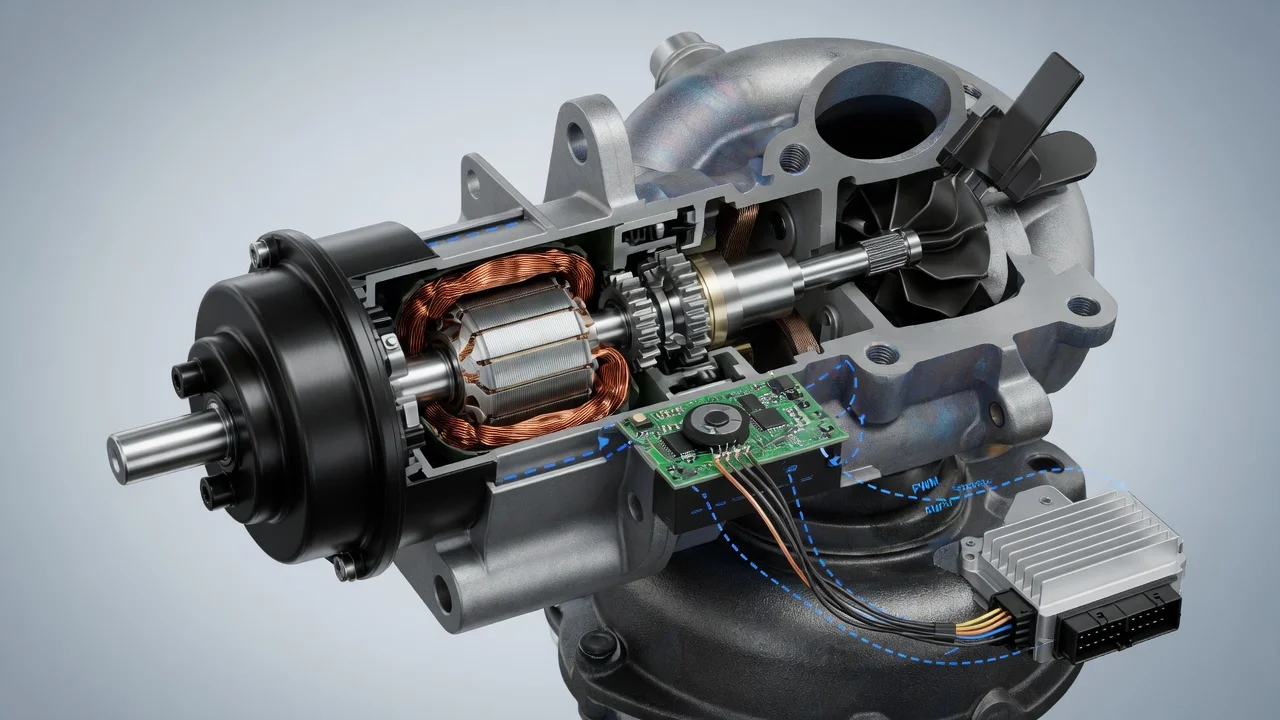
An electronic wastegate actuator lets the engine control module set turbocharger boost directly instead of relying only on vacuum or pressure signals. When it misbehaves, the result can range from a faint rattle to reduced power and a stored trouble code. A code, however, names a condition the computer monitored, not necessarily a failed part. This guide explains how the actuator works and how to move from symptoms to tests to a confirmed finding before buying anything.
How an electronic wastegate actuator works
A turbocharger's wastegate is a valve in the turbine housing that lets some exhaust bypass the turbine wheel. Closing it sends more exhaust through the turbine and raises boost. Opening it lowers boost. Older designs move the valve with a pneumatic diaphragm. An electronic version replaces that diaphragm with a small electric motor, a gear set and an output linkage that pushes or pulls the wastegate arm. A position sensor inside the actuator reports where the output is, so the engine computer can compare commanded and actual position.
Because the computer controls the valve directly, it can hold the wastegate open at light load to reduce exhaust back pressure, close it quickly when you accelerate and fine-tune boost from intake pressure and other inputs. On many vehicles the actuator also moves through its range during a self-check at key-on or shutdown. Some require a relearn of end stops after replacement or linkage work. The details, including whether a relearn exists and how it is triggered, vary by manufacturer and must come from the service information for the specific engine.
Establish the symptoms
Start by writing down exactly what happens and when. Note whether the problem appears cold or only after the engine is fully warm. Record whether it happens under hard acceleration, at steady cruise, at idle or right after startup. The following are all useful clues: reduced power, a hesitation that clears after restarting, a warning light, a reduced-power or limp mode message, a metallic rattle from the turbo area at idle or over bumps, and a whistle or whoosh that was not there before. Also note whether the engine feels flat everywhere or surges as if it has too much boost.
Before clearing anything, save every stored trouble code and its freeze-frame data. Freeze-frame data captures engine speed, load, temperature and other values at the moment the code set. Those symptom conditions often show what you need to recreate later. Also list recent changes: turbo or exhaust work, an engine tune, a battery disconnect, aftermarket intake parts, or a repair near the turbo where a connector or harness could have been disturbed. Generic codes that often appear with these complaints include P0299 for underboost, P0234 for overboost, P0045 for the boost control circuit, and P2562 through P2565 for the boost control position sensor. Manufacturer-specific codes are common too.
Distinguish plausible causes
Several different faults can produce the same symptom, so treat each as a hypothesis. The actuator itself can fail through motor wear, stripped gears or an internal sensor fault. A circuit-type code that sets at key-on with the engine cold supports an electrical fault in the actuator, its connector or its wiring. Some patterns fit mechanical binding or heat-related electrical trouble instead: a position code that sets only when the engine is hot, or a gap between commanded and actual position that grows as the engine warms up.
The wastegate valve and linkage are separate from the actuator motor. Worn bushings, a loose arm or an elongated linkage hole can cause rattle and inaccurate position control. Carbon or corrosion can make the valve stick. A rattle that disappears when the actuator holds the valve under tension supports linkage wear. If the linkage feels stiff or gritty when moved by hand, with the engine off and fully cooled, that supports binding at the valve or shaft rather than a weak motor.
Underboost without position errors often has a cause outside the actuator. Possibilities include a split intake hose, loose clamp or leaking intercooler, a restricted air filter, an exhaust restriction, a faulty boost or manifold pressure sensor, a leaking diverter or recirculation valve, or a worn turbocharger. These causes become more likely if the actuator reports reaching the commanded position while boost is still low. Overboost with normal position readings can point to a sensor reading error. It can also point to a linkage that has separated from the valve, so the actuator moves but the valve does not. This is why one observation rarely settles the question.
Checks in a useful order
Begin with checks any owner can do safely. With the engine off and the exhaust fully cool, look at the actuator connector for looseness, corrosion or heat damage. Follow the harness for melted insulation or chafing, and inspect the intake tract for loose clamps, oil-soaked hoses or splits. Listen for the rattle at idle and note whether it changes when engine speed rises slightly. Never reach near the turbo, the exhaust manifold or a moving linkage on a running or hot engine.
The next level needs a scan tool that shows live data. Compare commanded wastegate position with actual position, and boost or manifold pressure with the desired value, during a road test that reproduces the freeze-frame conditions. Where supported, a bidirectional actuator test lets you command the wastegate and watch the reported position respond. Some tools also show whether the computer has learned the end positions. Treat these readings as comparisons rather than absolute numbers unless you have the manufacturer specification.
Electrical and mechanical tests come after that. Checking power, ground, motor control and sensor circuits requires the wiring diagram, connector pinout and test values from service information, plus a meter used correctly. Probing the wrong pin can damage the module. Several further tests suit a qualified technician with the right equipment: a smoke test for intake leaks, a back-pressure check, measuring linkage free play against specification, and removing the actuator to inspect the valve. After any repair, finish with a confirmation test that recreates the original symptom conditions.
Interpret the findings
Each result narrows the field without automatically proving a part is bad. A circuit fault confirmed by wiring tests at the connector shows a problem in the harness or the actuator. A repaired wire or cleaned terminal must still be retested before you condemn the unit. If actual position follows the command smoothly across the range, a failed motor or sensor becomes less likely, and attention shifts to boost leaks, sensors or the turbocharger. If position lags, overshoots or stalls at the same point while the linkage feels free, that suggests an internal actuator fault. The same pattern with a stiff linkage points to the valve.
Replacing the actuator is justified when three things are true: its circuits test good, the linkage and valve move freely, and live data still shows it cannot reach or report the commanded position. Even then, check whether the replacement needs calibration, a relearn or a linkage length adjustment, since skipping that step can bring back the same code. A rattle with no codes and normal boost is usually a noise concern rather than a control failure. It still deserves a check that the play is within the manufacturer's tolerance. Clear codes only after recording them, then verify the repair under the conditions that originally set them.
Urgency and next action
Some signs justify stopping and arranging a tow or inspection instead of continuing to drive. These include sudden surging power that feels like overboost, a flashing check engine light, heavy smoke, a smell of fuel or burning oil, a loud new metallic noise from the turbo, or repeated drops into limp mode in traffic where losing power is dangerous. Overboost can stress the engine and turbocharger. Continued driving with an unknown fault can also turn a linkage or wiring repair into a larger one. No one can promise how far a vehicle will safely go with these symptoms.
To make the repair quicker and cheaper, bring the shop your notes. Include every code with its freeze-frame data, when the symptom appears, any noises, recent work or modifications, and the vehicle identification number so the correct service information and parts can be matched. If you captured live data showing commanded and actual wastegate position or boost readings, share that too. Before approving an actuator, turbocharger or harness replacement, ask the technician which test confirmed the cause.