Pneumatic Wastegate Actuator: Operation and Diagnostic Checks
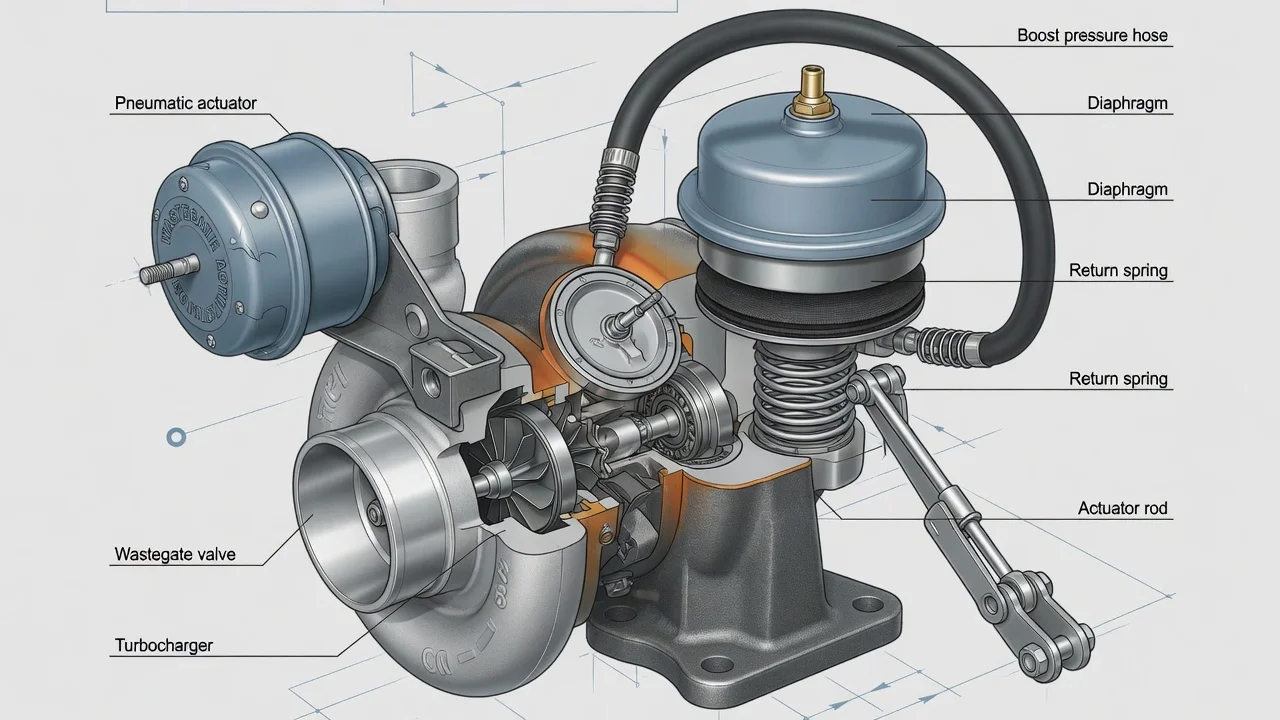
A pneumatic wastegate actuator controls how much exhaust gas bypasses the turbine, which limits boost pressure. It is a simple device: a sealed canister with a diaphragm and spring, linked by a rod to the wastegate valve. The engine computer only sees the boost result, so a trouble code for underboost or overboost describes a condition, not necessarily a failed actuator. This guide explains how the actuator works and how to separate possible causes, practical tests and confirmed findings.
How a pneumatic wastegate actuator works
Most gasoline turbo engines use a pressure-type actuator. A hose feeds boost pressure from the compressor side to one side of the diaphragm. A calibrated spring holds the wastegate closed until pressure overcomes its preload. Then the rod moves and opens the valve, sending some exhaust around the turbine wheel so that turbine speed and boost stop rising. On many vehicles a boost control solenoid sits in that hose circuit and bleeds off part of the signal. This lets the engine control module raise boost above the spring's base level.
Vacuum-type actuators work the other way. They are common on many diesels and some gasoline engines. A vacuum source, usually a pump, acts on the diaphragm through a control solenoid, and the module varies the vacuum to position the wastegate. Some designs are normally open and others normally closed, which matters when you read test results. Electronic actuators with a motor and position sensor are a different design and are not covered here. Service information for the specific engine shows which type is fitted and how it should behave.
Establish the symptoms
Start with a precise description before touching tools. Note whether the complaint is low power, surging, a sudden loss of power, a whistle or flutter, a rattle from the turbo area at idle or on deceleration, or a warning light with reduced engine power. Record when it happens. It might be with a cold or hot engine, at light or full throttle, in a particular gear or at a certain speed, at altitude, or after a long climb. Symptom conditions like these often point toward a leak, a sticking linkage or a control fault more clearly than the code itself.
Read every stored and pending trouble code and save the freeze-frame data. It captures engine speed, load, coolant temperature and often boost values at the moment the fault was set. Ask about recent work: turbo or intercooler service, hose or clamp replacement, tuning, an air filter change, or any damage near the intake. A problem that started right after other repairs often traces back to a disturbed hose or a misrouted line rather than a worn actuator.
Distinguish plausible causes
An underboost code such as P0299 can come from the actuator, but many other faults can set it. These include a boost leak at a hose, clamp or intercooler, a leaking or misrouted signal line, a boost control solenoid stuck in the wrong state, a weak vacuum supply, an exhaust restriction, a worn turbocharger, or a sensor reporting the wrong pressure. Underboost that appears mainly at higher load, together with a hiss, favors an intake leak. Underboost from the moment the engine starts, with the rod resting in the open position, points more toward the actuator, its linkage or the control circuit.
Overboost, for example P0234, suggests the wastegate is not opening enough. Candidates include a seized wastegate pivot and a disconnected or blocked signal line on a pressure-type system, since without a signal the gate stays shut. A solenoid diverting too much signal, a torn diaphragm that can no longer push the rod, and a rod set to the wrong length are also possible.
Circuit codes for the wastegate or boost control solenoid indicate an electrical fault in that circuit, such as an open, a short or an out-of-range signal. These usually lead to wiring and connector checks before anything mechanical. A rattle with normal boost often comes from worn wastegate bushings or linkage play rather than the diaphragm. Fluctuating boost can come from a sticking valve, a hose that cracks open when hot, or a solenoid responding erratically.
Checks in a useful order
With the engine off and cool, inspect what you can see safely. Follow the actuator hose from end to end and look for cracks, splits, softened sections, loose clamps, oil soaking and incorrect routing. Compare the routing with the underhood diagram or service information. Check that the rod is still attached to the wastegate arm with its clip in place and that the actuator bracket is secure. Oily residue at intercooler connections and boost hoses often marks a leak. Never reach near the turbocharger or exhaust after driving, because these parts stay hot enough to cause serious burns for a long time.
The next stage needs tools. A hand-operated pressure or vacuum pump, matched to the actuator type, applies a signal directly to the canister so you can watch the rod. It should move smoothly without binding, and the gauge reading should hold steady rather than leak down. Service information may give the value at which the rod begins to move and its travel at a given value. Without that specification you can confirm movement and sealing, but not correct calibration. Do not exceed the stated test value. Do not adjust rod length, because many actuators are set at the factory and some are sealed.
A scan tool shows how the system behaves while driving. During a controlled road test, have a helper compare desired and actual boost in live data and, where reported, the solenoid command or duty cycle. Some vehicles also allow an output test of the solenoid, and a smoke test can reveal leaks in the intake and signal lines. Leave road testing under load and solenoid circuit measurements to a qualified technician if you lack the equipment or a safe place to test.
Interpret the findings
A rod that moves smoothly while the gauge holds steady shows that the diaphragm seals and the canister responds. That weakens the case for actuator failure, but it does not prove the wastegate valve seals against its seat or that the actuator receives the correct signal. A slowly dropping gauge suggests a diaphragm or fitting leak. Confirm it by testing at the canister port with the hose removed so you know the leak is not in the hose. If the rod will not move at test pressure, or moves only after a sudden jump, something is binding in the actuator or at the wastegate pivot. Disconnecting the rod, where service information allows, shows which one is binding.
In live data, a lag between actual and desired boost while the system is commanding as much boost as it can points to a leak, a stuck-open gate or a turbocharger problem, not to the control module. If actual boost overshoots the target while the system is commanding the gate to open, the gate is likely unable to open. Before replacing any part, run a confirmation test that reproduces the original symptom conditions and shows the fault clearly. Repeat it after the repair to confirm that boost follows the target and the code does not return.
Urgency and next action
Treat overboost as urgent. If the boost reading is well above target, the engine drops into reduced power, or you hear knocking under load, stop driving hard and arrange a diagnosis, because uncontrolled boost can damage the engine. Stop driving and have the vehicle checked if you see heavy smoke, smell burning oil or exhaust fumes in the cabin, or the warning light flashes. Underboost with no other signs is usually less pressing but still needs prompt attention, because a leak or control fault can get worse and may hide other problems. No reliable distance can be promised for continued driving.
When you book the repair, bring the vehicle identification number, the exact codes with their freeze-frame data, and a description of when the symptom appears. Include any boost readings you captured, recent work history and the results of the checks you performed. With this information the technician can confirm the cause with targeted tests rather than starting over, and you avoid paying for an actuator, solenoid or turbocharger that was never at fault.