Bad Wastegate Actuator Symptoms: Signs, Causes and Checks
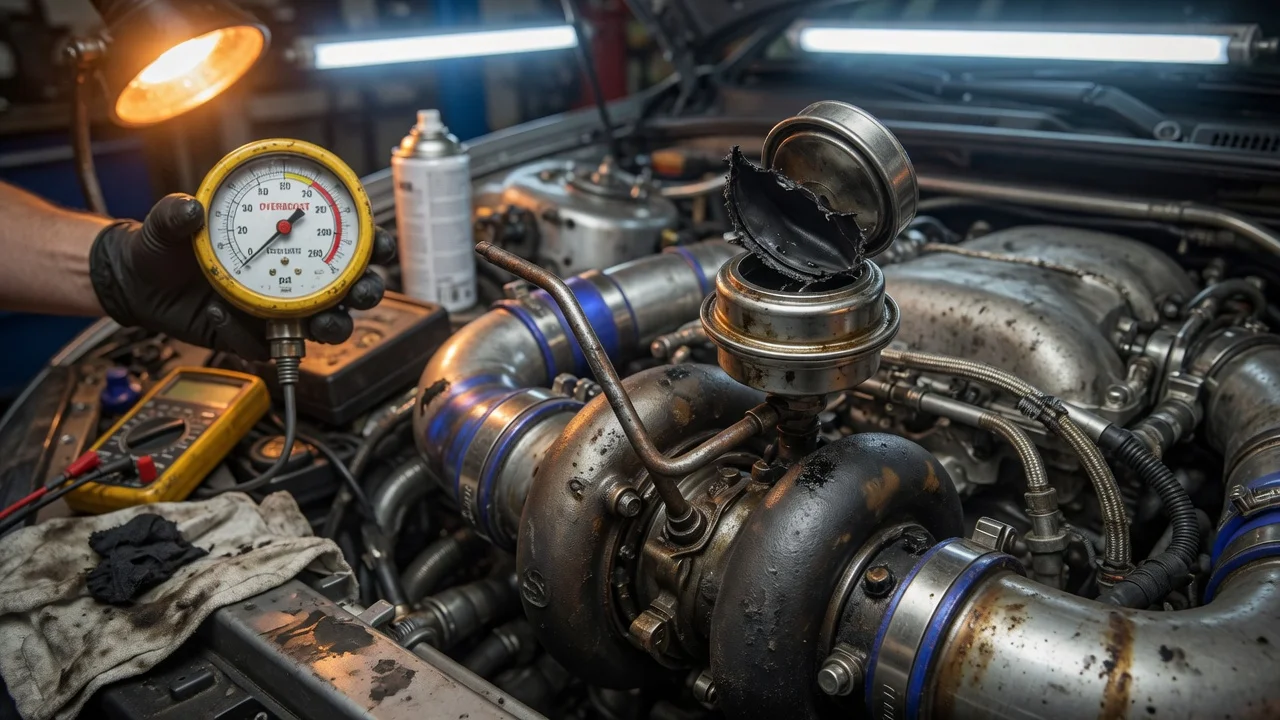
A wastegate actuator controls how much exhaust bypasses the turbine, which limits boost pressure. When it sticks, leaks or loses its position signal, the engine can feel flat, surge unpredictably or drop into reduced power. The symptoms of a bad wastegate actuator overlap with boost leaks, sensor faults and turbo wear. The useful approach is to record what happens, check the simplest explanations first and confirm the fault for your specific vehicle configuration before buying parts.
Establish the symptoms
Start by writing down when the problem appears. Note whether it happens on a cold start or only once the engine is fully warm, under light or hard acceleration, at a particular engine speed, while towing or climbing, or in hot or cold weather. Operating conditions matter because a sticking linkage can behave differently hot and cold, and a split vacuum line may only leak once pressure rises. Also record recent work such as a tune, intake or exhaust changes, a battery disconnection or turbo-related repairs, since these can change how boost is controlled.
Common signs fall into two groups. A wastegate held open, or an actuator that cannot close it, tends to cause underboost: sluggish acceleration, delayed turbo response and weak performance under load. A wastegate stuck closed, or an actuator that cannot open it, tends to cause overboost: a sudden surge, uneven pull, hesitation as the engine computer intervenes, or an abrupt cut to reduced power. Either case can turn on the check engine light, and many vehicles enter a limp mode that restricts boost until the engine is restarted. On some engines a worn electronic actuator or linkage also produces a rattle from the turbo area, most noticeable at idle or when lifting off the throttle.
Note any stored trouble codes. Generic codes such as P0299 for underboost or P0234 for overboost point to a boost control problem but do not identify the actuator by themselves. Manufacturer-specific codes mentioning wastegate position, actuator performance or the boost control solenoid narrow the search further.
Distinguish plausible causes
The actuator is only one part of the boost control system. On a pneumatic setup it is a diaphragm canister moved by vacuum or boost pressure, often regulated by a solenoid valve. A torn diaphragm, a cracked or disconnected hose, or a sticking solenoid will all affect the wastegate. On an electronic setup a motor and position sensor move the wastegate directly, so wiring faults, a failing motor, a position sensor error or a lost calibration become likely suspects.
Some causes sit outside the actuator. Carbon buildup or corrosion can seize the wastegate flap or its pivot, so even a healthy actuator cannot move it. A boost leak from a loose clamp, split intercooler hose or leaking intercooler causes underboost that feels identical from the driver's seat. A faulty boost or manifold pressure sensor can make the engine computer react to wrong readings. Worn turbo bearings, damaged turbine or compressor wheels, or an exhaust restriction can also limit boost.
Observations help weigh these options. A fault that changes with temperature favors a sticking linkage or a hose that opens up when hot. A hiss or whoosh under load favors a boost or vacuum leak. Excess play in the linkage, felt by hand with the engine off and cool, favors pivot or actuator wear. Actuator circuit or position codes point toward the electronic actuator and its wiring, while underboost codes alone keep leaks and mechanical restriction in contention.
Checks in a useful order
Begin with checks any owner can do safely. With the engine off and fully cool, inspect the vacuum or pressure lines to the actuator and solenoid for cracks, swelling, loose ends or oil soaking. Check intake and intercooler hoses and clamps for looseness, splits or oily residue. Look at the actuator rod and linkage for damage, a missing clip or a detached connector. Turbochargers and exhaust parts get extremely hot, so do not touch them after driving, and keep hands and tools clear of moving parts if the engine must run.
The next stage needs tools and the manufacturer specifications for your engine. A scan tool with live data lets you compare requested boost with actual boost and, on electronic actuators, commanded position with reported position. A hand vacuum or pressure pump on a pneumatic actuator shows whether the rod moves smoothly and whether the diaphragm holds without bleeding down. A smoke test of the intake side finds leaks that are hard to see. Electrical checks of the actuator circuit, solenoid and sensors need the correct wiring diagram and test values for that vehicle.
Some steps belong with a qualified technician. Adjusting wastegate rod length, inspecting the turbine housing or running an actuator calibration with a factory-level scan tool can harm the engine if done incorrectly, and many electronic actuators require that calibration after removal or replacement.
Interpret the findings
Each result answers a narrower question. A hose or clamp repair that fully cures the symptom is strong evidence, but clear the codes and confirm under the same conditions where the problem used to appear. An actuator that will not hold vacuum or pressure, or a rod that does not move when the correct signal is applied, points directly at the actuator. Still confirm the wastegate flap moves freely when disconnected, because a seized flap can quickly damage a replacement.
Live data showing actual boost well below or above the requested value confirms a boost control problem but not its location. If commanded and reported positions on an electronic actuator disagree, the cause could be the motor, the position sensor, the wiring or a stuck flap. A clean smoke test, a healthy actuator and a free-moving wastegate shift suspicion toward sensors, the control solenoid, the turbo itself or engine software. Before replacing parts, review the service history for earlier turbo or actuator work and ask a dealer about software updates or service bulletins, since some engines receive revised parts or calibrations for boost complaints.
Urgency and next action
Treat overboost symptoms seriously. Sudden surging, repeated overboost codes, knocking under load or a flashing check engine light are reasons to stop driving under load and arrange an inspection, because excessive boost can damage internal engine parts and the turbo. Also stop and have the vehicle checked if you see heavy smoke, smell burning oil or notice oil loss, as these suggest a problem beyond the actuator. Underboost with limp mode is usually less immediately damaging, but reduced power can make merging and overtaking unsafe, and there is no reliable way to predict how long a failing actuator will last.
For an accurate repair, give the shop or parts supplier the VIN, engine, transmission and any modifications. Supply the stored codes with freeze frame data, a description of when the symptoms occur, the checks already done with their results, and relevant service history. Follow the maintenance schedule and manufacturer specifications for your vehicle rather than a generic interval, and confirm whether the replacement actuator needs calibration so the repair is completed correctly.