Where Is the Wastegate Actuator Located?
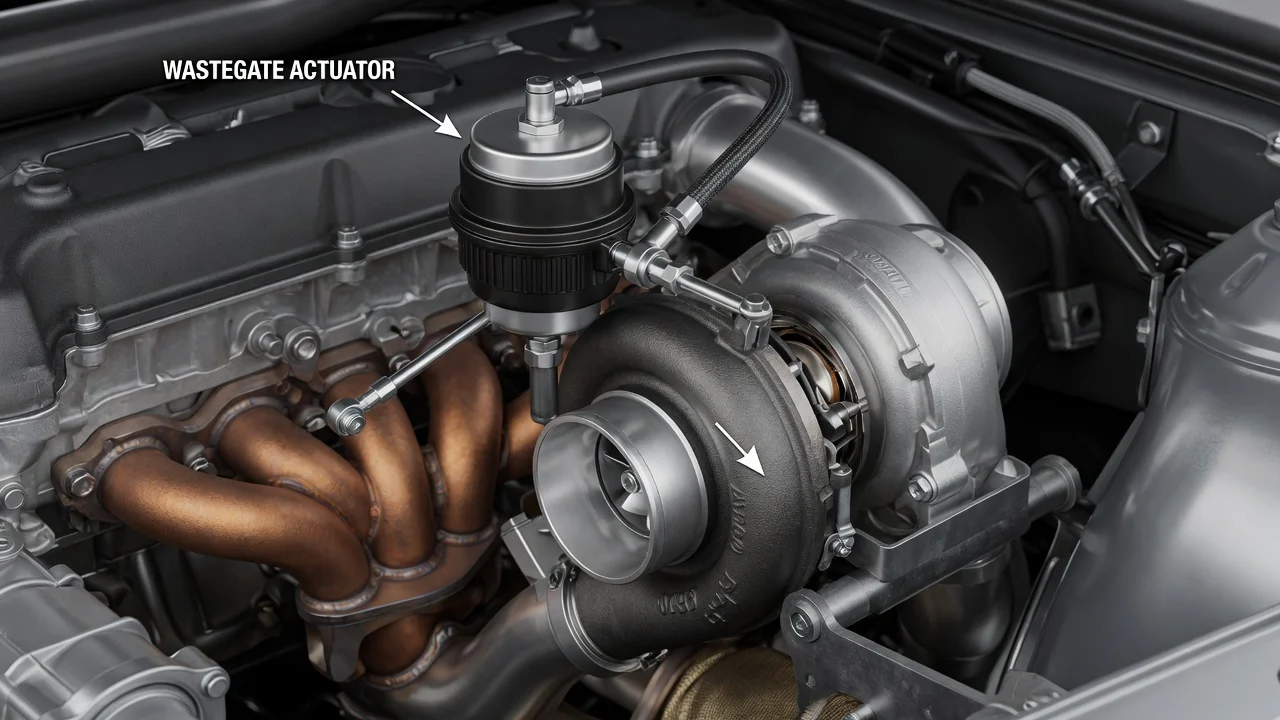
On most turbocharged engines, the wastegate actuator is mounted on the turbocharger itself. It is usually fixed to a bracket on the turbo housing, with a rod reaching across to the wastegate lever on the exhaust side. Where that puts it under your hood depends on where the turbo is mounted, what kind of wastegate the engine uses and whether the actuator is pneumatic or electronic. This guide explains how to find it, what changes the answer and when you need information for your exact vehicle.
The short answer
The wastegate actuator is almost always attached to the turbocharger or mounted very close to it. Most factory turbocharged cars, SUVs and pickups use an internal wastegate. On these engines, the actuator is either a round canister or a compact electronic motor housing fixed to the turbo assembly. A metal rod or linkage runs from the actuator to a small arm on the turbine housing, which is the exhaust side of the turbo. That arm turns a flap valve inside the housing, and the valve lets some exhaust bypass the turbine wheel.
The practical way to locate the actuator is to find the turbocharger first. Once the turbo is in view, look for a canister or motor with a rod connected to an external lever. Engines with an external wastegate are arranged differently. On those, the wastegate is a separate valve on the exhaust manifold or on the pipe feeding the turbo, and its actuator is the diaphragm housing built into the top of that valve.
What the actuator does
Exhaust gas spins the turbocharger. Without a way to limit it, the turbo would keep building boost as engine speed and load rise. The wastegate controls this by opening a bypass path so part of the exhaust skips the turbine. The actuator is the part that physically moves the wastegate valve open and closed.
In many pneumatic designs, a spring inside the canister holds the wastegate closed. When pressure or vacuum acts on a diaphragm and overcomes the spring, the diaphragm moves the rod and opens the valve. The engine computer usually influences this through a boost control solenoid, which regulates the signal reaching the actuator. Electronic actuators replace the diaphragm with a motor and position sensor, so the engine computer can command the valve position directly. In both cases the actuator has to sit where its rod can reach the wastegate lever, which is why it is mounted on or right next to the turbo.
Internal versus external wastegates
With an internal wastegate, the valve is built into the turbine housing. The actuator is commonly bolted to a bracket on the compressor housing, which is the cooler intake side of the turbo, and its rod spans across to the turbine side. Some designs mount the actuator elsewhere on the turbo assembly, but it stays physically connected to the turbocharger in nearly every case.
External wastegates appear on some performance applications and are common on aftermarket turbo builds. Here the wastegate is a separate unit welded or bolted into the exhaust manifold or turbo feed pipe, and the actuator is integrated into its upper housing. If the service history shows an aftermarket turbo, manifold or wastegate, the actuator location and type may differ from the factory layout, so do not rely on a factory diagram alone.
How engine layout changes the location
The turbo is bolted to the exhaust side of the engine, so the actuator ends up wherever that side faces. On an inline four- or six-cylinder engine, the exhaust side can face the radiator or the firewall, depending on whether the engine is mounted sideways or lengthwise and how the manufacturer oriented it. A turbo facing the firewall can be very hard to see from above. Some turbos sit low beside the engine block and are easier to reach from underneath the vehicle.
V6 and V8 engines with twin turbos have one turbo per cylinder bank, and each turbo has its own actuator. These are often mounted low on the sides of the engine. Some designs place the turbos in the valley between the cylinder banks. In that case the actuators sit on top of the engine but are buried under covers and heat shields. Many diesel engines use a variable geometry turbo instead of a conventional wastegate. Their vane actuator is sometimes called a wastegate actuator, and it is also mounted on the turbo, but it works differently.
Pneumatic, vacuum and electronic actuators look different
A pressure-type pneumatic actuator is a round metal canister with a single hose fitting. The hose usually runs to the compressor outlet or to the boost control solenoid. A vacuum-type actuator looks similar, but its hose connects to a vacuum supply, usually through a solenoid. An electronic actuator is a box-shaped or rounded housing with an electrical connector and no hose, and it is easy to mistake for a sensor or another module mounted near the turbo.
Two nearby parts are often confused with the wastegate actuator. The boost control solenoid is a small valve with an electrical connector and two or three hoses, mounted somewhere on the intake, a bracket or the inner fender. The blow-off or diverter valve sits on the intake piping or the compressor housing and releases boost when the throttle closes. Following the hose from the canister helps tell them apart, because only the actuator has a rod connected to the turbo.
How to find it on your own vehicle
Work only with the engine fully cooled, because turbochargers and exhaust parts get extremely hot. Remove the plastic engine cover if it lifts off easily. Trace the intake tube from the air filter box: it leads to the turbo compressor inlet. You can also follow the large intercooler pipes back toward the engine. The turbo has a snail-shaped housing, and the actuator is attached to it.
If heat shields block the view, use a flashlight with an inspection mirror or a phone camera. When the turbo sits low, look from below only with the vehicle safely supported on ramps or jack stands. During this inspection, check that the actuator hose is connected and not cracked, swollen or brittle. Also check that the electrical connector is seated and that the rod is attached to the wastegate lever with its retaining clip in place. Photograph what you find before touching anything.
Do not adjust the rod length or loosen the actuator mounting to experiment. Rod preload and actuator settings follow manufacturer specifications. Some electronic actuators also need a calibration procedure with a scan tool after replacement or removal.
Limitations and when to get vehicle-specific help
This is a general description, and the exact location depends on your vehicle configuration: engine code, model year, drivetrain and market version. The same model can be sold with several engines that use different turbo layouts. Factory service information or parts diagrams show the exact mounting point and removal procedure. Reaching the actuator often means removing heat shields, intake pipes or other components first, and on some engines the turbo itself has to come out.
See a qualified technician if you have boost-related trouble codes, loss of power, overboost or a rattle from the turbo area. Those symptoms can come from the actuator, linkage, solenoid, hoses, sensors or the turbo itself, and the actuator is only one possibility. Do not assume a universal replacement or service interval for the actuator. Check your vehicle's maintenance schedule for any listed turbo system inspection, and share the service history with the shop so earlier repairs or modifications are taken into account.