MK7 GTI Wastegate Actuator Location: Where It Is and How to Reach It
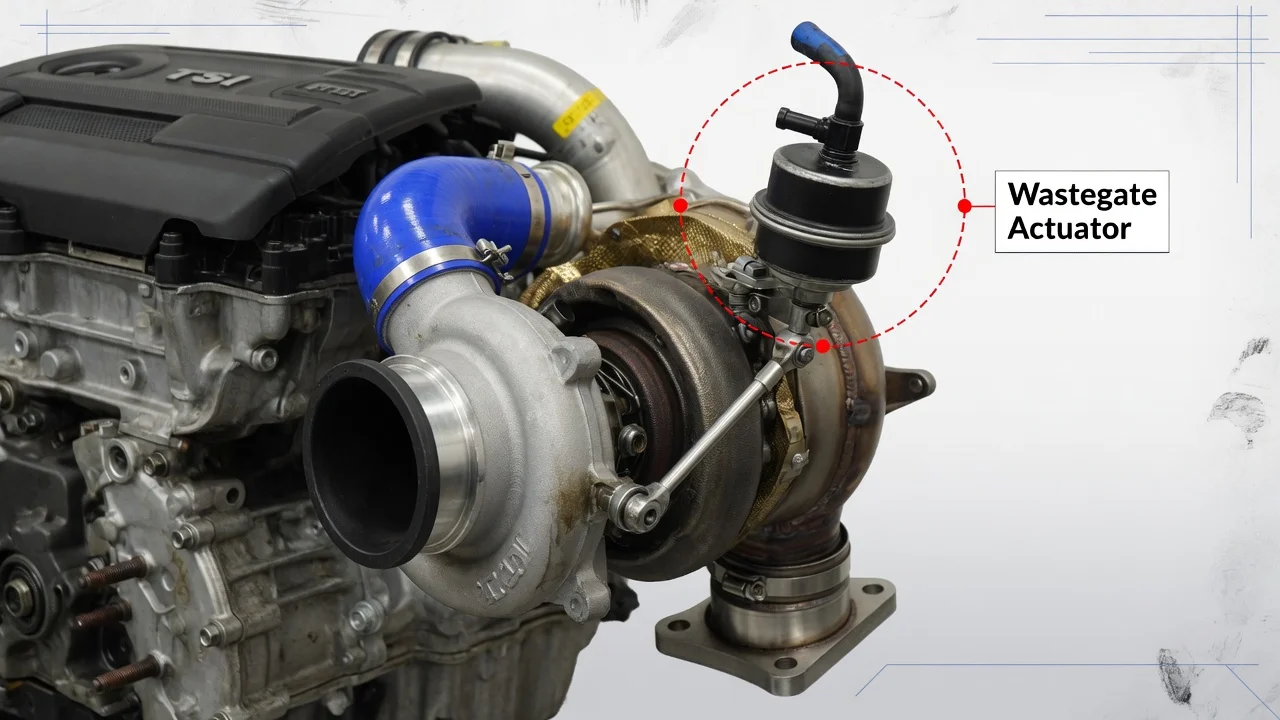
If you own an MK7 or MK7.5 Golf GTI and a scan tool has flagged a boost or wastegate fault, the first practical question is where the actuator actually is. On a stock car it is not a separate box on the intake or under the battery tray. It is part of the turbocharger assembly at the back of the engine. This guide explains where to look, how the part works, what can change the answer, and how far an owner can reasonably go before handing the job over.
Where the wastegate actuator is on an MK7 GTI
On a factory MK7 GTI, the wastegate actuator is mounted directly on the turbocharger. The 2.0-liter turbocharged four-cylinder sits transversely, and its exhaust side faces the firewall, so the turbo is tucked between the rear of the engine and the bulkhead. The actuator is a compact electric unit bolted to the turbo's compressor housing, which is the cooler side of the turbocharger. A short rod runs from it to the wastegate lever on the turbine, or exhaust, side. The wiring connector plugs into the actuator body itself.
From the top of the engine bay you will see little of it. With the engine cover off, a flashlight aimed down behind the engine toward the firewall may show part of the actuator and its wiring, but intake plumbing, heat shielding and surrounding hoses block most of the view. The clearest look usually comes from underneath, with the car safely supported and the lower engine cover removed, where the linkage and lever are easier to see.
How the electronic wastegate controls boost
A wastegate is a small flap valve in the turbine housing. When it opens, part of the exhaust bypasses the turbine wheel, which slows the turbo and limits boost. When it stays closed, more exhaust drives the turbine and boost rises. Many older turbocharged engines opened the flap with a vacuum or pressure canister. The stock MK7 GTI turbo uses an electric actuator instead: the engine control module commands a position, a motor inside the actuator moves the rod, and an internal position sensor reports where the rod actually is.
Because the system is closed-loop, the engine computer continuously compares requested boost with measured boost and adjusts the wastegate position. That is why a problem with the actuator, its wiring or the linkage tends to show up as a fault code, a warning light or reduced power rather than only as a vague loss of performance. It also means there is no vacuum-operated boost control solenoid with hoses to chase on a stock car, a part that owners of older Volkswagen turbo engines may expect to find.
What can change the location or the part
The description above applies to the original factory turbocharger on US-market MK7 GTIs, including the facelifted MK7.5 cars and those with the Performance Package. Trim levels and option packages change equipment and power output, not where the factory wastegate actuator is mounted.
Vehicle configuration matters much more once the car has been modified. A replacement turbo, whether a different factory unit or an aftermarket upgrade, may use a different actuator mounting or a different control method entirely, and some big-turbo kits use pneumatic or external wastegates with their own routing. Imported cars, other Golf variants and engines that share the same family name are not guaranteed to match, so the Golf R, non-GTI Golfs and other models on the same platform should be checked against their own documentation.
Also keep the wastegate actuator separate from nearby parts with related jobs. The diverter or recirculation valve, which vents boost when the throttle closes, may be mounted close by on the turbo's compressor side, but it is a different component. Replacing it will not fix a wastegate actuator fault, and the reverse is also true.
How to find and inspect it yourself
Start with information rather than tools. A scan tool that reads Volkswagen engine data can show stored codes and, depending on the tool, the commanded and actual wastegate position. Codes pointing to the actuator circuit, its position sensor or a boost deviation narrow the search. Note when symptoms appear: a metallic rattle from behind the engine at idle or when lifting off the throttle, a sudden loss of power with a warning light, or boost that falls short under load. Record each with mileage and the operating conditions at the time.
For a visual inspection, let the engine cool completely, since the turbo and exhaust stay hot long after shutdown. Remove the engine cover and look behind the engine with a light, then check from below if you can support the car safely on stands or a lift. Look for a loose or damaged connector, chafed wiring, a missing retaining clip on the linkage rod, oil or coolant contamination, and heat damage. Do not pry on the rod or force the lever; the actuator contains a motor and sensor that rough handling can damage.
If a part does need replacing, review the service history first. Some cars have already had turbo or actuator work, and warranty or goodwill coverage may apply depending on age, mileage and the manufacturer's current campaigns. Confirm parts by VIN, because availability differs by supplier: the actuator may be offered on its own or only as part of a complete turbocharger. After an actuator or turbo replacement, follow the calibration or basic-settings procedure in the service information, which requires a capable diagnostic tool, so the engine computer learns the new positions.
Limits of a visual check and when to get help
A visual check can confirm obvious damage, but it cannot prove the actuator is healthy. An electric actuator can fail internally while looking fine, and a boost fault can also come from leaks in the charge piping, a sensor problem, a worn wastegate flap or software. Replacing the actuator on a guess can waste money. Torque values, adaptation steps and part numbers should come from the manufacturer specifications for your exact car, not from advice about a similar model.
Take the car to a dealer or an independent shop familiar with Volkswagen turbo engines if codes keep returning after basic checks, if the car repeatedly enters reduced-power mode, if you see oil around the turbo, or if access requires removing heat shields or exhaust parts you are not equipped to handle. Bring the codes, your symptom notes and any previous repair records; that context usually shortens diagnosis more than any single test you could run at home.