What Is a Thermoplastic in a Car? Heat Behavior, Uses, and Repair
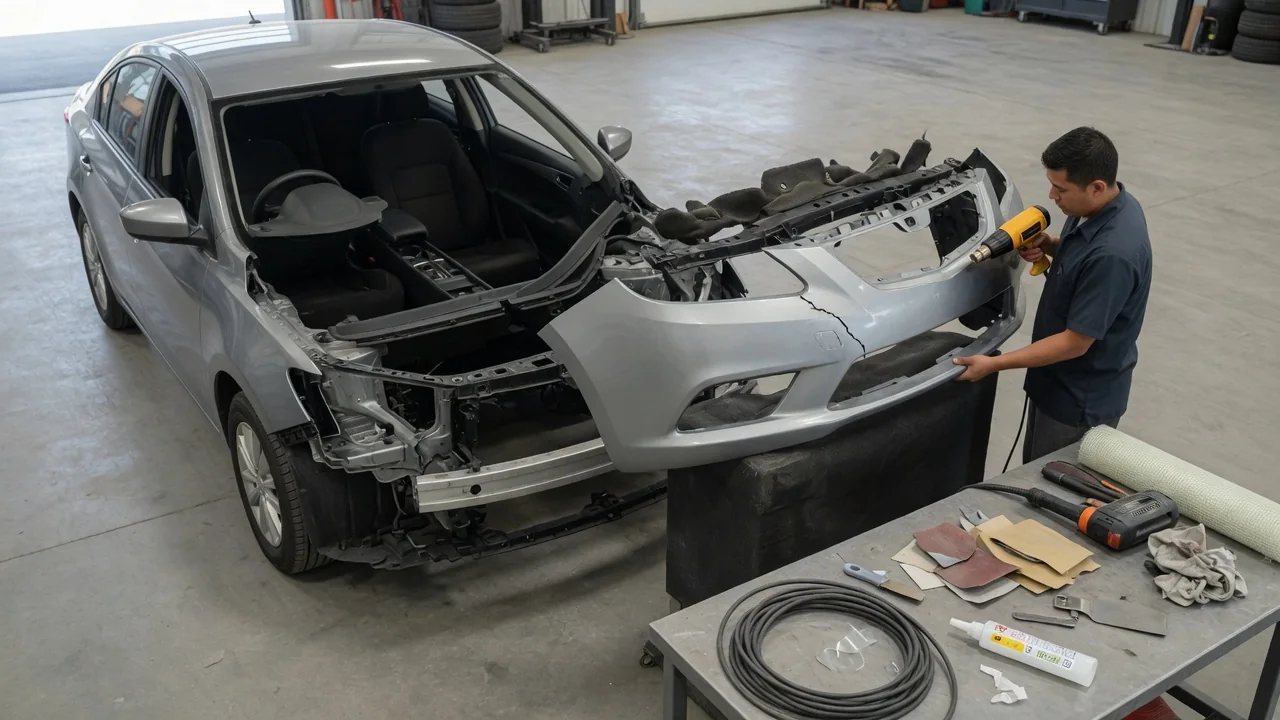
A thermoplastic is a plastic that softens when heated and hardens again when it cools, without a fundamental change in its chemistry. Because the change is reversible, the material is easy to mold into complex shapes and can often be reshaped or welded later. Much of the plastic you see and touch on a modern car belongs to this group. This guide explains how thermoplastics react to heat, where they are used in vehicles, how they are repaired, and what those traits mean for ownership.
Heating behavior: why thermoplastics soften and reharden
At the molecular level, a thermoplastic is made of long polymer chains that are tangled together but not chemically bonded to one another. Heat gives those chains enough energy to move past each other, so the material softens and eventually flows. When it cools, the chains lose mobility and the part becomes solid again. Because no permanent chemical change is required, the cycle can be repeated, although each overheating episode can degrade the polymer. This is the key difference from thermosets, such as the resins used in some fiberglass-reinforced body panels. A thermoset cures into a crosslinked network; once set, heating does not make it flow again, and excessive heat chars or decomposes it instead.
Thermoplastics do not all respond to heat the same way. Amorphous types, such as ABS and polycarbonate, soften gradually above their glass transition temperature rather than melting at a sharp point. Semicrystalline types, such as polypropylene and nylon, keep much of their stiffness until they approach a more defined melting range. In both cases, a part can deform long before it melts: a component carrying a load or clamped by fasteners may sag, warp, or creep when it stays warm for long periods. Cold matters too. Below certain temperatures some thermoplastics, polypropylene in particular, become noticeably more brittle and crack more easily on impact.
When a thermoplastic is heated past its working range, typical warning signs are a glossy or blistered surface, discoloration, distortion, and smoke or sharp fumes. Those fumes can be irritating or harmful, so heat-based repairs call for controlled temperatures and good ventilation.
Common uses: automotive thermoplastic examples
Thermoplastics are widespread on modern vehicles because they are light, resist corrosion, and can be molded into complex shapes with built-in clips and ribs. On the exterior, painted bumper covers are commonly made of polypropylene or thermoplastic olefin (TPO) blends. Grilles, mirror housings, and trim pieces are often ABS or a PC/ABS blend. Headlight lenses are typically polycarbonate, valued for impact resistance, while many taillight lenses use acrylic (PMMA). Wheel-well liners and underbody splash shields are frequently polypropylene or polyethylene, which tolerate flexing and road debris.
Inside the cabin, dashboard substrates, door panels, center consoles, pillar trim, and many small brackets are molded from polypropylene, ABS, or PC/ABS. Soft-touch skins may use thermoplastic elastomers or TPO, and some upholstery and wire insulation use PVC. Carpets and seat fabrics are often made from polyester or nylon fibers, which are thermoplastics in fiber form.
Under the hood, glass-filled nylon appears in intake manifolds, engine covers, radiator end tanks, and fan shrouds, where added fibers improve stiffness and heat resistance. Coolant reservoirs and washer fluid tanks are commonly polypropylene or polyethylene, and many fuel tanks are multilayer high-density polyethylene. Electrical connectors often use PBT or nylon, and small clips and gears are frequently acetal (POM). Many parts carry a molded identification code on a hidden surface, such as >PP<, >ABS<, or >PC<, that names the base material and sometimes its filler.
Repair: welding, bonding, and reshaping
Successful repair starts with identifying the material, because thermoplastics generally bond well only to the same or a compatible polymer. Check the back of the part for a molded code; if none is visible, the vehicle's repair information or the parts supplier may list it. With the material known, plastic welding is often the strongest repair for cracks and tears. The technician cleans the area, grooves the crack, and uses hot air or a dedicated plastic welder to fuse a matching filler rod into the base material. A mismatched rod may look attached but separate under stress. Hot stapling, where a heated metal staple is pressed into the back of a crack, is a common way to reinforce the repair or hold the pieces in alignment.
Two-part plastic repair adhesives are an alternative, especially for parts that are hard to weld or that may be a thermoset. Polypropylene and TPO have low surface energy, so they usually need an adhesion promoter before adhesive, filler, or paint will stick reliably. A reinforcing mesh or patch on the back side adds strength. Shallow dents in flexible bumper covers can sometimes be corrected by warming the plastic gently and pressing it back into form, since the material tends to return toward its molded shape. Too much heat, however, will glaze, stretch, or warp the surface.
Some parts are better replaced than repaired. Fuel tanks, cracked radiator end tanks, coolant reservoirs, and intake components work under pressure or vacuum, and a repair that holds at rest may leak in service. Cracked headlight housings can lose their seal and let moisture in. Yellowed polycarbonate lenses can be polished, but polishing removes the original UV-resistant coating, so a new protective coating is needed to slow the damage from returning.
Practical implications and limits
The same softening behavior that makes thermoplastics practical also defines how they should be treated. Heat shields near the exhaust and turbocharger protect nearby plastic parts, so they should be reinstalled after any service. In cold weather, trim panels and retaining clips are more likely to snap, so removing interior panels in a warm garage or after the cabin has warmed up reduces breakage. Sunlight also matters: ultraviolet exposure gradually fades and embrittles unpainted exterior trim, and protectants formulated for automotive plastics can slow that change. Strong solvents and some cleaners can craze or soften certain plastics, such as polycarbonate and ABS, so testing a product on a hidden area first is a sensible precaution.
There are also limits to what the word thermoplastic tells you. It describes a large family of materials, and the actual heat tolerance, stiffness, and chemical resistance of a part depend on the specific polymer, blend, fillers, and grade chosen by the manufacturer. A repaired component may not regain all of its original strength or appearance, and some areas carry extra requirements: bumper covers in front of radar or parking sensors, for example, may have restrictions on repair location, filler thickness, or paint in the manufacturer's repair procedures. When a part affects safety systems, sealing, or structure, the vehicle maker's repair information should guide the choice between repairing and replacing. Finally, while thermoplastics can in principle be remelted and recycled, painted, mixed-material, or contaminated parts are harder to process, so recyclability in practice varies.